Baune Bernhard T, Minelli Alessandra, Carpiniello Bernardo, Contu Martina, Domínguez Barragán Jorge, Donlo Chus, Ferensztajn-Rochowiak Ewa, Glaser Rosa, Kelch Britta, Kobelska Paulina, Kolasa Grzegorz, Kopeć Dobrochna, Martínez de Lagrán Cabredo María, Martini Paolo, Mayer Miguel-Angel, Menesello Valentina, Paribello Pasquale, Perera Bel Júlia, Perusi Giulia, Pinna Federica, Pinna Marco, Pisanu Claudia, Sierra Cesar, Stonner Inga, Wahner Viktor T H, Xicota Laura, Zang Johannes C S, Gennarelli Massimo, Manchia Mirko, Squassina Alessio, Potier Marie-Claude, Rybakowski Filip, Sanz Ferran, Dierssen Mara
Department of Mental Health, University of Münster, Münster, Germany.
Florey Institute of Neuroscience and Mental Health, Parkville, VIC, Australia.
Front Psychiatry. 2024 Jan 16;14:1279688. doi: 10.3389/fpsyt.2023.1279688. eCollection 2023.
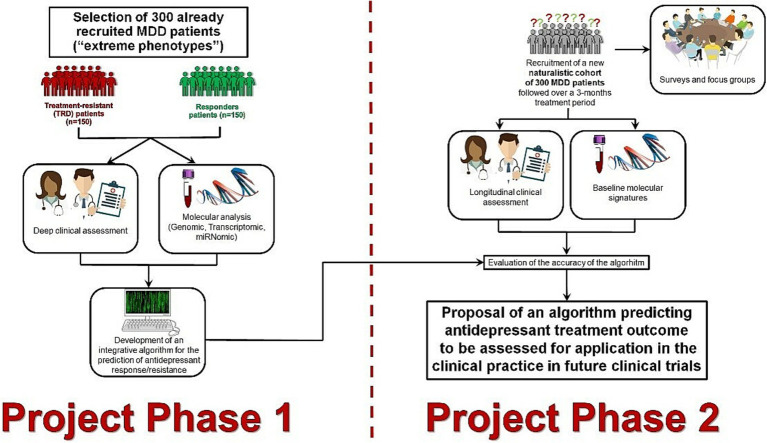
Major depressive disorder (MDD) is the most common psychiatric disease worldwide with a huge socio-economic impact. Pharmacotherapy represents the most common option among the first-line treatment choice; however, only about one third of patients respond to the first trial and about 30% are classified as treatment-resistant depression (TRD). TRD is associated with specific clinical features and genetic/gene expression signatures. To date, single sets of markers have shown limited power in response prediction. Here we describe the methodology of the PROMPT project that aims at the development of a precision medicine algorithm that would help early detection of non-responder patients, who might be more prone to later develop TRD. To address this, the project will be organized in 2 phases. Phase 1 will involve 300 patients with MDD already recruited, comprising 150 TRD and 150 responders, considered as extremes phenotypes of response. A deep clinical stratification will be performed for all patients; moreover, a genomic, transcriptomic and miRNomic profiling will be conducted. The data generated will be exploited to develop an innovative algorithm integrating clinical, omics and sex-related data, in order to predict treatment response and TRD development. In phase 2, a new naturalistic cohort of 300 MDD patients will be recruited to assess, under real-world conditions, the capability of the algorithm to correctly predict the treatment outcomes. Moreover, in this phase we will investigate shared decision making (SDM) in the context of pharmacogenetic testing and evaluate various needs and perspectives of different stakeholders toward the use of predictive tools for MDD treatment to foster active participation and patients' empowerment. This project represents a proof-of-concept study. The obtained results will provide information about the feasibility and usefulness of the proposed approach, with the perspective of designing future clinical trials in which algorithms could be tested as a predictive tool to drive decision making by clinicians, enabling a better prevention and management of MDD resistance.
重度抑郁症(MDD)是全球最常见的精神疾病,具有巨大的社会经济影响。药物治疗是一线治疗选择中最常见的方法;然而,只有约三分之一的患者对首次试验有反应,约30%的患者被归类为难治性抑郁症(TRD)。TRD与特定的临床特征以及遗传/基因表达特征相关。迄今为止,单一的标志物集在反应预测方面显示出有限的能力。在此,我们描述了PROMPT项目的方法,该项目旨在开发一种精准医学算法,以帮助早期检测可能更容易发展为TRD的无反应患者。为了解决这个问题,该项目将分两个阶段进行。第一阶段将纳入已招募的300例MDD患者,包括150例TRD患者和150例有反应者,将其视为反应的极端表型。将对所有患者进行深入的临床分层;此外,还将进行基因组、转录组和微小RNA组分析。所产生的数据将用于开发一种整合临床、组学和性别相关数据的创新算法,以预测治疗反应和TRD的发展。在第二阶段,将招募一个新的300例MDD患者的自然队列,以在现实世界条件下评估该算法正确预测治疗结果的能力。此外,在这个阶段我们将研究药物遗传学检测背景下的共同决策(SDM),并评估不同利益相关者对使用MDD治疗预测工具的各种需求和观点,以促进积极参与和患者赋权。该项目是一项概念验证研究。所获得的结果将提供有关所提出方法的可行性和实用性的信息,以期设计未来的临床试验,在其中算法可作为预测工具进行测试,以指导临床医生的决策,从而更好地预防和管理MDD耐药性。