Walton Bonnie L, Shattuck-Brandt Rebecca, Hamann Catherine A, Tung Victoria W, Colazo Juan M, Brand David D, Hasty Karen A, Duvall Craig L, Brunger Jonathan M
Department of Biomedical Engineering, Vanderbilt University, Nashville, TN, 37212, USA.
Research Service, Lt. Col. Luke Weathers, Jr. VA Medical Center, Memphis, TN 38105, USA.
bioRxiv. 2024 Feb 15:2024.01.31.578281. doi: 10.1101/2024.01.31.578281.
Investigational cell therapies have been developed as disease-modifying agents for the treatment of osteoarthritis (OA), including those that inducibly respond to inflammatory factors driving OA progression. However, dysregulated inflammatory cascades do not specifically signify the presence of OA. Here, we deploy a synthetic receptor platform that regulates cell behaviors in an arthritis-specific fashion to confine transgene expression to sites characterized by cartilage degeneration.
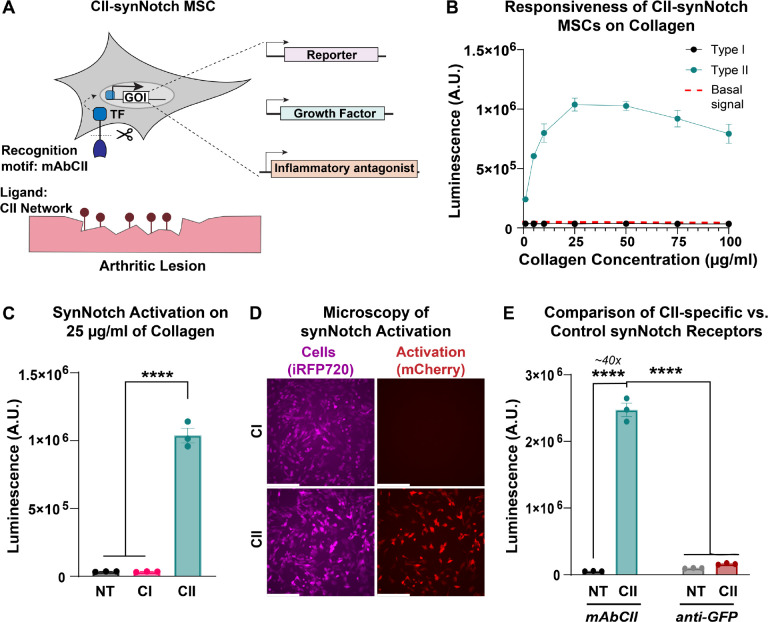
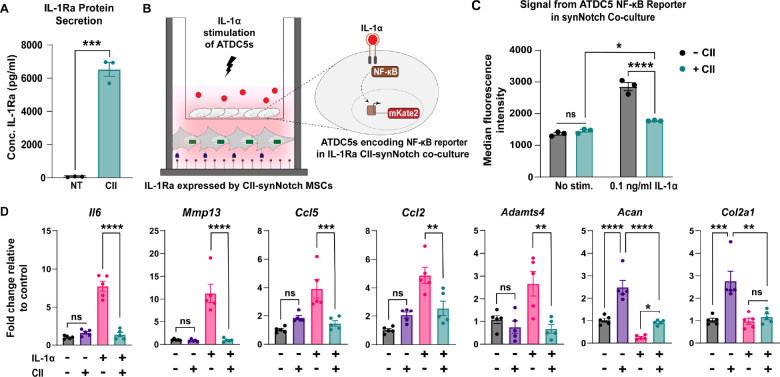
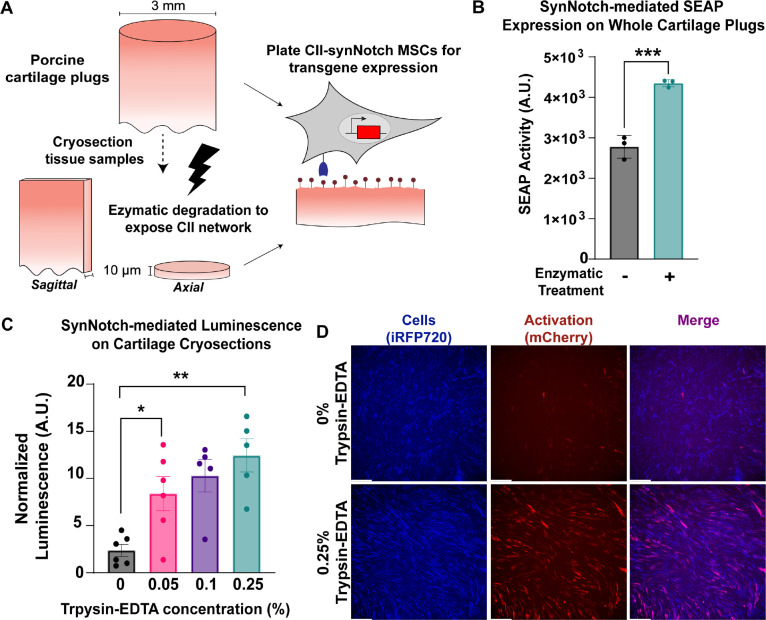
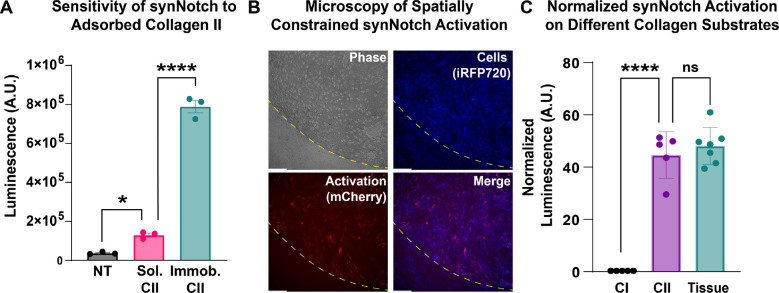
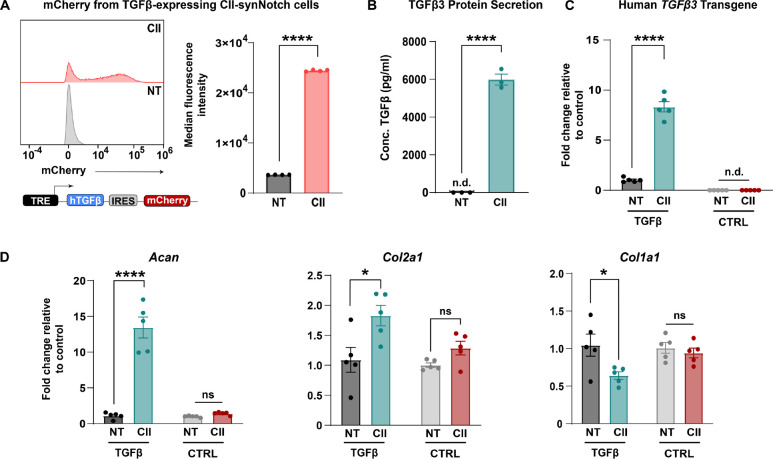
An scFv specific for type II collagen (CII) was used to produce a synthetic Notch (synNotch) receptor that enables "CII-synNotch" mesenchymal stromal cells (MSCs) to recognize CII fibers exposed in damaged cartilage. Engineered cell activation by both CII-treated culture surfaces and on primary tissue samples was measured via inducible reporter transgene expression. TGFβ3-expressing cells were assessed for cartilage anabolic gene expression via qRT-PCR. In a co-culture with CII-synNotch MSCs engineered to express IL-1Ra, ATDC5 chondrocytes were stimulated with IL-1α, and inflammatory responses of ATDC5s were profiled via qRT-PCR and an NF-κB reporter assay.
CII-synNotch MSCs are highly responsive to CII, displaying activation ranges over 40-fold in response to physiologic CII inputs. CII-synNotch cells exhibit the capacity to distinguish between healthy and damaged cartilage tissue and constrain transgene expression to regions of exposed CII fibers. Receptor-regulated TGFβ3 expression resulted in upregulation of and in MSCs, and inducible IL-1Ra expression by engineered CII-synNotch MSCs reduced pro-inflammatory gene expression in chondrocytes.
This work demonstrates proof-of-concept that the synNotch platform guides MSCs for spatially regulated, disease-dependent delivery of OA-relevant biologic drugs.
研究性细胞疗法已被开发为用于治疗骨关节炎(OA)的疾病修饰剂,包括那些可诱导响应驱动OA进展的炎症因子的疗法。然而,炎症级联反应失调并不特定表明OA的存在。在此,我们部署了一个合成受体平台,该平台以关节炎特异性方式调节细胞行为,将转基因表达限制在以软骨退变为特征的部位。
使用针对II型胶原(CII)的单链抗体片段(scFv)制备合成Notch(synNotch)受体,使“CII-synNotch”间充质基质细胞(MSC)能够识别受损软骨中暴露的CII纤维。通过诱导型报告基因转基因表达来测量经CII处理的培养表面和原代组织样本对工程细胞的激活。通过qRT-PCR评估表达转化生长因子β3(TGFβ3)的细胞的软骨合成代谢基因表达。在与工程化表达白细胞介素1受体拮抗剂(IL-1Ra)的CII-synNotch MSC共培养中,用IL-1α刺激阿特狄克5(ATDC5)软骨细胞,并通过qRT-PCR和NF-κB报告基因检测分析ATDC5的炎症反应。
CII-synNotch MSC对CII高度敏感,对生理CII输入的反应显示出超过40倍的激活范围。CII-synNotch细胞具有区分健康和受损软骨组织的能力,并将转基因表达限制在暴露的CII纤维区域。受体调节的TGFβ3表达导致MSC中 和 的上调,工程化的CII-synNotch MSC诱导的IL-1Ra表达降低了软骨细胞中的促炎基因表达。
这项工作证明了概念验证,即synNotch平台可指导MSC在空间上受调节、依赖疾病地递送与OA相关的生物药物。