Department of Analysis and Diagnostics, Norwegian Veterinary Institute, Ås, Norway.
National Veterinary Institute, Technical University of Denmark, Kongens Lyngby, Denmark.
Front Immunol. 2024 Jan 30;15:1297955. doi: 10.3389/fimmu.2024.1297955. eCollection 2024.
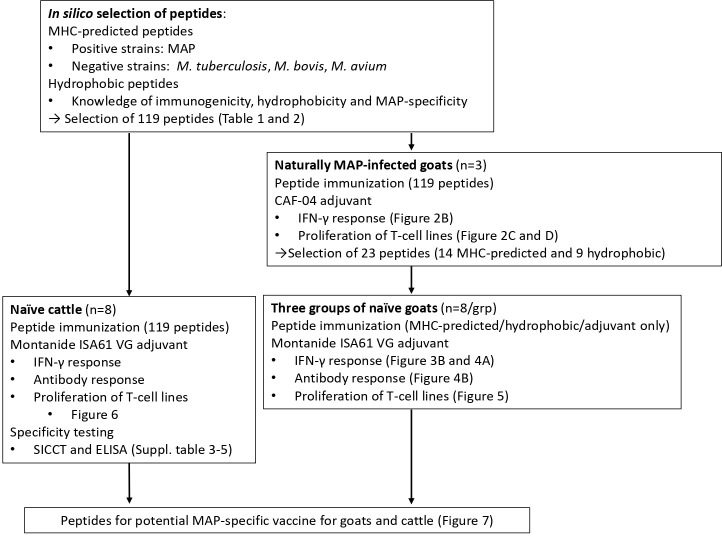
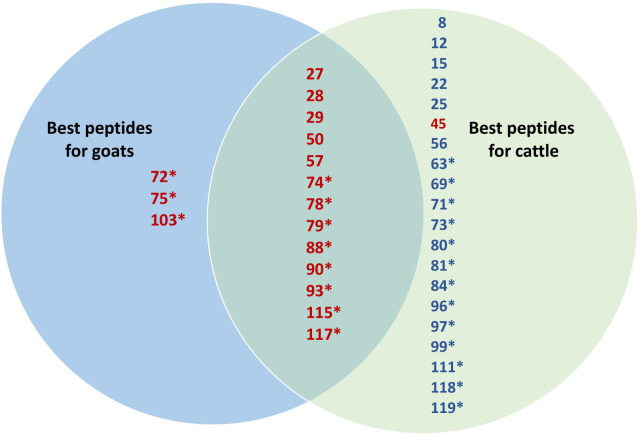
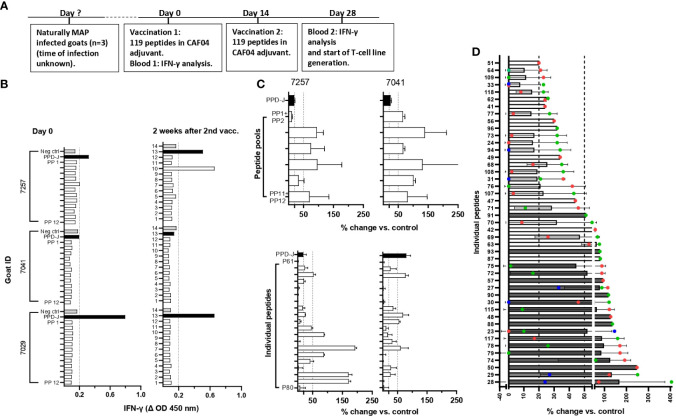
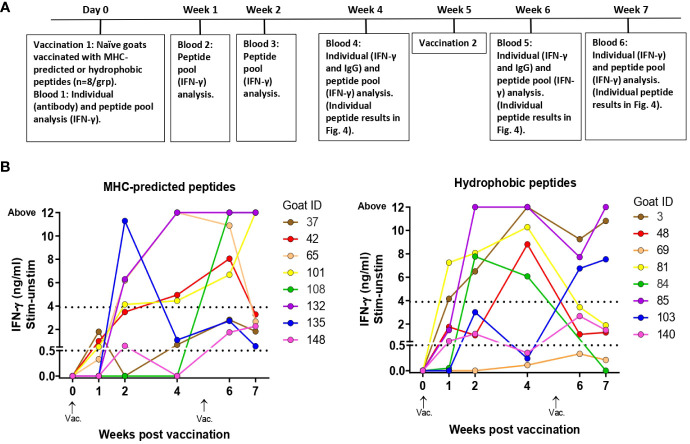
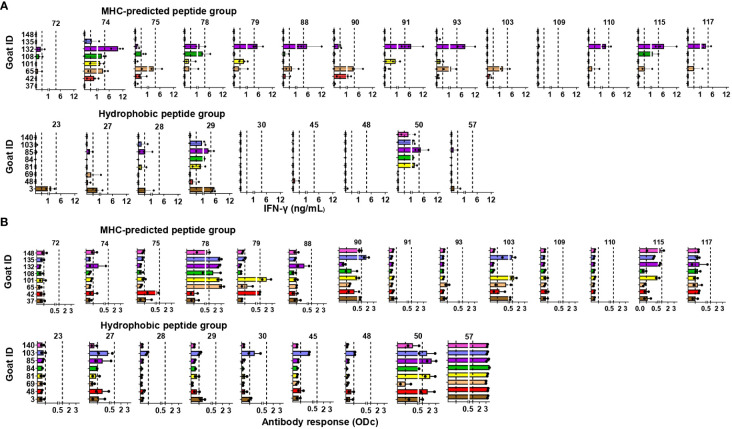
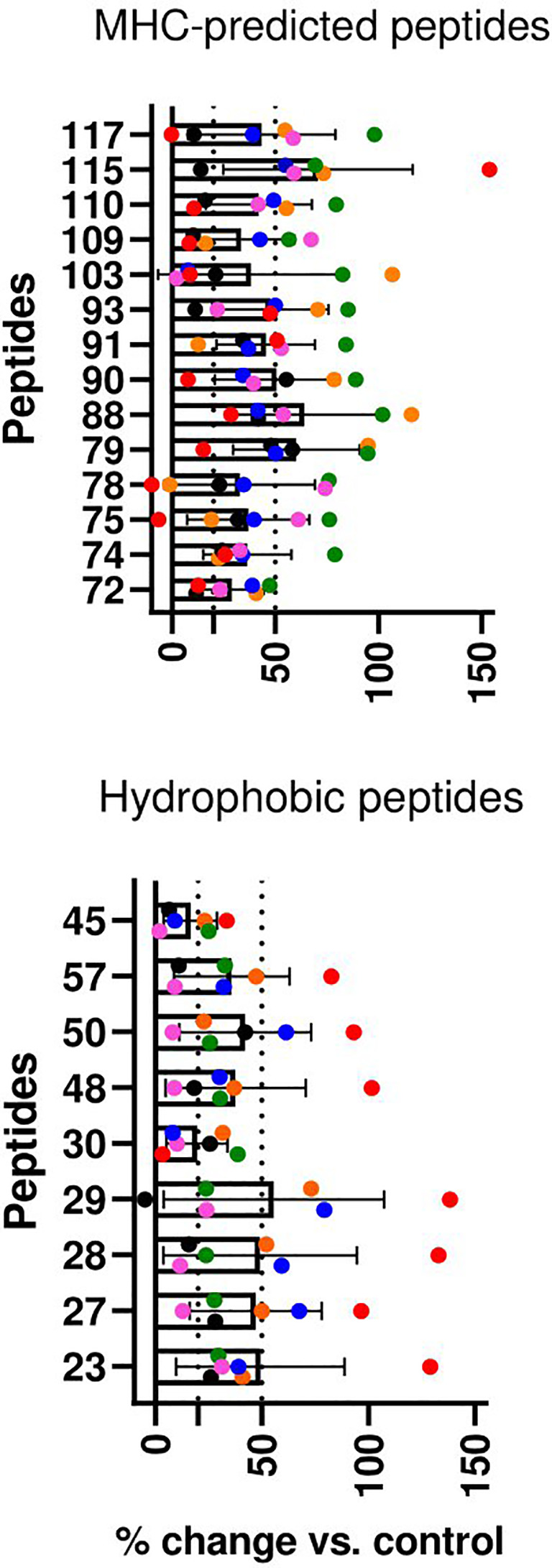
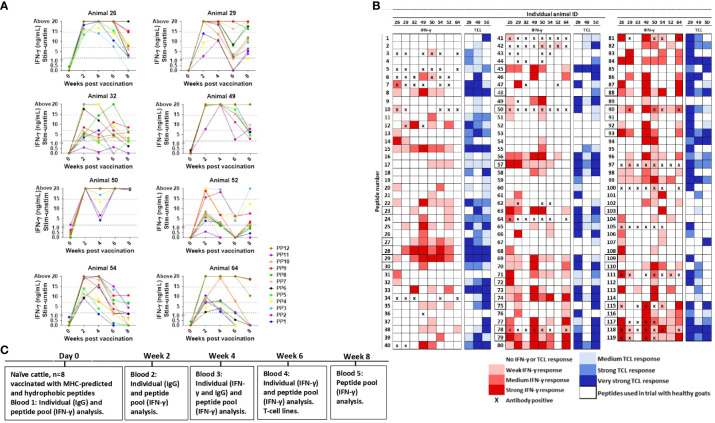
subspecies (MAP) is a global concern in modern livestock production worldwide. The available vaccines against paratuberculosis do not offer optimal protection and interfere with the diagnosis of bovine tuberculosis. The aim of this study was to identify immunogenic MAP-specific peptides that do not interfere with the diagnosis of bovine tuberculosis. Initially, 119 peptides were selected by either (1) identifying unique MAP peptides that were predicted to bind to bovine major histocompatibility complex class II (MHC-predicted peptides) or (2) selecting hydrophobic peptides unique to MAP within proteins previously shown to be immunogenic (hydrophobic peptides). Subsequent testing of peptide-specific CD4+ T-cell lines from MAP-infected, adult goats vaccinated with peptides in cationic liposome adjuvant pointed to 23 peptides as being most immunogenic. These peptides were included in a second vaccine trial where three groups of eight healthy goat kids were vaccinated with 14 MHC-predicted peptides, nine hydrophobic peptides, or no peptides in o/w emulsion adjuvant. The majority of the MHC-predicted (93%) and hydrophobic peptides (67%) induced interferon-gamma (IFN-γ) responses in at least one animal. Similarly, 86% of the MHC-predicted and 89% of the hydrophobic peptides induced antibody responses in at least one goat. The immunization of eight healthy heifers with all 119 peptides formulated in emulsion adjuvant identified more peptides as immunogenic, as peptide specific IFN-γ and antibody responses in at least one heifer was found toward 84% and 24% of the peptides, respectively. No peptide-induced reactivity was found with commercial ELISAs for detecting antibodies against or MAP or when performing tuberculin skin testing for bovine tuberculosis. The vaccinated animals experienced adverse reactions at the injection site; thus, it is recommend that future studies make improvements to the vaccine formulation. In conclusion, immunogenic MAP-specific peptides that appeared promising for use in a vaccine against paratuberculosis without interfering with surveillance and trade tests for bovine tuberculosis were identified by analysis and generation of CD4+ T-cell lines and validated by the immunization of goats and cattle. Future studies should test different peptide combinations in challenge trials to determine their protective effect and identify the most MHC-promiscuous vaccine candidates.
亚种 (MAP) 是全球现代畜牧业的一个全球性问题。现有的副结核病疫苗不能提供最佳保护,并且会干扰牛结核病的诊断。本研究的目的是鉴定不会干扰牛结核病诊断的具有免疫原性的 MAP 特异性肽。最初,通过以下两种方法之一选择了 119 个肽:(1)鉴定预测与牛主要组织相容性复合体 II (MHC-预测肽)结合的独特 MAP 肽,或(2)选择先前显示具有免疫原性的蛋白质内独特的疏水性 MAP 肽(疏水性肽)。随后,对用阳离子脂质体佐剂接种肽的感染 MAP 的成年山羊的肽特异性 CD4+ T 细胞系进行测试,指出 23 个肽最具免疫原性。这些肽被纳入第二项疫苗试验中,其中三组八只健康的山羊幼崽用 o/w 乳剂佐剂接种 14 种 MHC 预测肽、9 种疏水性肽或不接种肽。大多数 MHC 预测(93%)和疏水性肽(67%)在至少一种动物中诱导干扰素-γ(IFN-γ)反应。同样,MHC 预测的 86%和疏水性肽的 89%在至少一只山羊中诱导了抗体反应。用乳剂佐剂配制的所有 119 种肽对 8 只健康小母牛进行免疫,确定了更多具有免疫原性的肽,因为至少有一种小母牛对 84%和 24%的肽分别产生了针对特定肽的 IFN-γ和抗体反应。在用商业 ELISA 检测针对 或 MAP 的抗体或进行牛结核病结核菌素皮肤试验时,没有发现肽诱导的反应。接种动物在注射部位出现不良反应;因此,建议未来的研究改进疫苗配方。总之,通过分析和产生 CD4+ T 细胞系鉴定出了具有免疫原性的 MAP 特异性肽,这些肽有望用于副结核病疫苗而不会干扰牛结核病的监测和贸易测试,并通过山羊和牛的免疫验证。未来的研究应在挑战试验中测试不同的肽组合,以确定其保护作用,并确定最具 MHC 混杂性的疫苗候选物。