Soonchunhyang Institute of Medi-Bio Science (SIMS) and Department of Integrated Biomedical Science, Soonchunhyang University, Cheonan-si, South Korea.
Soonchunhyang Institute of Medi-Bio Science (SIMS) and Department of Integrated Biomedical Science, Soonchunhyang University, Cheonan-si, South Korea.
Mol Cells. 2024 Feb;47(2):100031. doi: 10.1016/j.mocell.2024.100031. Epub 2024 Feb 13.
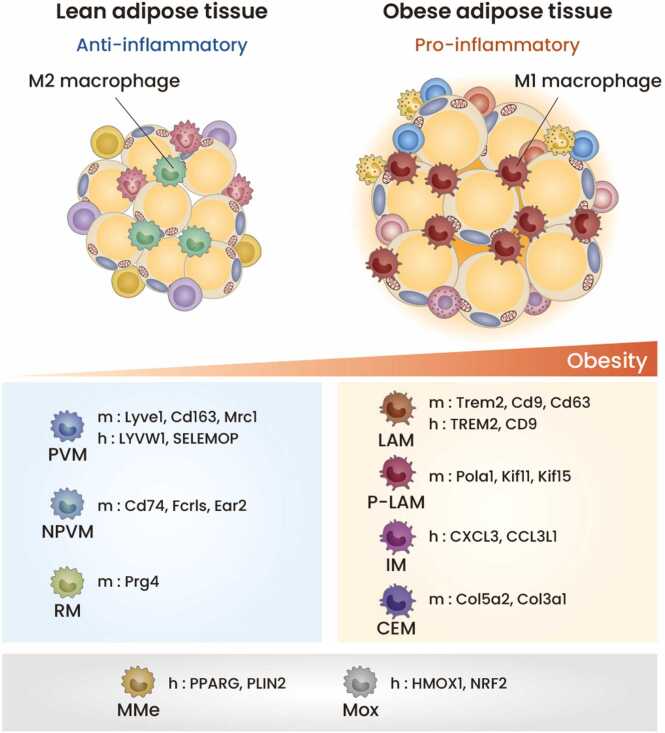
It is now well-accepted that obesity-induced inflammation plays an important role in the development of insulin resistance and type 2 diabetes. A key source of the inflammation is the murine epididymal and human visceral adipose tissue. The current paradigm is that obesity activates multiple proinflammatory immune cell types in adipose tissue, including adipose-tissue macrophages (ATMs), T Helper 1 (Th1) T cells, and natural killer (NK) cells, while concomitantly suppressing anti-inflammatory immune cells such as T Helper 2 (Th2) T cells and regulatory T cells (Tregs). A key feature of the current paradigm is that obesity induces the anti-inflammatory M2 ATMs in lean adipose tissue to polarize into proinflammatory M1 ATMs. However, recent single-cell transcriptomics studies suggest that the story is much more complex. Here we describe the single-cell genomics technologies that have been developed recently and the emerging results from studies using these technologies. While further studies are needed, it is clear that ATMs are highly heterogeneous. Moreover, while a variety of ATM clusters with quite distinct features have been found to be expanded by obesity, none truly resemble classical M1 ATMs. It is likely that single-cell transcriptomics technology will further revolutionize the field, thereby promoting our understanding of ATMs, adipose-tissue inflammation, and insulin resistance and accelerating the development of therapies for type 2 diabetes.
现在人们普遍认为,肥胖引起的炎症在胰岛素抵抗和 2 型糖尿病的发展中起着重要作用。炎症的一个主要来源是鼠附睾和人内脏脂肪组织。目前的模式是,肥胖会激活脂肪组织中多种促炎免疫细胞类型,包括脂肪组织巨噬细胞(ATMs)、辅助性 T 细胞 1(Th1)T 细胞和自然杀伤(NK)细胞,同时抑制抗炎免疫细胞,如辅助性 T 细胞 2(Th2)T 细胞和调节性 T 细胞(Tregs)。目前模式的一个关键特征是,肥胖会诱导瘦脂肪组织中原本具有抗炎作用的 M2 ATMs 向促炎的 M1 ATMs 极化。然而,最近的单细胞转录组学研究表明,情况要复杂得多。在这里,我们描述了最近开发的单细胞基因组学技术,以及使用这些技术进行的研究的新兴结果。虽然还需要进一步的研究,但很明显,ATMs 具有高度异质性。此外,虽然肥胖会导致多种具有明显特征的 ATM 簇扩张,但没有一种真正类似于经典的 M1 ATMs。很可能单细胞转录组学技术将进一步推动该领域的发展,从而促进我们对 ATMs、脂肪组织炎症和胰岛素抵抗的理解,并加速 2 型糖尿病治疗方法的开发。