Ai Dashan, Hao Shengnan, Shen Wenbin, Wu Qibing, Zhang Shengjian, Chen Yun, Liu Qi, Deng Jiaying, Zhu Hongcheng, Chen Ke, Mo Miao, Gu Dayong, Liu Yatian, Zhang Zhi, Zhou Guoren, Hu Jingwen, Zhang Zhen, Ye Jinjun, Zhao Kuaile
Department of Radiation Oncology, Fudan University Shanghai Cancer Center, Shanghai, China.
Department of Oncology, Shanghai Medical College, Fudan University, Shanghai, China.
EClinicalMedicine. 2024 Feb 6;69:102471. doi: 10.1016/j.eclinm.2024.102471. eCollection 2024 Mar.
Concurrent chemoradiotherapy is the standard nonoperative treatment for locally advanced esophageal squamous cell carcinoma. However, local recurrence is still the main failure pattern, accounting for more than half of all treatment failures, indicating that the sensitivity of radiotherapy still needs to be improved. This trial aimed at demonstrating whether PD-1 inhibitors followed by chemoradiotherapy could promote esophageal tumor vascular normalization, alleviate hypoxia, and thus enhance radiosensitivity and improve local control.
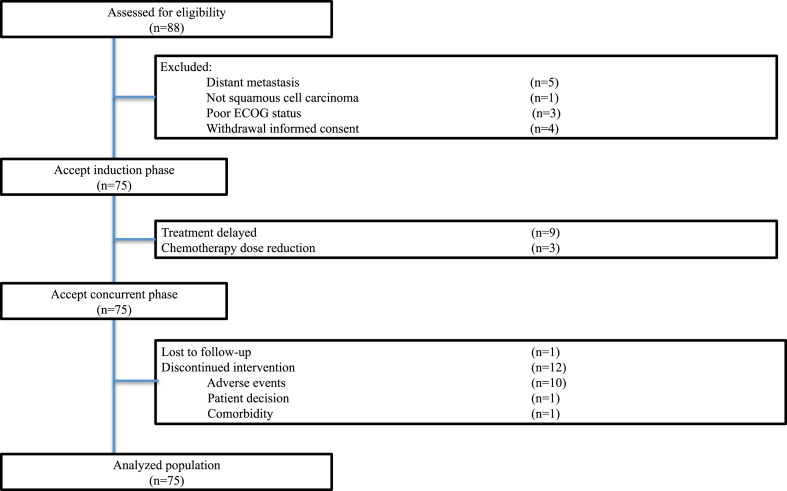
We did a multicenter, single-arm, phase 2 trial in China. Patients with locally advanced esophageal cancer were enrolled in this study. In induction phase, patients received two cycles of sintilimab, paclitaxel and carboplatin once per 21 days. In concurrent phase, patients were treated with five cycles of carboplatin and paclitaxel once per week concurrent with radiotherapy of 50.4Gy delivered in 28 fractions. The primary endpoint was 2-year local control rate. Hypoxia and vessel normalization was assessed before and after induction phase using immunofluorescence and perfusion CT. This trial is registered with ClinicalTrials.gov (NCT03985046).
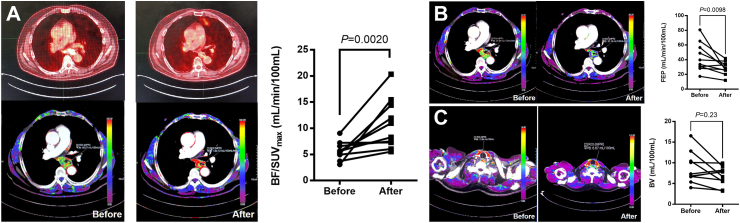
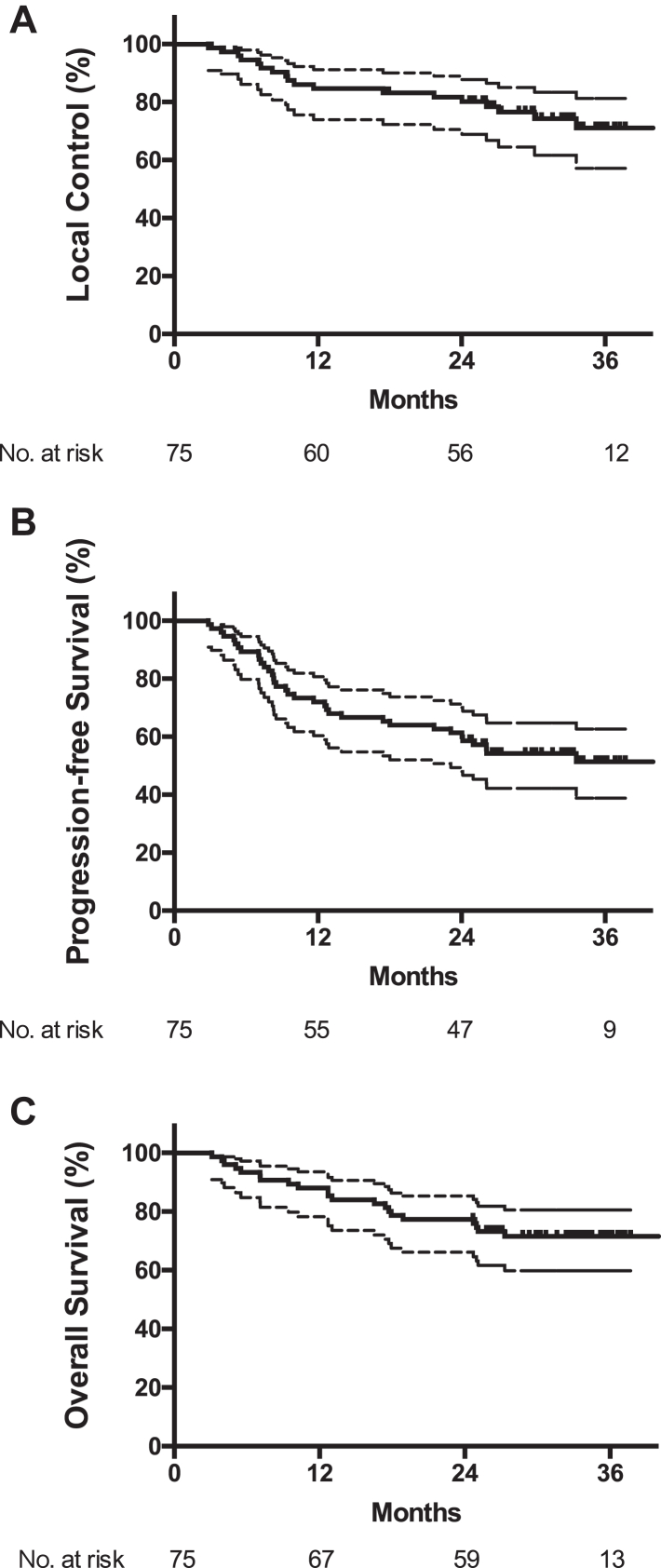
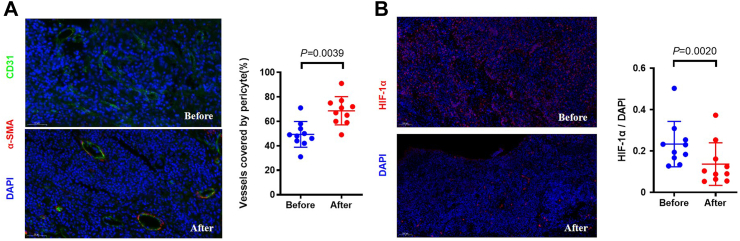
Seventy-five patients with esophageal cancer were enrolled in this study between October 2019 and April 2021. The median follow-up of surviving patients was 33.6 months (IQR 29.3-35.7). The 2-year local control rate was 81.7% (95% confidence interval, 72.7%-90.7%), which was much higher than that in concurrent chemoradiation only (71.3%) in previous studies. Vascular normalization and hypoxia alleviation were observed in both biopsy specimens and perfusion CT.
The addition of induction immunotherapy to standard concurrent chemoradiotherapy could improve radiosensitivity for locally advanced esophageal cancer as non-surgical treatment. New treatment combination led to higher local control rate through promoting vascular normalization and alleviating hypoxia. Our findings suggest that induction immunotherapy followed by concurrent chemoradiotherapy could be a potential option in future treatment.
National Natural Science Foundation of China and Shanghai Rising-Star Program.
同步放化疗是局部晚期食管鳞状细胞癌的标准非手术治疗方法。然而,局部复发仍然是主要的失败模式,占所有治疗失败的一半以上,这表明放疗的敏感性仍需提高。本试验旨在证明PD-1抑制剂序贯放化疗是否能促进食管肿瘤血管正常化、缓解缺氧,从而提高放射敏感性并改善局部控制。
我们在中国进行了一项多中心、单臂、2期试验。纳入局部晚期食管癌患者。在诱导期,患者每21天接受两个周期的信迪利单抗、紫杉醇和卡铂治疗。在同步期,患者每周接受五个周期的卡铂和紫杉醇治疗,同时进行50.4Gy、分28次的放疗。主要终点是2年局部控制率。在诱导期前后使用免疫荧光和灌注CT评估缺氧和血管正常化情况。本试验已在ClinicalTrials.gov注册(NCT03985046)。
2019年10月至2021年4月期间,75例食管癌患者纳入本研究。存活患者的中位随访时间为33.6个月(四分位间距29.3 - 35.7)。2年局部控制率为81.7%(95%置信区间,72.7% - 90.7%),远高于既往研究中单纯同步放化疗的局部控制率(71.3%)。在活检标本和灌注CT中均观察到血管正常化和缺氧缓解。
在标准同步放化疗基础上加用诱导免疫治疗可提高局部晚期食管癌非手术治疗的放射敏感性。新的治疗组合通过促进血管正常化和缓解缺氧导致更高的局部控制率。我们的研究结果表明,诱导免疫治疗序贯同步放化疗可能是未来治疗的一个潜在选择。
国家自然科学基金和上海市启明星计划。