Digestive Disease Institute, Cleveland Clinic, Cleveland, Ohio, USA.
University of Texas Health Science Center at Houston, Houston, Texas, USA.
Clin Transl Gastroenterol. 2024 May 1;15(5):e00687. doi: 10.14309/ctg.0000000000000687.
This real-world US-based claims study compared constipation-related symptoms and complications 6 months before and after prucalopride initiation in adults with chronic idiopathic constipation (CIC).
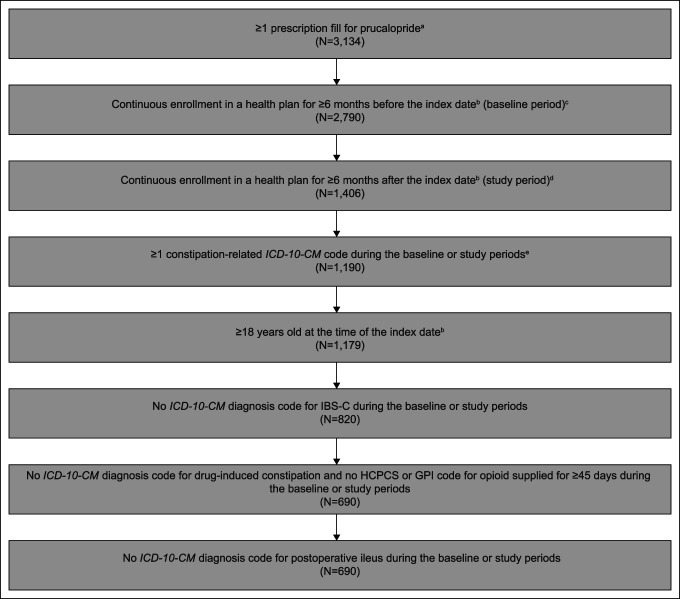
This observational, retrospective cohort analysis used the IBM MarketScan Commercial Claims and Encounters Database and the Medicare Supplemental Database (January 2015-June 2020). Prucalopride-treated patients (≥18 years old) who had ≥1 constipation-related International Classification of Diseases, Tenth Revision, Clinical Modification ( ICD-10-CM ) diagnosis code during the baseline or study period were included. The proportions of patients with constipation-related symptoms (abdominal pain, abdominal distension [gaseous], incomplete defecation, and nausea) and constipation-related complications (anal fissure and fistula, intestinal obstruction, rectal prolapse, hemorrhoids, perianal venous thrombosis, perianal/perirectal abscess, and rectal bleeding) were examined. Constipation-related symptoms and complications were identified using ICD-10-CM , ICD-10 - Procedure Coding System , or Current Procedural Terminology codes. Data were stratified by age (overall, 18-64 years, and ≥65 years).
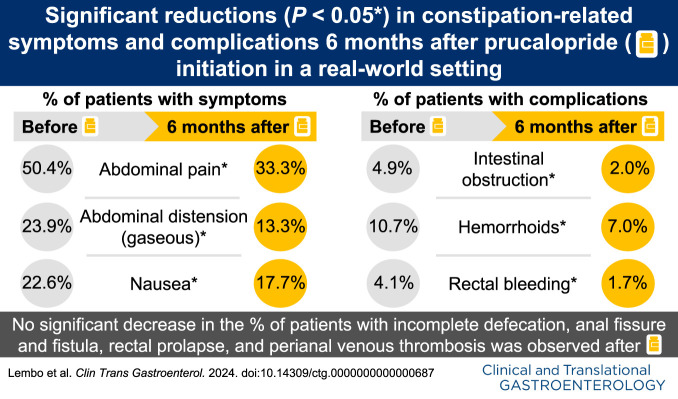
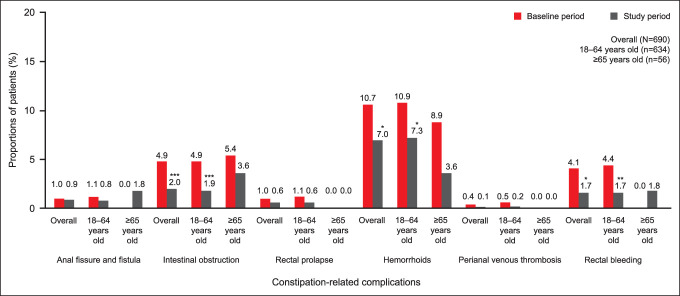
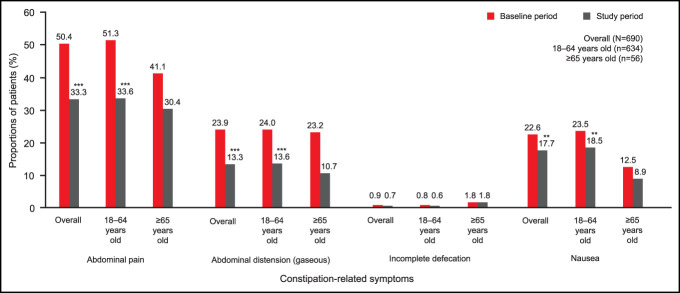
This study included 690 patients: The mean (SD) patient age was 48.0 (14.7) years, and 87.5% were women. The proportions of patients overall with constipation-related symptoms decreased 6 months after prucalopride initiation (abdominal pain [50.4% vs 33.3%, P < 0.001]; abdominal distension [gaseous] [23.9% vs 13.3%, P < 0.001]; and nausea [22.6% vs 17.7%, P < 0.01]; no improvements observed for incomplete defecation). Similarly, the proportions of patients overall with constipation-related complications decreased 6 months after prucalopride initiation (intestinal obstruction [4.9% vs 2.0%, P < 0.001]; hemorrhoids [10.7% vs 7.0%, P < 0.05]; and rectal bleeding [4.1% vs 1.7%, P < 0.05]).
This study suggests that prucalopride may be associated with improved constipation-related symptoms and complications 6 months after treatment initiation.
本项基于美国真实世界数据的研究比较了慢性特发性便秘(CIC)成人在普芦卡必利治疗开始前和开始后 6 个月的便秘相关症状和并发症。
这是一项观察性、回顾性队列分析,使用了 IBM MarketScan 商业索赔和就诊数据库以及 Medicare 补充数据库(2015 年 1 月至 2020 年 6 月)。纳入至少 18 岁且基线期或研究期至少有 1 次便秘相关的国际疾病分类,第 10 次修订版,临床修正(ICD-10-CM)诊断代码的普芦卡必利治疗患者。使用 ICD-10-CM、ICD-10-手术操作分类系统或当前操作术语代码评估便秘相关症状(腹痛、腹胀[气性]、不完全排便和恶心)和便秘相关并发症(肛裂和瘘管、肠梗阻、直肠脱垂、痔疮、肛周静脉血栓形成、肛周/直肠脓肿和直肠出血)的患者比例。便秘相关症状和并发症的诊断依据 ICD-10-CM、ICD-10-手术操作分类系统或当前操作术语代码。数据按年龄(总体、18-64 岁和≥65 岁)分层。
这项研究共纳入 690 例患者:患者的平均(标准差)年龄为 48.0(14.7)岁,87.5%为女性。总体而言,普芦卡必利治疗 6 个月后,便秘相关症状的患者比例下降(腹痛[50.4%比 33.3%,P<0.001];腹胀[气性][23.9%比 13.3%,P<0.001];恶心[22.6%比 17.7%,P<0.01];不完全排便无改善)。同样,总体而言,普芦卡必利治疗 6 个月后,便秘相关并发症的患者比例下降(肠梗阻[4.9%比 2.0%,P<0.001];痔疮[10.7%比 7.0%,P<0.05];直肠出血[4.1%比 1.7%,P<0.05])。
本研究表明,普芦卡必利治疗开始后 6 个月可能与改善便秘相关症状和并发症相关。