• 文献检索
  • 文档翻译
  • 深度研究
  • 学术资讯
  • Suppr Zotero 插件Zotero 插件
  • 邀请有礼
  • 套餐&价格
  • 历史记录
应用&插件
Suppr Zotero 插件Zotero 插件浏览器插件Mac 客户端Windows 客户端微信小程序
定价
高级版会员购买积分包购买API积分包
服务
文献检索文档翻译深度研究API 文档MCP 服务
关于我们
关于 Suppr公司介绍联系我们用户协议隐私条款
关注我们

Suppr 超能文献

核心技术专利:CN118964589B侵权必究
粤ICP备2023148730 号-1Suppr @ 2026

文献检索

告别复杂PubMed语法,用中文像聊天一样搜索,搜遍4000万医学文献。AI智能推荐,让科研检索更轻松。

立即免费搜索

文件翻译

保留排版,准确专业,支持PDF/Word/PPT等文件格式,支持 12+语言互译。

免费翻译文档

深度研究

AI帮你快速写综述,25分钟生成高质量综述,智能提取关键信息,辅助科研写作。

立即免费体验

FOXI1和POU2F3在不同唾液腺肿瘤中的表达各异,在沃辛瘤中表达更高。

Expression of FOXI1 and POU2F3 varies among different salivary gland neoplasms and is higher in Warthin tumor.

作者信息

Hoki Masahito, Yamada Yosuke, Hiratomo Emi, Hirata Masahiro, Takeuchi Yasuhide, Yoshimatsu Masayoshi, Kikuchi Masahiro, Kishimoto Yo, Marx Alexander, Haga Hironori

机构信息

Department of Diagnostic Pathology, Kyoto University Hospital, 54 Shogoin Kawahara-cho, Sakyo-ku, Kyoto, 606-8507, Japan.

Department of Otolaryngology, Head and Neck Surgery, Graduate School of Medical and Dental Sciences, Kagoshima University, Kagoshima, Japan.

出版信息

Discov Oncol. 2024 Feb 15;15(1):36. doi: 10.1007/s12672-024-00892-7.

DOI:10.1007/s12672-024-00892-7
PMID:38358561
原文链接:https://pmc.ncbi.nlm.nih.gov/articles/PMC10869675/
Abstract

PURPOSE

Salivary gland tumors are histologically diverse. Ionocytes and tuft cells, rare epithelial cells found in normal salivary glands, might be associated with salivary tumors. Here, we explored the expression of FOXI1 and POU2F3, master regulators of ionocytes and tuft cells, respectively, for common salivary neoplasms using immunohistochemistry.

METHODS

We analyzed normal salivary tissues and nine salivary gland tumors; Warthin tumors (WT), pleomorphic adenomas (PA), basal cell adenomas, and oncocytomas were benign, whereas mucoepidermoid, adenoid cystic, acinic cell, salivary duct carcinomas, and polymorphous adenocarcinomas were malignant.

RESULTS

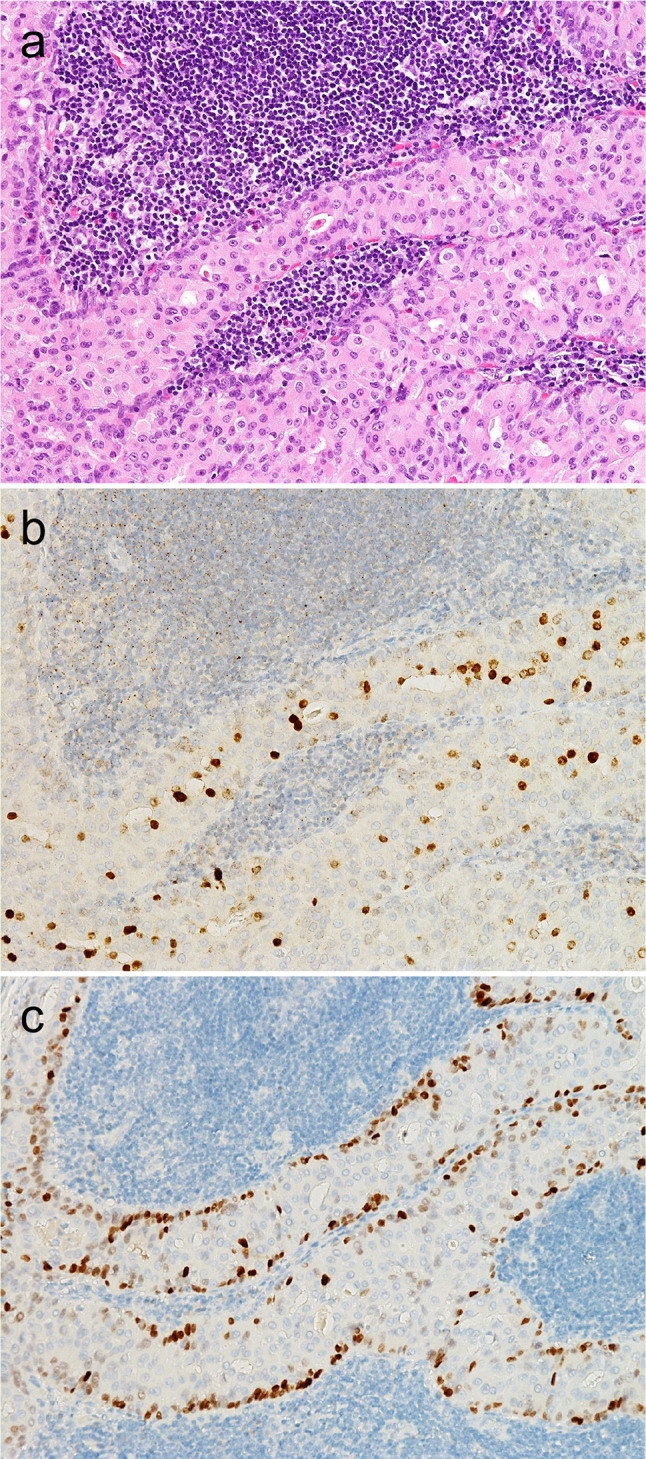
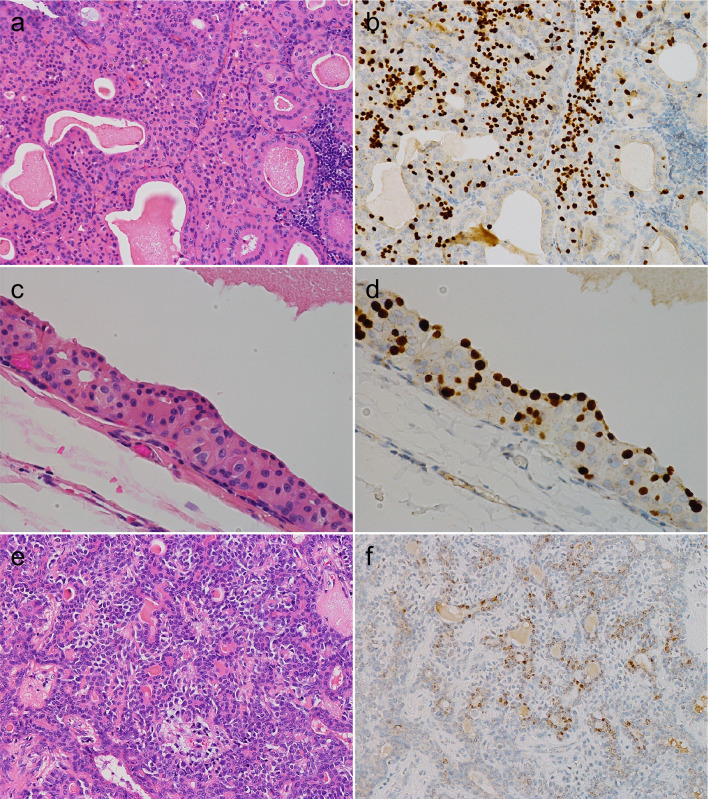
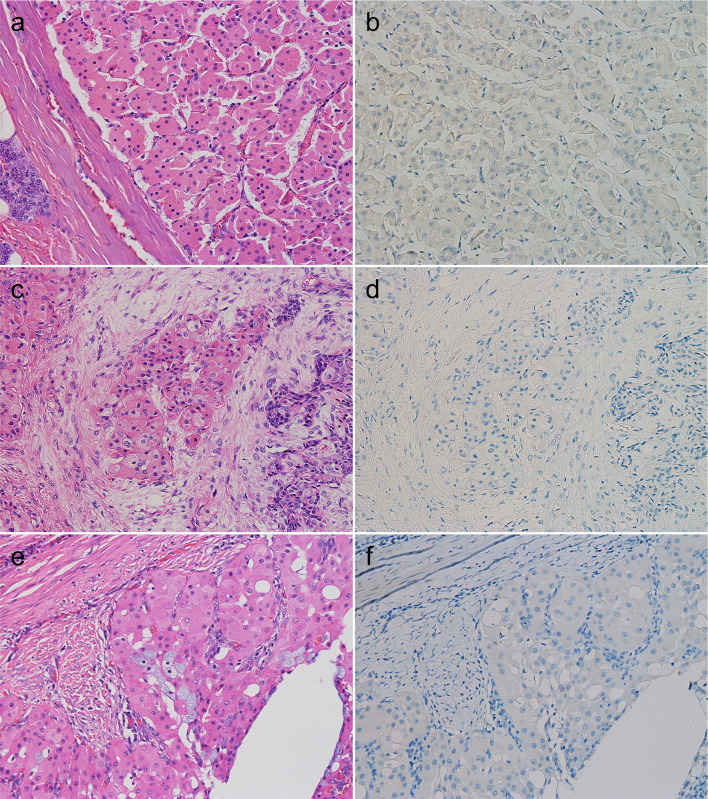
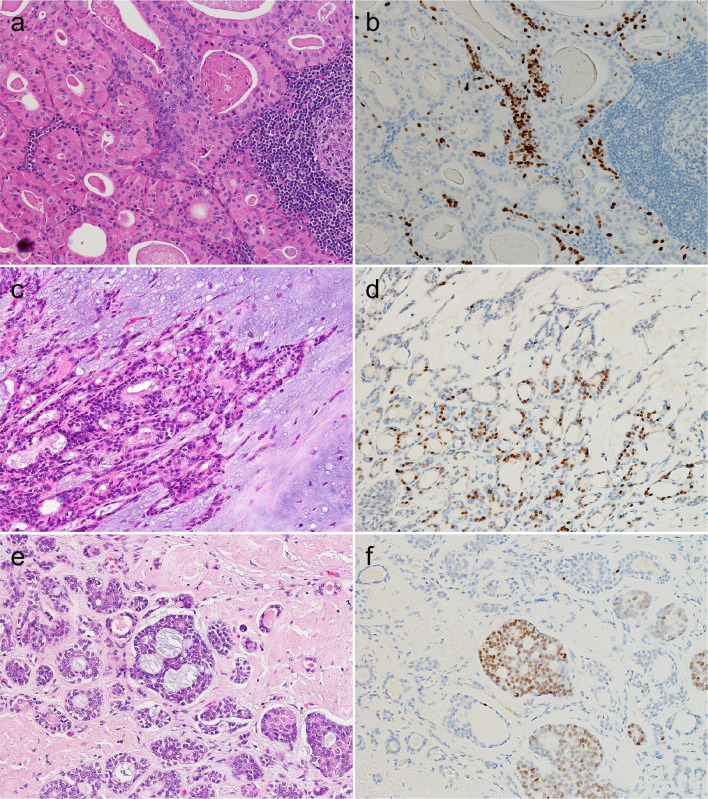
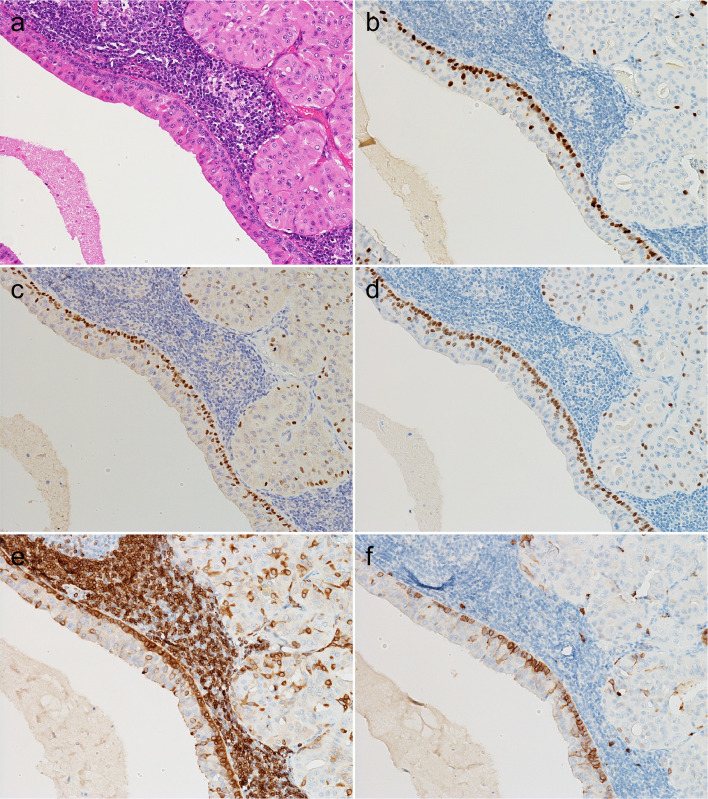
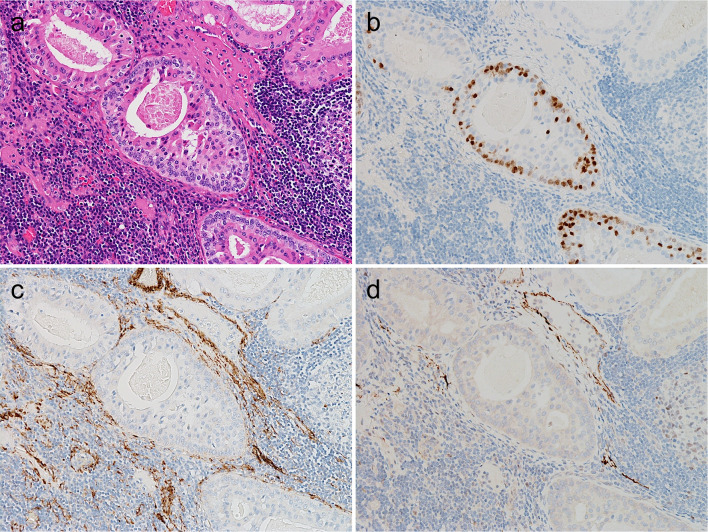
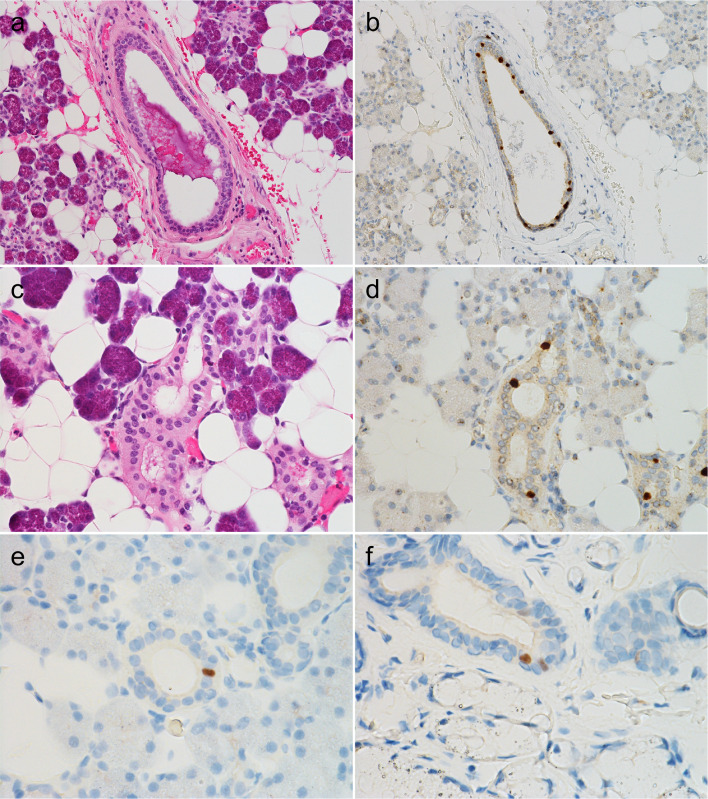
Normal salivary glands contained a few FOXI1- and POU2F3-positive cells in the ducts instead of the acini, consistent with ionocytes and tuft cells, respectively. Among the benign tumors, only WTs and PAs consistently expressed FOXI1 (10/10 and 9/10, respectively). The median H-score of WTs was significantly higher than that of PAs (17.5 vs. 4, P = 0.01). While WTs and PAs harbored POU2F3-positive cells (10/10 and 9/10, respectively), the median H-score was higher in WTs than in PAs (10.5 vs 4, respectively). Furthermore, WTs exhibited a unique staining pattern of FOXI1- and POU2F3-positive cells, which were present in luminal and abluminal locations, respectively. Whereas none of the malignant tumors expressed FOXI1, only adenoid cystic carcinoma consistently expressed POU2F3 (5/5), with a median H-score of 4.

CONCLUSION

The expression patterns of the characteristic transcription factors found in ionocytes and tuft cells vary among salivary gland tumor types and are higher in WT, which might be relevant for understanding and diagnosing salivary gland neoplasms.

摘要

目的

唾液腺肿瘤在组织学上具有多样性。离子细胞和簇状细胞是正常唾液腺中发现的罕见上皮细胞,可能与唾液腺肿瘤有关。在此,我们使用免疫组织化学方法探究了离子细胞和簇状细胞的主要调节因子FOXI1和POU2F3在常见唾液腺肿瘤中的表达情况。

方法

我们分析了正常唾液组织和9种唾液腺肿瘤;沃辛瘤(WT)、多形性腺瘤(PA)、基底细胞腺瘤和嗜酸细胞瘤为良性肿瘤,而黏液表皮样癌、腺样囊性癌、腺泡细胞癌、唾液导管癌和多形性腺癌为恶性肿瘤。

结果

正常唾液腺导管中含有少量FOXI1和POU2F3阳性细胞,而非腺泡,分别与离子细胞和簇状细胞一致。在良性肿瘤中,只有WT和PA持续表达FOXI1(分别为10/10和9/10)。WT的中位H评分显著高于PA(17.5对4,P = 0.01)。虽然WT和PA都含有POU2F3阳性细胞(分别为10/10和9/10),但WT的中位H评分高于PA(分别为10.5和4)。此外,WT表现出独特的FOXI1和POU2F3阳性细胞染色模式,分别位于管腔和管腔外位置。而恶性肿瘤均不表达FOXI1,只有腺样囊性癌持续表达POU2F3(5/5),中位H评分为4。

结论

离子细胞和簇状细胞中发现的特征性转录因子的表达模式在唾液腺肿瘤类型中有所不同,在WT中更高,这可能与唾液腺肿瘤的理解和诊断有关。
https://cdn.ncbi.nlm.nih.gov/pmc/blobs/1c93/10869675/d2f9ff207f9b/12672_2024_892_Fig7_HTML.jpg
https://cdn.ncbi.nlm.nih.gov/pmc/blobs/1c93/10869675/6bb5a21c01ae/12672_2024_892_Fig1_HTML.jpg
https://cdn.ncbi.nlm.nih.gov/pmc/blobs/1c93/10869675/986fade58b0c/12672_2024_892_Fig2_HTML.jpg
https://cdn.ncbi.nlm.nih.gov/pmc/blobs/1c93/10869675/5b00e09f7663/12672_2024_892_Fig3_HTML.jpg
https://cdn.ncbi.nlm.nih.gov/pmc/blobs/1c93/10869675/2637de91c8a1/12672_2024_892_Fig4_HTML.jpg
https://cdn.ncbi.nlm.nih.gov/pmc/blobs/1c93/10869675/f86dcba4051b/12672_2024_892_Fig5_HTML.jpg
https://cdn.ncbi.nlm.nih.gov/pmc/blobs/1c93/10869675/796e82b158e9/12672_2024_892_Fig6_HTML.jpg
https://cdn.ncbi.nlm.nih.gov/pmc/blobs/1c93/10869675/d2f9ff207f9b/12672_2024_892_Fig7_HTML.jpg
https://cdn.ncbi.nlm.nih.gov/pmc/blobs/1c93/10869675/6bb5a21c01ae/12672_2024_892_Fig1_HTML.jpg
https://cdn.ncbi.nlm.nih.gov/pmc/blobs/1c93/10869675/986fade58b0c/12672_2024_892_Fig2_HTML.jpg
https://cdn.ncbi.nlm.nih.gov/pmc/blobs/1c93/10869675/5b00e09f7663/12672_2024_892_Fig3_HTML.jpg
https://cdn.ncbi.nlm.nih.gov/pmc/blobs/1c93/10869675/2637de91c8a1/12672_2024_892_Fig4_HTML.jpg
https://cdn.ncbi.nlm.nih.gov/pmc/blobs/1c93/10869675/f86dcba4051b/12672_2024_892_Fig5_HTML.jpg
https://cdn.ncbi.nlm.nih.gov/pmc/blobs/1c93/10869675/796e82b158e9/12672_2024_892_Fig6_HTML.jpg
https://cdn.ncbi.nlm.nih.gov/pmc/blobs/1c93/10869675/d2f9ff207f9b/12672_2024_892_Fig7_HTML.jpg

相似文献

1
Expression of FOXI1 and POU2F3 varies among different salivary gland neoplasms and is higher in Warthin tumor.FOXI1和POU2F3在不同唾液腺肿瘤中的表达各异,在沃辛瘤中表达更高。
Discov Oncol. 2024 Feb 15;15(1):36. doi: 10.1007/s12672-024-00892-7.
2
The myoepithelial immunophenotype in 135 benign and malignant salivary gland tumors other than pleomorphic adenoma.135例除多形性腺瘤外的涎腺良恶性肿瘤的肌上皮免疫表型
Arch Pathol Lab Med. 1999 Sep;123(9):801-6. doi: 10.5858/1999-123-0801-TMIIBA.
3
GATA3 immunohistochemical expression in salivary gland neoplasms.GATA3在涎腺肿瘤中的免疫组化表达
Head Neck Pathol. 2013 Dec;7(4):311-5. doi: 10.1007/s12105-013-0442-3. Epub 2013 Apr 20.
4
SOX10 is a novel marker of acinus and intercalated duct differentiation in salivary gland tumors: a clue to the histogenesis for tumor diagnosis.SOX10 是唾液腺肿瘤中腺泡和闰管分化的新型标志物:提示肿瘤发生的组织发生学有助于诊断。
Mod Pathol. 2013 Aug;26(8):1041-50. doi: 10.1038/modpathol.2013.54. Epub 2013 Apr 5.
5
Glial Fibrillary Acidic Protein Expression Helps Distinguish Pleomorphic Adenoma from Histologic Mimics.胶质纤维酸性蛋白表达有助于鉴别多形性腺瘤与组织学类似物。
Head Neck Pathol. 2022 Sep;16(3):695-702. doi: 10.1007/s12105-021-01409-2. Epub 2022 Jan 22.
6
Diagnostic utility of PLAG1 immunohistochemical determination in salivary gland tumors.PLAG1免疫组化检测在涎腺肿瘤中的诊断效用
Appl Immunohistochem Mol Morphol. 2014 May-Jun;22(5):390-4. doi: 10.1097/PAI.0b013e3182936ea7.
7
[Expression of NR4A3/NOR-1 in acinic cell carcinoma of the salivary gland].[NR4A3/NOR-1在涎腺腺泡细胞癌中的表达]
Zhonghua Bing Li Xue Za Zhi. 2020 Nov 8;49(11):1142-1146. doi: 10.3760/cma.j.cn112151-20200224-00127.
8
Nestin is a wide-spectrum abluminal cell marker of salivary gland tumors.巢蛋白是唾液腺肿瘤的广谱管腔细胞标志物。
Pathol Int. 2013 Oct;63(10):496-501. doi: 10.1111/pin.12103. Epub 2013 Oct 18.
9
P63 is expressed in basal and myoepithelial cells of human normal and tumor salivary gland tissues.P63在人正常和肿瘤唾液腺组织的基底细胞和肌上皮细胞中表达。
J Histochem Cytochem. 2003 Feb;51(2):133-9. doi: 10.1177/002215540305100201.
10
Immunohistochemical localization of WT1 in epithelial salivary tumors.WT1在上皮性唾液腺肿瘤中的免疫组织化学定位。
Pathol Res Pract. 2014 Nov;210(11):726-32. doi: 10.1016/j.prp.2014.06.029. Epub 2014 Jul 9.

引用本文的文献

1
Differential expression of haematopoietic prostaglandin D synthase by POU2F3‑positive tuft cells in conventional bilayered oncocytic and metaplastic epithelia of Warthin tumours.沃辛瘤传统双层嗜酸性细胞和化生上皮中POU2F3阳性簇状细胞对造血前列腺素D合酶的差异表达
Mol Med Rep. 2025 Oct;32(4). doi: 10.3892/mmr.2025.13624. Epub 2025 Jul 19.
2
Identifying key genes associated with recurrence in non-small cell lung cancer through TCGA and single-cell analysis.通过TCGA和单细胞分析鉴定与非小细胞肺癌复发相关的关键基因。
Front Med (Lausanne). 2025 Jun 11;12:1549969. doi: 10.3389/fmed.2025.1549969. eCollection 2025.
3

本文引用的文献

1
An exploratory study for tuft cells in the breast and their relevance in triple-negative breast cancer: the possible relationship of SOX9.一项关于乳腺簇状细胞及其在三阴性乳腺癌中相关性的探索性研究:SOX9 的可能关系。
BMC Cancer. 2023 May 13;23(1):438. doi: 10.1186/s12885-023-10949-5.
2
High-Resolution Transcriptomic Landscape of the Human Submandibular Gland.人类下颌下腺的高分辨率转录组图谱。
J Dent Res. 2023 May;102(5):525-535. doi: 10.1177/00220345221147908. Epub 2023 Feb 1.
3
The critical roles and therapeutic implications of tuft cells in cancer.
Oncocytic Tumors in the Salivary Gland: Cytopathological, Pathological, and Molecular Features.
涎腺嗜酸性细胞瘤:细胞病理学、病理学及分子特征
Acta Cytol. 2025 Apr 1:1-12. doi: 10.1159/000544802.
簇状细胞在癌症中的关键作用及治疗意义
Front Pharmacol. 2022 Dec 9;13:1047188. doi: 10.3389/fphar.2022.1047188. eCollection 2022.
4
Pulmonary cancers across different histotypes share hybrid tuft cell/ionocyte-like molecular features and potentially druggable vulnerabilities.不同组织学类型的肺癌具有混合微绒毛发细胞/离子细胞样分子特征和潜在可药物治疗的脆弱性。
Cell Death Dis. 2022 Nov 19;13(11):979. doi: 10.1038/s41419-022-05428-x.
5
Molecular Classification of Extrapulmonary Neuroendocrine Carcinomas With Emphasis on POU2F3-positive Tuft Cell Carcinoma.肺外神经内分泌癌的分子分类,重点介绍 POU2F3 阳性簇状细胞癌。
Am J Surg Pathol. 2023 Feb 1;47(2):183-193. doi: 10.1097/PAS.0000000000001977. Epub 2022 Oct 14.
6
Injury-induced pulmonary tuft cells are heterogenous, arise independent of key Type 2 cytokines, and are dispensable for dysplastic repair.损伤诱导的肺簇状细胞具有异质性,独立于关键的 2 型细胞因子产生,并且对于发育不良的修复是可有可无的。
Elife. 2022 Sep 8;11:e78074. doi: 10.7554/eLife.78074.
7
Tuft cell-like carcinomas: novel cancer subsets present in multiple organs sharing a unique gene expression signature.簇状细胞样癌:存在于多个器官中的新型癌症亚群,具有独特的基因表达特征。
Br J Cancer. 2022 Nov;127(10):1876-1885. doi: 10.1038/s41416-022-01957-6. Epub 2022 Aug 23.
8
Tuft Cells Are Present in Submandibular Glands Across Species.Tuft 细胞存在于各种物种的颌下腺中。
J Histochem Cytochem. 2022 Sep;70(9):659-667. doi: 10.1369/00221554221120301. Epub 2022 Aug 21.
9
A mesenchymal to epithelial switch in Fgf10 expression specifies an evolutionary-conserved population of ionocytes in salivary glands.Fgf10 表达的间质到上皮的转变指定了唾液腺中一个进化保守的离子细胞群体。
Cell Rep. 2022 Apr 12;39(2):110663. doi: 10.1016/j.celrep.2022.110663.
10
POU2F3 beyond thymic carcinomas: expression across the spectrum of thymomas hints to medullary differentiation in type A thymoma.POU2F3在胸腺癌之外:胸腺瘤谱系中的表达提示A型胸腺瘤存在髓质分化。
Virchows Arch. 2022 Apr;480(4):843-851. doi: 10.1007/s00428-021-03229-9. Epub 2022 Jan 6.