Barts Cancer Institute, Queen Mary University of London, London, United Kingdom.
The Mid and South Essex University Hospitals Group, Chelmsford, United Kingdom.
JAMA Oncol. 2024 Apr 1;10(4):475-483. doi: 10.1001/jamaoncol.2023.6789.
Arginine deprivation using ADI-PEG20 (pegargiminase) combined with chemotherapy is untested in a randomized study among patients with cancer. ATOMIC-Meso (ADI-PEG20 Targeting of Malignancies Induces Cytotoxicity-Mesothelioma) is a pivotal trial comparing standard first-line chemotherapy plus pegargiminase or placebo in patients with nonepithelioid pleural mesothelioma.
To determine the effect of pegargiminase-based chemotherapy on survival in nonepithelioid pleural mesothelioma, an arginine-auxotrophic tumor.
DESIGN, SETTING, AND PARTICIPANTS: This was a phase 2-3, double-blind randomized clinical trial conducted at 43 centers in 5 countries that included patients with chemotherapy-naive nonepithelioid pleural mesothelioma from August 1, 2017, to August 15, 2021, with at least 12 months' follow-up. Final follow-up was on August 15, 2022. Data analysis was performed from March 2018 to June 2023.
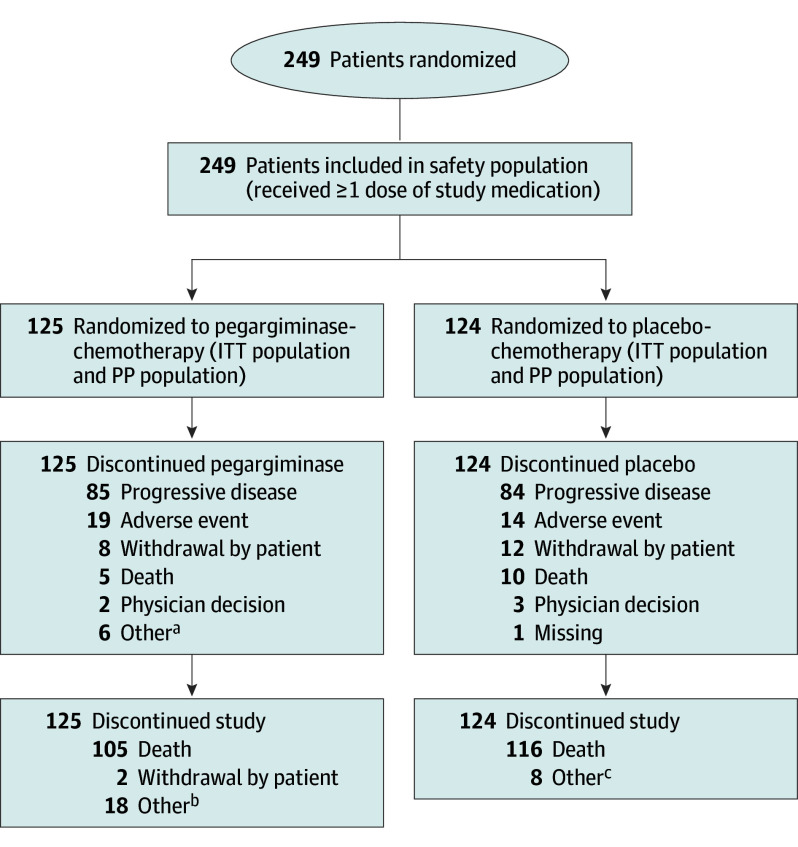
Patients were randomly assigned (1:1) to receive weekly intramuscular pegargiminase (36.8 mg/m2) or placebo. All patients received intravenous pemetrexed (500 mg/m2) and platinum (75-mg/m2 cisplatin or carboplatin area under the curve 5) chemotherapy every 3 weeks up to 6 cycles. Pegargiminase or placebo was continued until progression, toxicity, or 24 months.
The primary end point was overall survival, and secondary end points were progression-free survival and safety. Response rate by blinded independent central review was assessed in the phase 2 portion only.
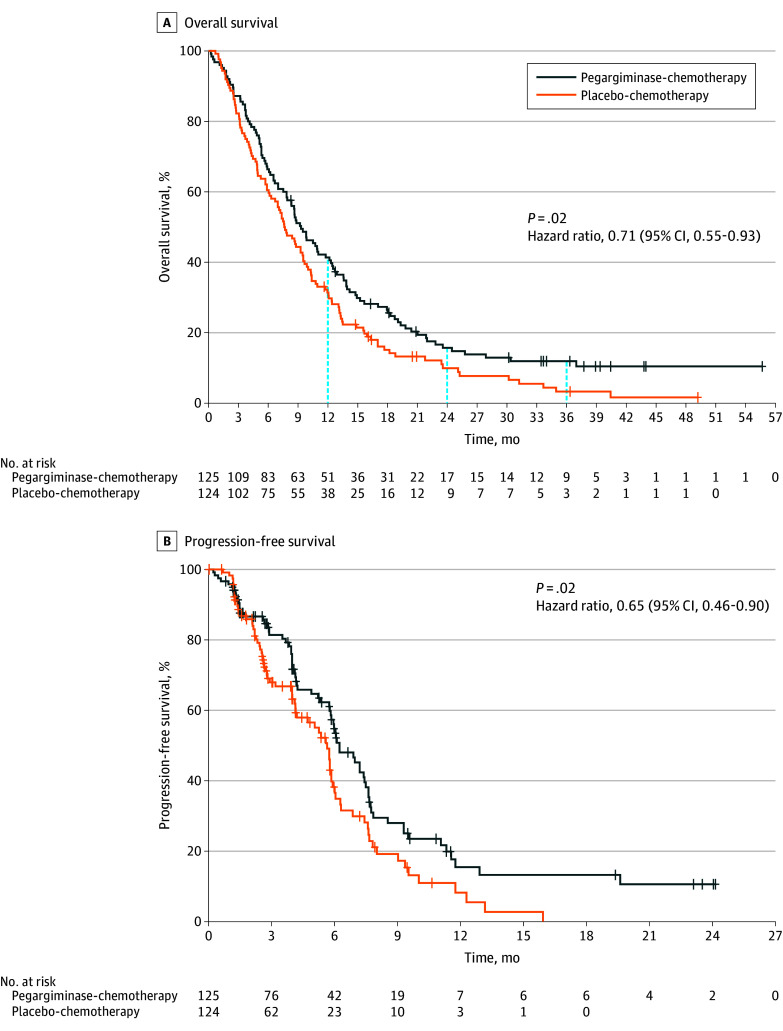
Among 249 randomized patients (mean [SD] age, 69.5 [7.9] years; 43 female individuals [17.3%] and 206 male individuals [82.7%]), all were included in the analysis. The median overall survival was 9.3 months (95% CI, 7.9-11.8 months) with pegargiminase-chemotherapy as compared with 7.7 months (95% CI, 6.1-9.5 months) with placebo-chemotherapy (hazard ratio [HR] for death, 0.71; 95% CI, 0.55-0.93; P = .02). The median progression-free survival was 6.2 months (95% CI, 5.8-7.4 months) with pegargiminase-chemotherapy as compared with 5.6 months (95% CI, 4.1-5.9 months) with placebo-chemotherapy (HR, 0.65; 95% CI, 0.46-0.90; P = .02). Grade 3 to 4 adverse events with pegargiminase occurred in 36 patients (28.8%) and with placebo in 21 patients (16.9%); drug hypersensitivity and skin reactions occurred in the experimental arm in 3 patients (2.4%) and 2 patients (1.6%), respectively, and none in the placebo arm. Rates of poststudy treatments were comparable in both arms (57 patients [45.6%] with pegargiminase vs 58 patients [46.8%] with placebo).
In this randomized clinical trial of arginine depletion with pegargiminase plus chemotherapy, survival was extended beyond standard chemotherapy with a favorable safety profile in patients with nonepithelioid pleural mesothelioma. Pegargiminase-based chemotherapy as a novel antimetabolite strategy for mesothelioma validates wider clinical testing in oncology.
ClinicalTrials.gov Identifier: NCT02709512.
重要性:在癌症患者中,使用 ADI-PEG20(聚乙二醇化精氨酸酶)联合化疗进行精氨酸剥夺的随机研究尚未进行。ATOMIC-Meso(ADI-PEG20 靶向恶性肿瘤诱导细胞毒性-间皮瘤)是一项关键性试验,比较了非上皮样胸膜间皮瘤患者中标准一线化疗加聚乙二醇化精氨酸酶或安慰剂的疗效。
目的:确定聚乙二醇化精氨酸酶为基础的化疗对精氨酸营养缺陷型肿瘤-非上皮样胸膜间皮瘤患者生存的影响。
设计、地点和参与者:这是一项在 5 个国家的 43 个中心进行的 2-3 期、双盲随机临床试验,纳入了 2017 年 8 月 1 日至 2021 年 8 月 15 日接受化疗的非上皮样胸膜间皮瘤患者,至少随访 12 个月。最终随访时间为 2022 年 8 月 15 日。数据分析时间为 2018 年 3 月至 2023 年 6 月。
干预措施:患者被随机分配(1:1)接受每周一次肌肉内聚乙二醇化精氨酸酶(36.8mg/m2)或安慰剂。所有患者每 3 周接受静脉注射培美曲塞(500mg/m2)和铂类(75mg/m2 顺铂或卡铂曲线下面积 5)化疗,共 6 个周期。聚乙二醇化精氨酸酶或安慰剂持续至疾病进展、毒性或 24 个月。
主要终点和次要终点:主要终点是总生存期,次要终点是无进展生存期和安全性。仅在 2 期部分评估了盲法独立中心评估的缓解率。
结果:在 249 名随机患者中(平均[SD]年龄,69.5[7.9]岁;43 名女性[17.3%]和 206 名男性[82.7%]),所有患者均纳入分析。聚乙二醇化精氨酸酶联合化疗组的中位总生存期为 9.3 个月(95%CI,7.9-11.8 个月),而安慰剂联合化疗组为 7.7 个月(95%CI,6.1-9.5 个月)(死亡风险比[HR],0.71;95%CI,0.55-0.93;P=0.02)。聚乙二醇化精氨酸酶联合化疗组的中位无进展生存期为 6.2 个月(95%CI,5.8-7.4 个月),而安慰剂联合化疗组为 5.6 个月(95%CI,4.1-5.9 个月)(HR,0.65;95%CI,0.46-0.90;P=0.02)。聚乙二醇化精氨酸酶组发生 3 至 4 级不良事件的患者有 36 例(28.8%),安慰剂组有 21 例(16.9%);实验组有 3 例(2.4%)和 2 例(1.6%)分别发生药物过敏和皮肤反应,安慰剂组均未发生。两组患者的研究后治疗率相似(聚乙二醇化精氨酸酶组 57 例[45.6%],安慰剂组 58 例[46.8%])。
结论和相关性:在这项非上皮样胸膜间皮瘤患者中进行的精氨酸耗竭联合化疗的随机临床试验中,与标准化疗相比,聚乙二醇化精氨酸酶联合化疗延长了患者的生存时间,且具有良好的安全性。聚乙二醇化精氨酸酶为基础的化疗作为一种新型代谢物策略用于间皮瘤,验证了其在肿瘤学中的更广泛临床测试。
试验注册:ClinicalTrials.gov 标识符:NCT02709512。