Department of Obstetrics and Gynecology, Division of Gynecology Oncology, CHA Hospital Ilsan Medical Center, Goyang-si, Gyonggi-do, Republic of Korea.
Department of Obstetrics and Gynecology, Seoul National University College of Medicine, Seoul National University Hospital Healthcare System Gangnam Center, Seoul, Republic of Korea.
PLoS One. 2024 Feb 15;19(2):e0291157. doi: 10.1371/journal.pone.0291157. eCollection 2024.
Uterine leiomyoma (UL), the most prevalent benign gynecologic tumor among reproductive-aged women, lacks sufficient research on the potential association between dietary intake and its occurrence in Korean women. Addressing this research gap, this study aims to evaluate the potential link between dietary intake and the prevalence of UL in Korean women.
In this cross-sectional study, a cohort of 672 women, aged 23 to 73, were enrolled, with 383 (57%) being premenopausal. Dietary intake was assessed using a validated food frequency questionnaire (FFQ), and UL presence was determined through ultrasonography. The analysis focused exclusively on items within ten categories, including vegetables/fruit, vegetables, fruits, red meat, processed meat, poultry, fish, dairy product, milk, and alcohol. Multiple logistic regression models were employed to explore the relationship between dietary intake and the prevalence of UL, calculating odds ratios (ORs) and 95% confidence intervals (CIs) while adjusting for confounding factors.
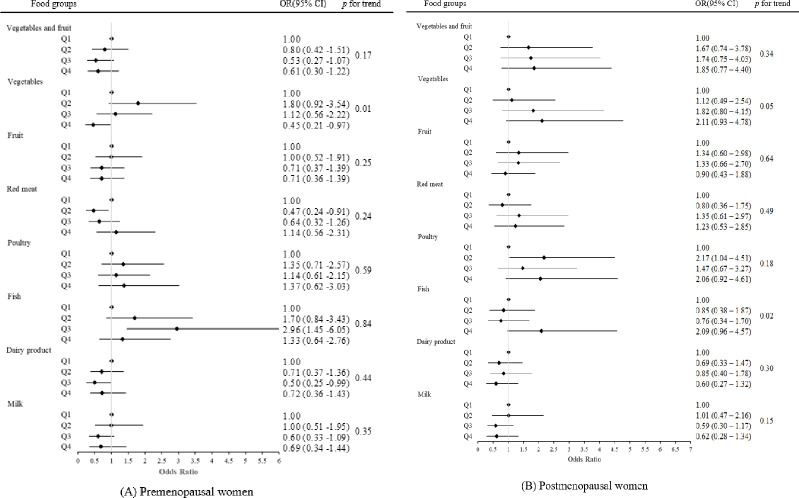
Within the total cohort, 220 (32.7%) women were diagnosed with UL. High intakes of fish and poultry showed an association with higher UL prevalence. Odds ratios (95% CIs) for the upper quartiles compared to the lower quartiles were 1.68 (1.01-2.81; p trend = 0.05) for fish intake and 1.87 (1.11-3.17; p trend = 0.06) for poultry intake. Conversely, an inverse relationship emerged between dairy product intake and UL prevalence, with an odds ratio of 0.58 (95% CI 0.35-0.96; p trend = 0.05). Stratifying the analysis by menopausal status revealed a parallel pattern, with heightened UL prevalence with fish intake and reduced prevalence with dairy product intake. However, the link between poultry intake and UL prevalence was primarily observed among postmenopausal women. Among premenopausal women, elevated vegetable intake was linked to a decreased UL prevalence (OR 0.45, 95% CI 0.21-0.97 for top vs. bottom quartiles; p trend = 0.01).
We found that high consumption of fish and poultry, coupled with low intake of dairy products, correlated with an elevated prevalence of UL. Furthermore, vegetable intake exhibited an inverse relationship with UL prevalence, particularly among premenopausal women.
子宫肌瘤(UL)是生殖期女性最常见的良性妇科肿瘤,但关于其在韩国女性中发生与饮食摄入之间潜在关联的研究还很不足。为了解决这一研究空白,本研究旨在评估饮食摄入与韩国女性 UL 患病率之间的潜在联系。
在这项横断面研究中,共纳入了 672 名年龄在 23 岁至 73 岁之间的女性,其中 383 名(57%)处于绝经前状态。饮食摄入通过验证后的食物频率问卷(FFQ)进行评估,UL 的存在则通过超声检查确定。分析仅关注 10 个类别中的项目,包括蔬菜/水果、蔬菜、水果、红色肉类、加工肉类、家禽、鱼类、乳制品、牛奶和酒精。采用多因素 logistic 回归模型探讨饮食摄入与 UL 患病率之间的关系,计算比值比(ORs)和 95%置信区间(CIs),同时调整混杂因素。
在总队列中,有 220 名(32.7%)女性被诊断为 UL。鱼类和家禽的高摄入量与 UL 患病率较高有关。与最低四分位相比,最高四分位的比值比(95%CI)分别为 1.68(1.01-2.81;p 趋势=0.05)和 1.87(1.11-3.17;p 趋势=0.06)。相反,乳制品摄入量与 UL 患病率呈负相关,比值比为 0.58(95%CI 0.35-0.96;p 趋势=0.05)。按绝经状态进行分层分析后,也出现了类似的模式,鱼类摄入与 UL 患病率升高有关,而乳制品摄入与 UL 患病率降低有关。然而,家禽摄入与 UL 患病率之间的关联主要见于绝经后女性。在绝经前女性中,蔬菜摄入量增加与 UL 患病率降低有关(最高 vs. 最低四分位的比值比为 0.45,95%CI 0.21-0.97;p 趋势=0.01)。
我们发现,鱼类和家禽的高摄入量,加上乳制品的低摄入量,与 UL 患病率的升高相关。此外,蔬菜摄入与 UL 患病率呈负相关,特别是在绝经前女性中。