Romão Beatriz Marinho Silva, Duval Felipe Vieira, Lima Elisângela Costa, da Silva Fabrício Alves Barbosa, de Matos Guacira Correa
Observatory of Medicines Surveillance and Use, Pharmacy School, Federal University of Rio de Janeiro, Rio de Janeiro, Brazil.
Electric Power Research Center, Rio de Janeiro, Brazil.
Front Pharmacol. 2024 Jan 31;15:1349543. doi: 10.3389/fphar.2024.1349543. eCollection 2024.
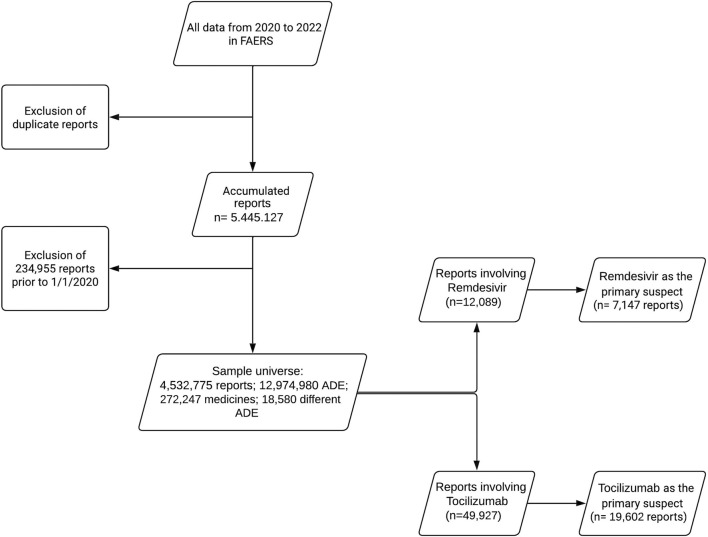
The in-hospital treatment for COVID-19 may include medicines from various therapeutic classes, such as antiviral remdesivir and immunosuppressant tocilizumab. Safety data for these medicines are based on controlled clinical trials and case reports, limiting the knowledge about less frequent, rare or unique population adverse events excluded from clinical trials. This study aims at analyzing the reports of Adverse Drug Events (ADEs) related to these two medicines, focusing on events in pregnant women and foetuses. Data from the open-access FDA Adverse Event Reporting System (FAERS) from 2020 to 2022 were used to create a dashboard on the Grafana platform to ease querying and analyzing report events. Potential safety signals were generated using the ROR disproportionality measure. Remdesivir was notified as the primary suspect in 7,147 reports and tocilizumab in 19,602. Three hundred and three potential safety signals were identified for remdesivir, of which six were related to pregnant women and foetuses (including abortion and foetal deaths). Tocilizumab accumulated 578 potential safety signals, and three of them were associated with this population (including neonatal death). None of the possible signals generated for this population were found in the product labels. According to the NIH and the WHO protocols, both medicines are recommended for pregnant women hospitalized with COVID-19. Despite the known limitations of working with open data from spontaneous reporting systems (e.g., absence of certain clinical data, underreporting, a tendency to report severe events and recent medicines) and disproportionality analysis, the findings suggest concerning associations that need to be confirmed or rejected in subsequent clinical studies.
新型冠状病毒肺炎(COVID-19)的院内治疗可能包括各类治疗药物,如抗病毒药物瑞德西韦和免疫抑制剂托珠单抗。这些药物的安全性数据基于对照临床试验和病例报告,限制了我们对临床试验中未纳入的不常见、罕见或独特人群不良事件的了解。本研究旨在分析与这两种药物相关的药物不良事件(ADE)报告,重点关注孕妇和胎儿的事件。利用2020年至2022年开放获取的美国食品药品监督管理局不良事件报告系统(FAERS)的数据,在Grafana平台上创建了一个仪表板,以方便查询和分析报告事件。使用报告比值比(ROR)不均衡性测量方法生成潜在的安全信号。瑞德西韦在7147份报告中被列为主要怀疑药物,托珠单抗在19602份报告中被列为主要怀疑药物。瑞德西韦识别出303个潜在安全信号,其中6个与孕妇和胎儿有关(包括流产和胎儿死亡)。托珠单抗积累了578个潜在安全信号,其中3个与该人群有关(包括新生儿死亡)。在产品标签中未发现针对该人群产生的任何可能信号。根据美国国立卫生研究院(NIH)和世界卫生组织(WHO)的方案,这两种药物均推荐用于因COVID-19住院的孕妇。尽管使用来自自发报告系统的开放数据存在已知局限性(例如,缺乏某些临床数据、报告不足、倾向于报告严重事件和近期药物)以及不均衡性分析存在局限性,但研究结果表明存在需要在后续临床研究中得到证实或排除的相关关联。