Centre for Genetics and Genomics Versus Arthritis, Centre for Musculoskeletal Research, Division of Musculoskeletal and Dermatological Sciences, University of Manchester, Manchester, UK.
Department of Diabetes and Metabolic Diseases, Graduate School of Medicine, University of Tokyo, Tokyo, Japan.
Nature. 2024 Mar;627(8003):347-357. doi: 10.1038/s41586-024-07019-6. Epub 2024 Feb 19.
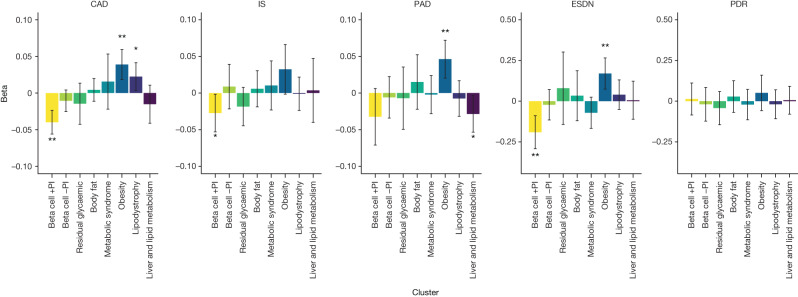
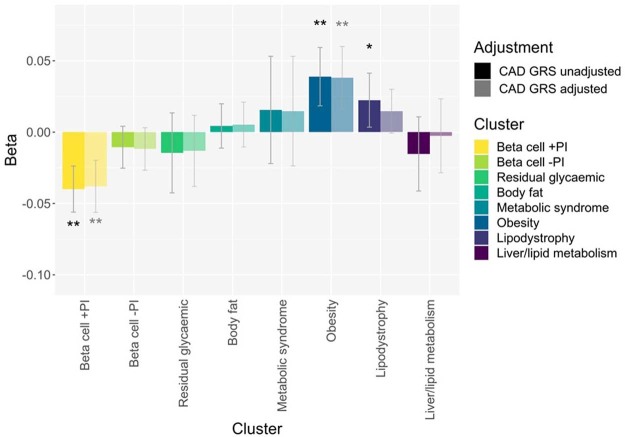
Type 2 diabetes (T2D) is a heterogeneous disease that develops through diverse pathophysiological processes and molecular mechanisms that are often specific to cell type. Here, to characterize the genetic contribution to these processes across ancestry groups, we aggregate genome-wide association study data from 2,535,601 individuals (39.7% not of European ancestry), including 428,452 cases of T2D. We identify 1,289 independent association signals at genome-wide significance (P < 5 × 10) that map to 611 loci, of which 145 loci are, to our knowledge, previously unreported. We define eight non-overlapping clusters of T2D signals that are characterized by distinct profiles of cardiometabolic trait associations. These clusters are differentially enriched for cell-type-specific regions of open chromatin, including pancreatic islets, adipocytes, endothelial cells and enteroendocrine cells. We build cluster-specific partitioned polygenic scores in a further 279,552 individuals of diverse ancestry, including 30,288 cases of T2D, and test their association with T2D-related vascular outcomes. Cluster-specific partitioned polygenic scores are associated with coronary artery disease, peripheral artery disease and end-stage diabetic nephropathy across ancestry groups, highlighting the importance of obesity-related processes in the development of vascular outcomes. Our findings show the value of integrating multi-ancestry genome-wide association study data with single-cell epigenomics to disentangle the aetiological heterogeneity that drives the development and progression of T2D. This might offer a route to optimize global access to genetically informed diabetes care.
2 型糖尿病(T2D)是一种异质性疾病,通过不同的病理生理过程和分子机制发展,这些过程和机制通常特定于细胞类型。在这里,为了描述这些过程在不同祖先群体中的遗传贡献,我们汇总了来自 2535601 个人(39.7%不是欧洲血统)的全基因组关联研究数据,其中包括 428452 例 T2D 病例。我们在全基因组范围内鉴定出 1289 个独立的关联信号,达到了显著水平(P<5×10),这些信号映射到 611 个基因座,其中 145 个基因座是我们以前未报道过的。我们定义了 8 个非重叠的 T2D 信号簇,这些簇的特征是与代谢特征相关的独特模式。这些簇在胰腺胰岛、脂肪细胞、内皮细胞和肠内分泌细胞等特定细胞类型的开放染色质区域中得到了不同程度的富集。我们在 279552 名具有不同祖先的个体中构建了特定于簇的分区多基因评分,其中包括 30288 例 T2D,并测试了它们与 T2D 相关的血管结局的关联。特定于簇的分区多基因评分与冠心病、外周动脉疾病和终末期糖尿病肾病在不同的祖先群体中相关,这突显了肥胖相关过程在血管结局发展中的重要性。我们的研究结果表明,整合多祖先全基因组关联研究数据与单细胞表观基因组学以揭示导致 T2D 发生和进展的病因异质性具有重要价值。这可能为优化全球范围内基于遗传的糖尿病护理提供了一种途径。