Lai Sijia, Jin Qiubai, Wang Dayang, Li Tianli, Wang Xian
Institute of Cardiovascular Disease, Dongzhimen Hospital, Beijing University of Chinese Medicine, Beijing, China.
Guang'anmen Hospital, China Academy of Chinese Medical Sciences, Beijing, China.
Front Endocrinol (Lausanne). 2024 Feb 5;15:1302312. doi: 10.3389/fendo.2024.1302312. eCollection 2024.
Observational studies have demonstrated associations between menstrual disorders, dysmenorrhea, and cardiovascular disease (CVD). However, it remains unclear whether these associations are causal. This study is to investigate whether menstrual disorders and dysmenorrhea causally affect the risk of CVD.
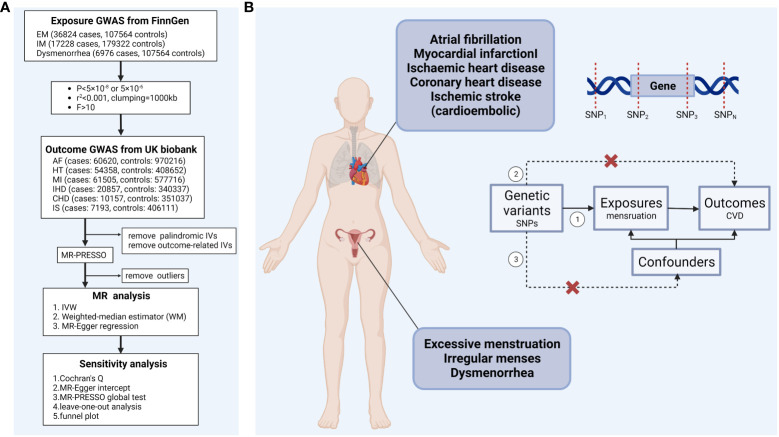
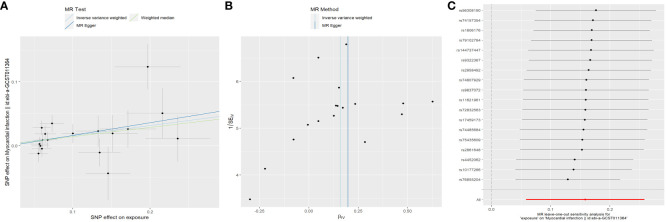
The summary data for menstrual disorders (excessive menstruation and irregular menses) and dysmenorrhea were obtained from FinnGen study, summary data for CVD were obtained from UK Biobank and meta-analysis. The inverse-variance-weighted method was mainly used in the Mendelian randomization for causality analysis. Sensitivity analyses were performed by several methods under different model assumptions.
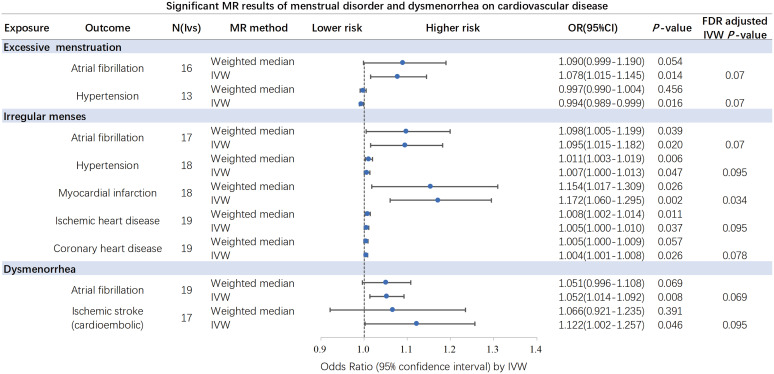
Genetic liability to excessive menstruation was associated with higher risk of atrial fibrillation (odds ratio (OR), 1.078 [95% confidence interval (CI), 1.015-1.145]; =0.014), but a lower risk of hypertension (OR, 0.994 [95% CI: 0.989-0.999]; =0.016). Irregular menses was associated with higher risk of atrial fibrillation (OR, 1.095 [95% CI: 1.015-1.182]; =0.02), hypertension (OR, 1.007 [95% CI: 1.000-1.013]; =0.047), myocardial infarction (OR, 1.172 [95% CI: 1.060-1.295]; =0.02), ischemic heart disease, (OR, 1.005 [95% CI: 1.000-1.010]; =0.037) and coronary heart disease (OR, 1.004 [95% CI: 1.001-1.008]; =0.026). Dysmenorrhea was associated with higher risk of atrial fibrillation (OR, 1.052 [95% CI: 1.014-1.092]; =0.008) and Ischemic stroke (cardioembolic) (OR, 1.122 [95% CI: 1.002-1.257]; =0.046). After Benjamini-Hochberg correction, irregular menses was associated with higher risk of myocardial infarction.
We confirmed a causal relationship of excessive menstruation, irregular menses and dysmenorrhea on cardiovascular outcomes independent of sex hormone levels, with an emphasis on the link between irregular menses and myocardial infarction. These clinical features can be utilized as markers to identify women at higher risk of developing CVD in the future, recommending early clinical intervention of menstrual diseases.
观察性研究已证明月经紊乱、痛经与心血管疾病(CVD)之间存在关联。然而,这些关联是否为因果关系仍不清楚。本研究旨在调查月经紊乱和痛经是否会因果性地影响心血管疾病风险。
月经紊乱(月经过多和月经不调)和痛经的汇总数据来自芬兰基因研究,心血管疾病的汇总数据来自英国生物银行和荟萃分析。在孟德尔随机化因果分析中主要使用逆方差加权法。在不同模型假设下通过多种方法进行敏感性分析。
月经过多的遗传易感性与心房颤动风险较高相关(优势比(OR),1.078 [95%置信区间(CI),1.015 - 1.145];P = 0.014),但与高血压风险较低相关(OR,0.994 [95% CI:0.989 - 0.999];P = 0.016)。月经不调与心房颤动风险较高相关(OR,1.095 [95% CI:1.015 - 1.182];P = 0.02)、高血压(OR,1.007 [95% CI:1.000 - 1.013];P = 0.047)、心肌梗死(OR,1.172 [95% CI:1.060 - 1.295];P = 0.02)、缺血性心脏病(OR,1.005 [95% CI:1.000 - 1.010];P = 0.037)和冠心病(OR,1.