Du Yong, Baumert Jens, Damerow Stefan, Rommel Alexander, Neuhauser Hannelore, Heidemann Christin
Department of Epidemiology and Health Monitoring, Robert Koch Institute, Berlin, Germany.
German Centre for Cardiovascular Research (DZHK), Berlin, Germany.
J Multidiscip Healthc. 2024 Feb 13;17:675-687. doi: 10.2147/JMDH.S445899. eCollection 2024.
Fear of severe acute respiratory syndrome coronavirus 2 (SARS-CoV-2) infection and lockdown measures may have an impact on health care utilization particularly for people with chronic diseases. We investigated changes in outpatient utilization behavior in pandemic phases among people with selected chronic diseases in Germany.
The nationwide population-based telephone surveys German Health Update (GEDA) 2019/2020 (April 2019 to September 2020) and GEDA 2021 (July to December 2021) covered 4 out of 7 pandemic phases from the pre-pandemic to the 4th pandemic wave. Data on hypertension, diabetes and major cardiovascular diseases (CVD) in the past 12 months and visiting a general practitioner (GP) or a specialist (excluding dentist) in the past 4 weeks was collected using a standardized questionnaire. Proportions and odds ratios were derived from logistic regression models adjusted for age, sex, education and federal states.
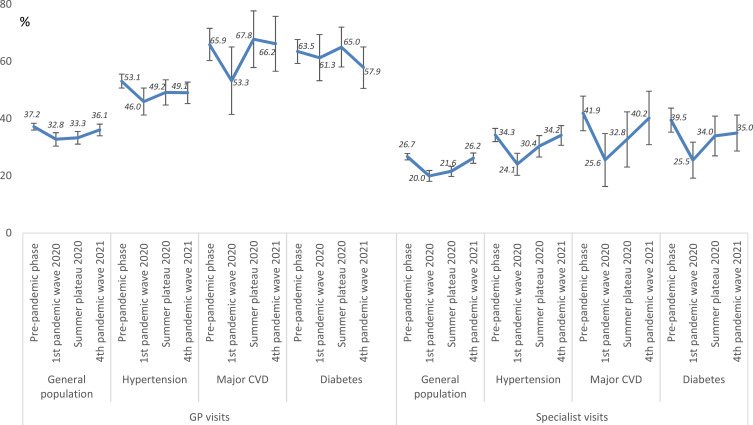
Among 27,967 participants aged ≥16 years, 8,449, 2,497 and 1,136 individuals had hypertension, diabetes and major CVD. Participants with these chronic diseases visited a GP or specialist significantly more often than the overall study population, irrespective of pandemic phases. Compared to the pre-pandemic phase, a significant reduction in specialist-visiting was found in the first pandemic wave among people with hypertension (34.3% vs 24.1%), diabetes (39.5% vs 25.5%) and major CVD (41.9% vs 25.6%). GP-visiting was lower only among people with hypertension (53.0% vs 46.0%). No difference in GP or specialist visiting was found in the 4th pandemic wave compared to the pre-pandemic phase.
The observed decrease particularly in specialist utilization among people with the selected chronic diseases at the beginning of the pandemic was not observed for the second half of 2021 despite the ongoing pandemic. Further studies are required to examine whether the temporary changes in the utilization of ambulatory health care have affected the disease management of people with chronic diseases.
对严重急性呼吸综合征冠状病毒2(SARS-CoV-2)感染的恐惧以及封锁措施可能会对医疗保健利用产生影响,尤其是对患有慢性病的人群。我们调查了德国特定慢性病患者在疫情阶段门诊利用行为的变化。
基于全国人口的电话调查《德国健康更新》(GEDA)2019/2020(2019年4月至2020年9月)和GEDA 2021(2021年7月至12月)涵盖了从疫情前到第四波疫情的7个疫情阶段中的4个。使用标准化问卷收集过去12个月内高血压、糖尿病和主要心血管疾病(CVD)的数据,以及过去4周内拜访全科医生(GP)或专科医生(不包括牙医)的数据。比例和比值比来自经年龄、性别、教育程度和联邦州调整的逻辑回归模型。
在27967名年龄≥16岁的参与者中,8449人、2497人和1136人分别患有高血压、糖尿病和主要心血管疾病。患有这些慢性病的参与者拜访全科医生或专科医生的频率明显高于总体研究人群,且与疫情阶段无关。与疫情前阶段相比,在第一波疫情中,高血压患者(34.3%对24.1%)、糖尿病患者(39.5%对25.5%)和主要心血管疾病患者(41.9%对25.6%)的专科就诊率显著降低。只有高血压患者的全科医生就诊率较低(53.0%对46.0%)。与疫情前阶段相比,第四波疫情中的全科医生或专科医生就诊率没有差异。
尽管疫情仍在持续,但在2021年下半年未观察到疫情开始时所选慢性病患者尤其是专科就诊率的下降情况。需要进一步研究来检查门诊医疗利用的临时变化是否影响了慢性病患者的疾病管理。