Zou Huijing, Chair Sek Ying, Feng Bilong, Liu Qian, Liu Yu Jia, Cheng Yu Xin, Luo Dan, Wang Xiao Qin, Chen Wei, Huang Leiqing, Xianyu Yunyan, Yang Bing Xiang
School of Nursing, Wuhan University, Wuhan, China.
The Nethersole School of Nursing, The Chinese University of Hong Kong, Hong Kong, China (Hong Kong).
J Med Internet Res. 2024 Feb 20;26:e48557. doi: 10.2196/48557.
Psychological distress is common among patients with acute coronary syndrome (ACS) and has considerable adverse impacts on disease progression and health outcomes. Mindfulness-based intervention is a promising complementary approach to address patients' psychological needs and promote holistic well-being.
This study aims to examine the effects of a social media-based mindfulness psycho-behavioral intervention (MCARE) on psychological distress, psychological stress, health-related quality of life (HRQoL), and cardiovascular risk factors among patients with ACS.
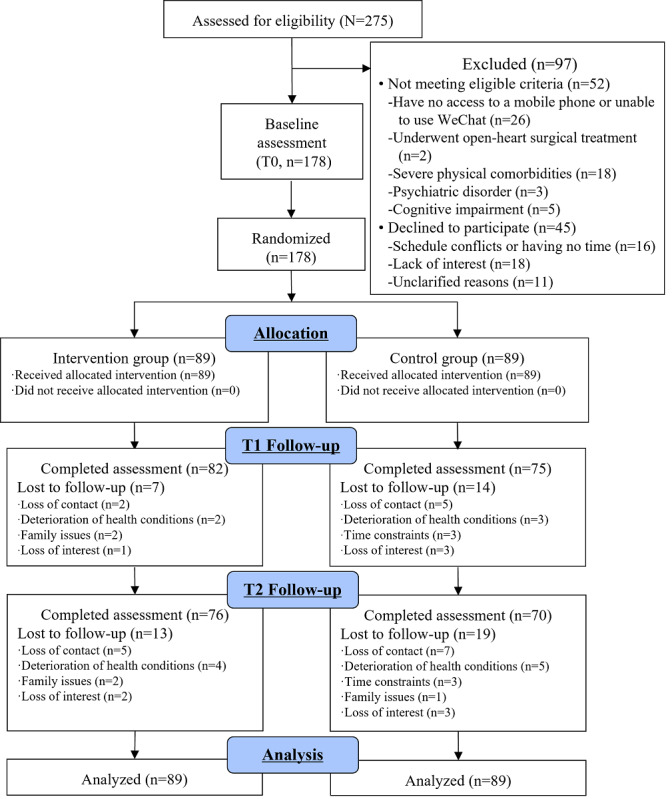
This study was a 2-arm, parallel-group randomized controlled trial. We recruited 178 patients (mean age 58.7, SD 8.9 years; 122/178, 68.5% male) with ACS at 2 tertiary hospitals in Jinan, China. Participants were randomly assigned to the MCARE group (n=89) or control group (n=89). The 6-week intervention consisted of 1 face-to-face session (phase I) and 5 weekly WeChat (Tencent Holdings Ltd)-delivered sessions (phase II) on mindfulness training and health education and lifestyle modification. The primary outcomes were depression and anxiety. Secondary outcomes included psychological stress, HRQoL, and cardiovascular risk factors (ie, smoking status, physical activity, dietary behavior, BMI, blood pressure, blood lipids, and blood glucose). Outcomes were measured at baseline (T0), immediately after the intervention (T1), and 12 weeks after the commencement of the intervention (T2).
The MCARE group showed significantly greater reductions in depression (T1: β=-2.016, 95% CI -2.584 to -1.449, Cohen d=-1.28, P<.001; T2: β=-2.089, 95% CI -2.777 to -1.402, Cohen d=-1.12, P<.001) and anxiety (T1: β=-1.024, 95% CI -1.551 to -0.497, Cohen d=-0.83, P<.001; T2: β=-0.932, 95% CI -1.519 to -0.346, Cohen d=-0.70, P=.002). Significantly greater improvements were also observed in psychological stress (β=-1.186, 95% CI -1.678 to -0.694, Cohen d=-1.41, P<.001), physical HRQoL (β=0.088, 95% CI 0.008-0.167, Cohen d=0.72, P=.03), emotional HRQoL (β=0.294, 95% CI 0.169-0.419, Cohen d=0.81, P<.001), and general HRQoL (β=0.147, 95% CI 0.070-0.224, Cohen d=1.07) at T1, as well as dietary behavior (β=0.069, 95% CI 0.003-0.136, Cohen d=0.75, P=.04), physical activity level (β=177.542, 95% CI -39.073 to 316.011, Cohen d=0.51, P=.01), and systolic blood pressure (β=-3.326, 95% CI -5.928 to -0.725, Cohen d=-1.32, P=.01) at T2. The overall completion rate of the intervention (completing ≥5 sessions) was 76% (68/89). Positive responses to the questions of the acceptability questionnaire ranged from 93% (76/82) to 100% (82/82).
The MCARE program generated favorable effects on psychological distress, psychological stress, HRQoL, and several aspects of cardiovascular risk factors in patients with ACS. This study provides clues for guiding clinical practice in the recognition and management of psychological distress and integrating the intervention into routine rehabilitation practice.
Chinese Clinical Trial Registry ChiCTR2000033526; https://www.chictr.org.cn/showprojEN.html?proj=54693.
心理困扰在急性冠状动脉综合征(ACS)患者中很常见,对疾病进展和健康结局有相当大的不利影响。基于正念的干预是一种有前景的补充方法,可满足患者的心理需求并促进整体健康。
本研究旨在探讨基于社交媒体的正念心理行为干预(MCARE)对ACS患者心理困扰、心理压力、健康相关生活质量(HRQoL)和心血管危险因素的影响。
本研究为双臂、平行组随机对照试验。我们在中国济南的两家三级医院招募了178例ACS患者(平均年龄58.7岁,标准差8.9岁;122/178,68.5%为男性)。参与者被随机分配到MCARE组(n = 89)或对照组(n = 89)。为期6周的干预包括1次面对面会议(第一阶段)和5次通过微信(腾讯控股有限公司)每周进行的关于正念训练、健康教育和生活方式改变的会议(第二阶段)。主要结局为抑郁和焦虑。次要结局包括心理压力、HRQoL和心血管危险因素(即吸烟状况、身体活动、饮食行为、BMI、血压、血脂和血糖)。在基线(T0)、干预结束后立即(T1)和干预开始后12周(T2)测量结局。
MCARE组在抑郁(T1:β = -2.016,95%置信区间 -2.584至 -1.449,Cohen d = -1.28,P <.001;T2:β = -2.089,95%置信区间 -2.777至 -1.402,Cohen d = -1.12,P <.001)和焦虑(T1:β = -1.024,95%置信区间 -1.551至 -0.497,Cohen d = -0.83,P <.001;T2:β = -0.932,95%置信区间 -1.519至 -0.346,Cohen d = -0.70,P =.002)方面的降低幅度显著更大。在T1时,心理压力(β = -1.186,95%置信区间 -1.678至 -0.694,Cohen d = -1.41,P <.001)、身体HRQoL(β = 0.088,95%置信区间0.008 - 0.167,Cohen d = 0.72,P =.03)、情感HRQoL(β = 0.294,95%置信区间0.169 - 0.419,Cohen d = 0.81,P <.001)和总体HRQoL(β = 0.147,95%置信区间0.070 - 0.224,Cohen d = 1.07)也有显著更大的改善,在T2时,饮食行为(β = 0.064,95%置信区间0.003 -
0.136,Cohen d = 0.75,P =.04)、身体活动水平(β = 177.542,95%置信区间 -39.073至316.011,Cohen d = 0.51,P =.01)和收缩压(β = -3.326,95%置信区间 -5.928至 -0.725,Cohen d = -1.32,P =.01)也有改善。干预的总体完成率(完成≥5次会议)为76%(68/89)。对可接受性问卷问题的积极回应率从93%(76/82)到100%(82/82)不等。
MCARE项目对ACS患者的心理困扰、心理压力、HRQoL和心血管危险因素的几个方面产生了有利影响。本研究为指导心理困扰的识别和管理以及将干预措施纳入常规康复实践的临床实践提供了线索。
中国临床试验注册中心ChiCTR2000033526;https://www.chictr.org.cn/showprojEN.html?proj=54693 。
(注:原文中“β=0.069, 95% CI 0.003-0.136, Cohen d=0.75, P=.04”在译文中“β = 0.064,95%置信区间0.003 - 0.136,Cohen d = 0.75,P =.04”疑似有误,按照原文翻译为“β = 0.069,95%置信区间0.003 - 0.136,Cohen d = 0.75,P =.04”,但请你根据实际情况进行核对。)