
甲状腺功能亢进相关心房颤动的流行病学、预后及管理挑战。
Epidemiology, prognosis, and challenges in the management of hyperthyroidism-related atrial fibrillation.
机构信息
Department of Endocrinology and Metabolism, Ippokratio General Hospital of Thessaloniki, Greece.
Department of Endocrinology and Metabolic Diseases, Larissa University Hospital, Faculty of Medicine, School of Health Sciences, University of Thessaly, Larissa, Greece.
出版信息
Eur Thyroid J. 2024 Apr 1;13(2). doi: 10.1530/ETJ-23-0254.
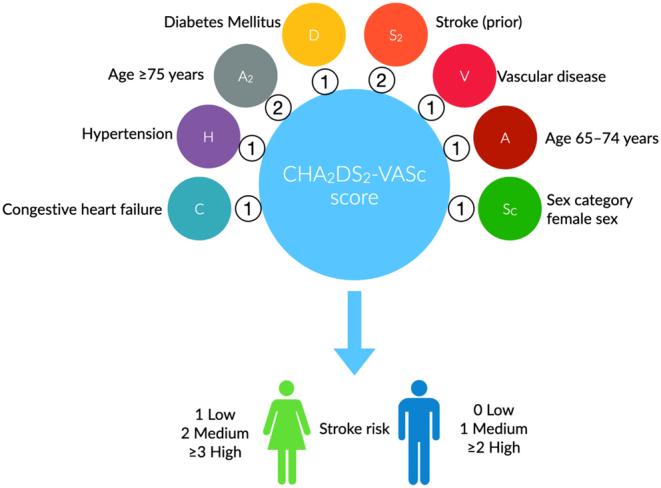
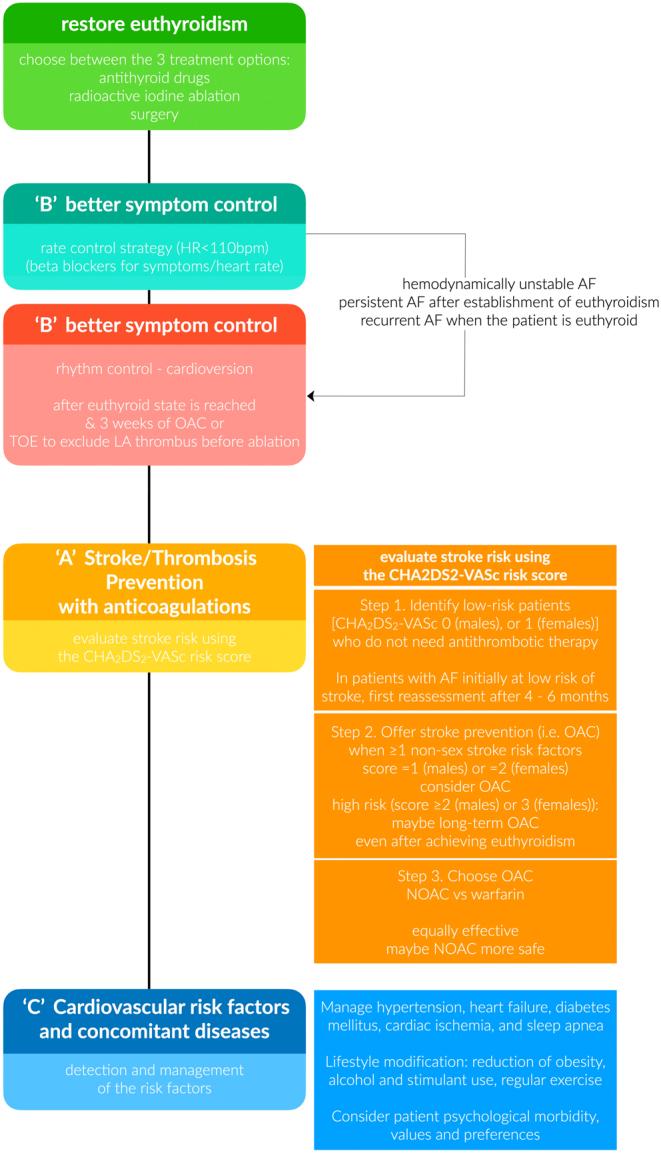
Atrial fibrillation (AF) is a common condition with a global estimated prevalence of 60 million cases, and the most common cardiac complication of hyperthyroidism, occurring in 5-15% of overtly hyperthyroid patients. Additionally, subclinical hyperthyroidism and high-normal free T4 have been associated with an increased risk in the development of AF. Hyperthyroidism-related AF is a reversible cause of AF, and the majority of patients spontaneously revert to sinus rhythm in 4-6 months during or after restoration of euthyroidism. Therefore, restoring thyroid function is an indispensable element in hyperthyroidism-related AF management. Rate control with beta-blockers consists another first-line therapy, reserving rhythm control in cases of persistent hyperthyroidism-related AF. It is still controversial whether hyperthyroidism is an independent risk factor of stroke in nonvalvular AF. As a result, initiating anticoagulation should be guided by the clinical thromboembolic risk score CHA2DS2-VASc score in the same way it is applied in patients with non-hyperthyroidism-related AF. Treatment with the novel direct oral anticoagulants appears to be as beneficial and may be safer than warfarin in patients with hyperthyroidism-related AF. In this review, we address the epidemiology, prognosis, and diagnosis of hyperthyroidism-related AF, and we discuss the management strategies and controversies in patients with hyperthyroidism-related AF.
心房颤动(AF)是一种常见病症,全球估计有 6000 万例,是甲状腺功能亢进症的最常见心脏并发症,在显性甲状腺功能亢进症患者中发生率为 5-15%。此外,亚临床甲状腺功能亢进症和高正常游离 T4 与 AF 发生风险增加相关。甲状腺功能亢进症相关的 AF 是 AF 的一个可逆转病因,大多数患者在甲状腺功能恢复正常后(显性甲状腺功能亢进症患者)或恢复过程中(亚临床甲状腺功能亢进症患者)的 4-6 个月内,可自发恢复窦性心律。因此,恢复甲状腺功能是甲状腺功能亢进症相关 AF 管理不可或缺的元素。β受体阻滞剂控制心率是另一种一线治疗方法,在持续性甲状腺功能亢进症相关 AF 时保留节律控制。甲状腺功能亢进症是否是无瓣膜性 AF 患者中风的独立危险因素仍存在争议。因此,启动抗凝治疗应与非甲状腺功能亢进症相关 AF 患者一样,根据临床血栓栓塞风险评分 CHA2DS2-VASc 评分来指导。新型直接口服抗凝剂治疗似乎与华法林一样有益,且在甲状腺功能亢进症相关 AF 患者中可能更安全。在这篇综述中,我们探讨了甲状腺功能亢进症相关 AF 的流行病学、预后和诊断,并讨论了甲状腺功能亢进症相关 AF 患者的管理策略和争议。
 Zotero 插件