Department of Oncology, Second Affiliated Hospital of Harbin Medical University, Harbin.
Department of Oncology, Heilongjiang Sengong General Hospital, Harbin, People's Republic of China.
ESMO Open. 2024 Apr;9(4):102384. doi: 10.1016/j.esmoop.2024.102384. Epub 2024 Feb 19.
This study aimed to evaluate the efficacy and safety of intrathecal pemetrexed (IP) for treating patients with leptomeningeal metastases (LM) from non-small-cell lung cancer (NSCLC) who progressed from epidermal growth factor receptor (EGFR)-tyrosine kinase inhibitor (TKI) treatment in an expanded, prospective, single-arm, phase II clinical study (ChiCTR1800016615).
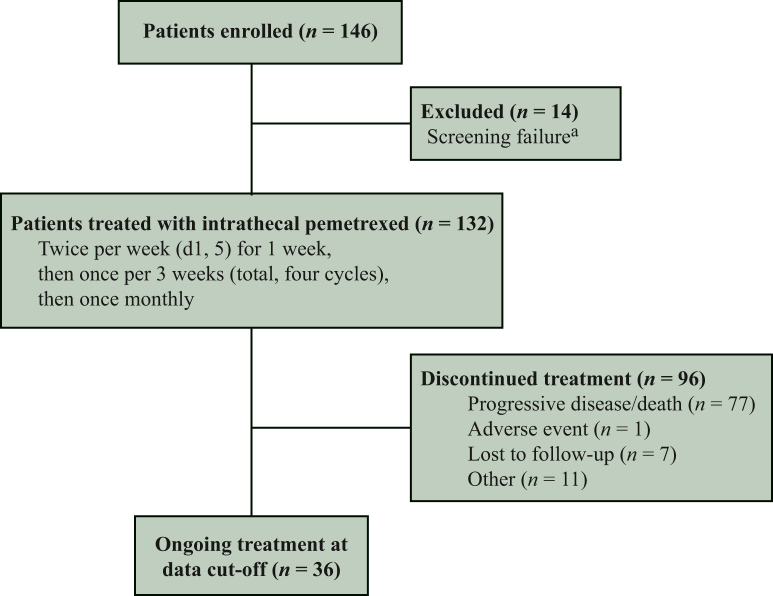
Patients with confirmed NSCLC-LM who progressed from TKI received IP (50 mg, day 1/day 5 for 1 week, then every 3 weeks for four cycles, and then once monthly) until disease progression or intolerance. Objectives were to assess overall survival (OS), response rate, and safety. Measurable lesions were assessed by investigator according to RECIST version 1.1. LM were assessed according to the Response Assessment in Neuro-Oncology (RANO) criteria.
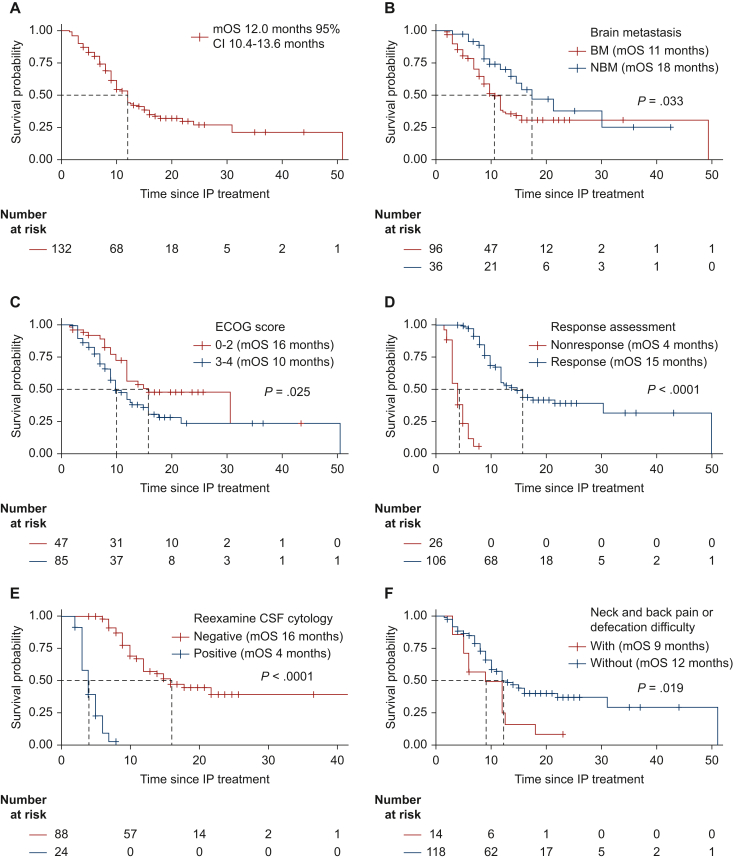
The study included 132 patients; 68% were female and median age was 52 years (31-74 years). The median OS was 12 months (95% confidence interval 10.4-13.6 months), RANO-assessed response rate was 80.3% (106/132), and the most common adverse event was myelosuppression (n = 42; 31.8%), which reversed after symptomatic treatment. The results of subgroup analysis showed that absence of brain parenchymal metastasis, good Eastern Cooperative Oncology Group score, good response to IP treatment, negative cytology after treatment, and patients without neck/back pain/difficult defecation had longer survival. Gender, age, previous intrathecal methotrexate/cytarabine, and whole-brain radiotherapy had no significant influence on OS.
This study further showed that IP is an effective and safe treatment method for the EGFR-TKI-failed NSCLC-LM, and should be recommended for these patients in clinical practice and guidelines.
本研究旨在评估鞘内注射培美曲塞(IP)治疗表皮生长因子受体(EGFR)-酪氨酸激酶抑制剂(TKI)治疗后进展的非小细胞肺癌(NSCLC)患者脑膜转移(LM)的疗效和安全性。在一项扩大的、前瞻性、单臂、II 期临床研究(ChiCTR1800016615)中。
经证实患有 NSCLC-LM 且经 TKI 治疗后进展的患者接受 IP(50 mg,第 1 天/第 5 天,每周 1 次,连用 4 个周期,然后每月 1 次)治疗,直至疾病进展或不耐受。主要终点为总生存期(OS)、缓解率和安全性。可测量病灶由研究者根据 RECIST 版本 1.1 进行评估。LM 根据反应评估神经肿瘤学(RANO)标准进行评估。
该研究纳入 132 例患者;68%为女性,中位年龄为 52 岁(31-74 岁)。中位 OS 为 12 个月(95%置信区间 10.4-13.6 个月),RANO 评估的缓解率为 80.3%(106/132),最常见的不良反应是骨髓抑制(n=42;31.8%),经对症治疗后逆转。亚组分析结果显示,无脑实质转移、ECOG 评分良好、IP 治疗反应良好、治疗后细胞学检查阴性、无颈部/背部疼痛/排便困难的患者生存期更长。性别、年龄、既往鞘内甲氨蝶呤/阿糖胞苷和全脑放疗对 OS 无显著影响。
本研究进一步表明,IP 是 EGFR-TKI 失败的 NSCLC-LM 的一种有效且安全的治疗方法,应在临床实践和指南中推荐给此类患者。