191599Department of Medical Oncology, The First Affiliated Hospital of Zhengzhou University, Zhengzhou, Henan Province, China.
Technol Cancer Res Treat. 2022 Jan-Dec;21:15330338221078429. doi: 10.1177/15330338221078429.
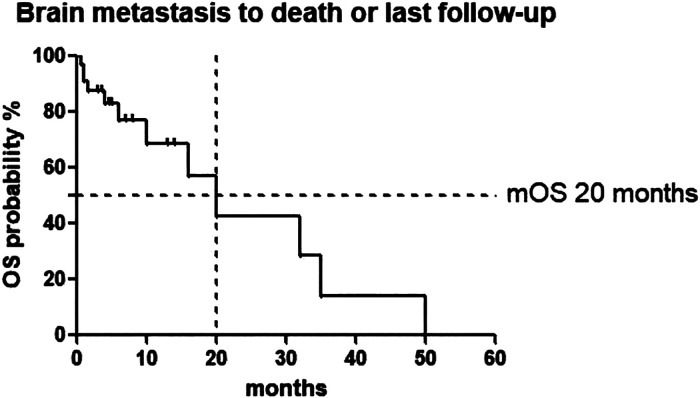
This retrospective study aimed to investigate the clinical features of lung cancer patients with leptomeningeal metastasis (LM) and explore the clinical efficacy and tolerance of intrathecal pemetrexed (IP) combined with systemic antitumor therapy. Thirty-four lung cancer patients (11 men, 23 women) with LM receiving IP at our hospital were retrospectively reviewed between August 2018 and December 2019. Identified cases showed either positive cerebrospinal fluid cytology or typical findings (leptomeningeal enhancement or ventricle broadening) upon imaging examination. Before the diagnosis of LM, 24 (70.6%) patients received EGFR-TKI therapy with or without other agents (antivascular therapy, or chemotherapy), 5 (14.7%) patients received chemotherapy, 1 (2.9%) patient received antivascular therapy, and 3 (8.8%) patients received ALK inhibitors. Fourteen (41.2%) patients did not change the systematic regimen at the beginning of IP, while 20 (58.8%) patients changed to antitumor agents. IP was administered for a median of 3 times (range, 1-12 times). The IP dose was 15, 20, 25, 30, and 40 mg in 8 (23.5%), 21 (58.8%), 2 (5.9%), 2 (5.9%), and 1 (5.9%) patient, respectively. In all IP dose levels, the major adverse events were myelosuppression and elevation of hepatic aminotransferases (EHA). Grade 1/2 myelosuppression occurred in 4 (11.8%) patients. Grade 1/2 EHA also occurred in 4 (11.8%) patients. Grades 3/4 adverse events were not observed. After IP and systematic therapy, the clinical manifestations related to LM in 26 (76.5%) patients improved. In the whole cohort, the median overall survival was 20 months. The median time from the initial IP administration until death or the last follow-up was 3.5 months. IP showed controllable toxicity and good efficacy, prolonged the survival time, and improved the quality of life when combined with tailored systemic antitumor therapy in lung cancer patients.
本回顾性研究旨在探讨肺癌脑膜转移(LM)患者的临床特征,并探讨鞘内培美曲塞(IP)联合全身抗肿瘤治疗的临床疗效和耐受性。 2018 年 8 月至 2019 年 12 月,我院对 34 例接受 IP 治疗的 LM 肺癌患者进行了回顾性分析。确诊病例在影像学检查中显示脑脊液细胞学阳性或有典型表现(软脑膜增强或脑室扩大)。 在诊断为 LM 之前,24 例(70.6%)患者接受了 EGFR-TKI 治疗,联合或不联合其他药物(抗血管治疗或化疗),5 例(14.7%)患者接受了化疗,1 例(2.9%)患者接受了抗血管治疗,3 例(8.8%)患者接受了 ALK 抑制剂治疗。14 例(41.2%)患者在开始 IP 治疗时未改变全身治疗方案,20 例(58.8%)患者更换为抗肿瘤药物。IP 中位治疗次数为 3 次(范围,1-12 次)。IP 剂量为 8 例(23.5%)患者为 15mg,21 例(58.8%)患者为 20mg,2 例(5.9%)患者为 25mg,2 例(5.9%)患者为 30mg,1 例(5.9%)患者为 40mg。在所有 IP 剂量水平中,主要不良反应为骨髓抑制和肝氨基转移酶升高(EHA)。4 例(11.8%)患者发生 1/2 级骨髓抑制。4 例(11.8%)患者也发生了 1/2 级 EHA。未观察到 3/4 级不良事件。在 IP 和系统治疗后,26 例(76.5%)患者与 LM 相关的临床表现得到改善。在整个队列中,中位总生存期为 20 个月。从初始 IP 给药到死亡或最后一次随访的中位时间为 3.5 个月。 IP 联合个体化全身抗肿瘤治疗在肺癌患者中具有可控的毒性和良好的疗效,可延长生存时间,提高生活质量。