Ding Dandan, Xu Chenguang, Zhang Jufeng, Zhang Ying, Xue Lipeng, Song Jingjing, Luo Zhiming, Hong Xiaoyu, Wang Jian, Liang Weicheng, Xue Xingyang
Department of Thoracic Surgery, Affiliated Cancer Hospital & Institute of Guangzhou Medical University, Guangzhou, 510095, China; First People's Hospital of Foshan, Foshan, 528000, China.
Affiliated Cancer Hospital and Institute of Guangzhou Medical University, Guangzhou, 510182, China; Key Laboratory for Cell Homeostasis and Cancer Research of Guangdong Higher Education Institutes, Guangzhou, 510182, China.
Transl Oncol. 2024 May;43:101895. doi: 10.1016/j.tranon.2024.101895. Epub 2024 Feb 19.
Osimertinib, a third-generation epidermal growth factor receptor-tyrosine kinase inhibitor (EGFR-TKI), is the preferred treatment for EGFR-mutated lung cancer. However, acquired resistance inevitably develops. While non-coding RNAs have been implicated in lung cancer through various functions, the molecular mechanisms responsible for osimertinib resistance remain incompletely elucidated.
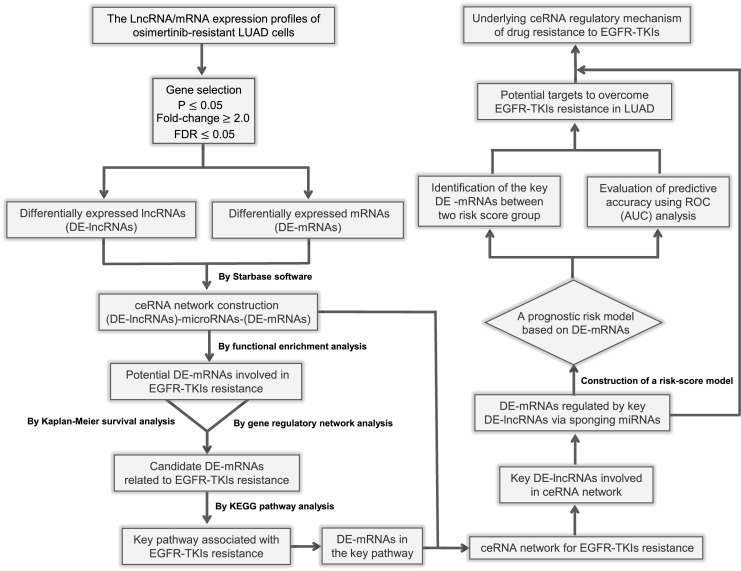
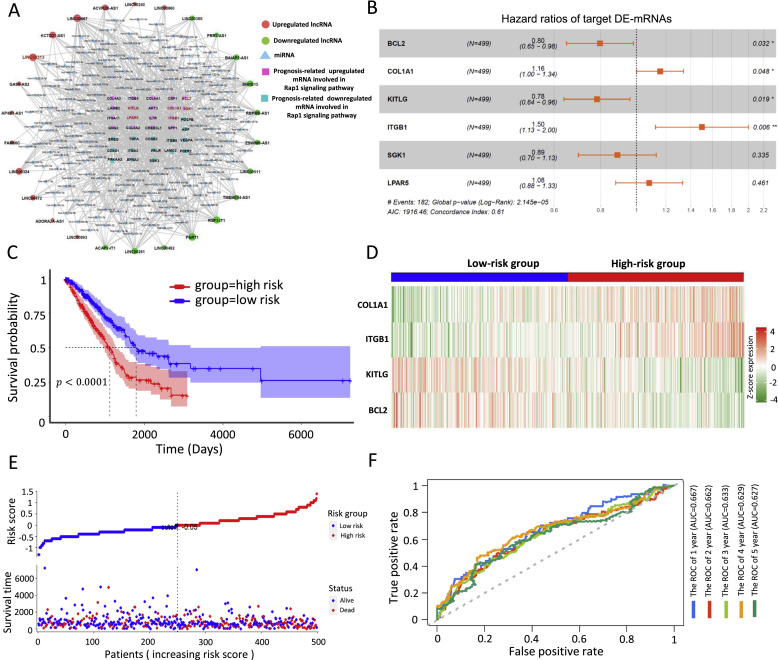
RNA-sequencing technology was employed to determine differentially expressed lncRNAs (DE-lncRNAs) and mRNAs (DE-mRNAs) between H1975 and H1975OR cell lines. Starbase 2.0 was utilized to predict DE-lncRNA and DE-mRNA interactions, constructing ceRNA networks. Subsequently, functional and pathway enrichment analysis were performed on target DE-mRNAs to identify pathways associated with osimertinib resistance. Key target DE-mRNAs were then selected as potential risk signatures for lung adenocarcinoma (LUAD) prognostic modeling using multivariate Cox regression analyses. The Quantitative Real-Time Polymerase Chain Reaction (qRT-PCR) and immunohistochemistry staining were used for result validation.
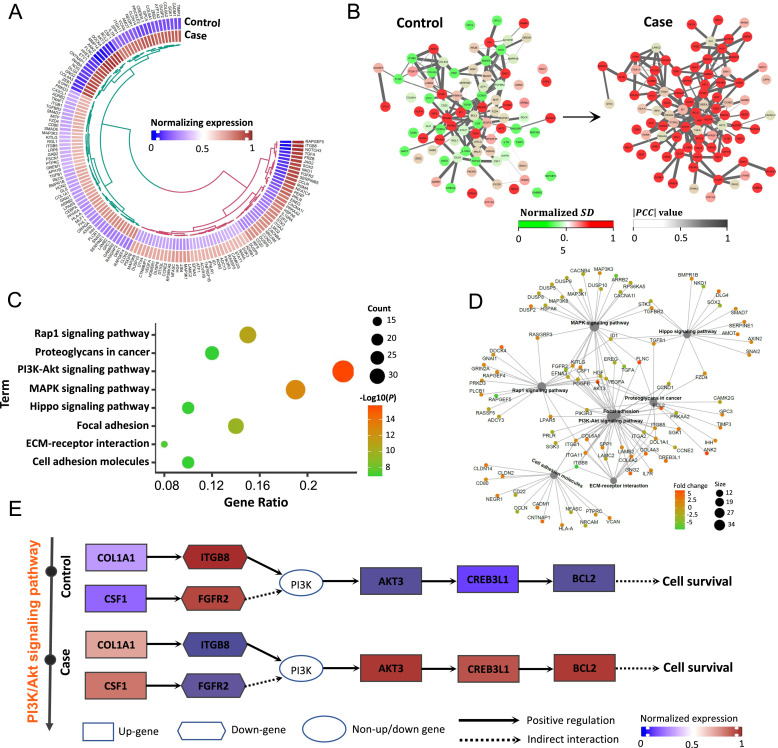
Functional analysis revealed that the identified DE-mRNAs primarily enriched in EGFR-TKI resistance pathways, especially in the PI3K/Akt signaling pathway, where their concerted actions may lead to osimertinib resistance. Specifically, upregulation of LINC00313 enhanced COL1A1 expression by acting as a miR-218-5p sponge, triggering an upstream response that activates the PI3K/Akt pathway, potentially contributing to osimertinib resistance. Furthermore, the expressions of LINC00313 and COL1A1 were validated by qRT-PCR, and the activation of the PI3K/Akt pathway was confirmed by immunohistochemistry staining.
Our results suggest that the LINC00313/miR-218-5p/COL1A1 axis potentially contributes to osimertinib resistance through the PI3K/Akt signaling pathway, providing novel insights into the molecular mechanisms underlying acquired osimertinib resistance in LUAD. Additionally, our study may aid in the identification of potential therapeutic targets for overcoming resistance to osimertinib.
奥希替尼是第三代表皮生长因子受体酪氨酸激酶抑制剂(EGFR-TKI),是EGFR突变型肺癌的首选治疗药物。然而,不可避免地会出现获得性耐药。虽然非编码RNA通过多种功能参与肺癌的发生发展,但其导致奥希替尼耐药的分子机制仍未完全阐明。
采用RNA测序技术确定H1975和H1975OR细胞系之间差异表达的长链非编码RNA(DE-lncRNAs)和信使核糖核酸(DE-mRNAs)。利用Starbase 2.0预测DE-lncRNA和DE-mRNA的相互作用,构建竞争性内源RNA(ceRNA)网络。随后,对目标DE-mRNAs进行功能和通路富集分析,以确定与奥希替尼耐药相关的通路。然后,使用多变量Cox回归分析选择关键目标DE-mRNAs作为肺腺癌(LUAD)预后模型的潜在风险标志物。采用定量实时聚合酶链反应(qRT-PCR)和免疫组织化学染色进行结果验证。
功能分析表明,鉴定出的DE-mRNAs主要富集于EGFR-TKI耐药通路,尤其是PI3K/Akt信号通路,它们的协同作用可能导致奥希替尼耐药。具体而言,LINC00313的上调通过充当miR-218-5p海绵增强了COL1A1的表达,触发了激活PI3K/Akt通路的上游反应,可能导致奥希替尼耐药。此外,通过qRT-PCR验证了LINC00313和COL1A1的表达,并通过免疫组织化学染色证实了PI3K/Akt通路的激活。
我们的结果表明,LINC00313/miR-218-5p/COL1A1轴可能通过PI3K/Akt信号通路导致奥希替尼耐药,为LUAD中获得性奥希替尼耐药的分子机制提供了新的见解。此外,我们的研究可能有助于识别克服奥希替尼耐药的潜在治疗靶点。