Department of Medicine, Division of Pulmonary, Critical Care, Allergy, Sleep and Occupational Medicine, Indiana University School of Medicine, 1120 W. Michigan St, Gatch Hall, CL 290B, Indianapolis, IN, 46202, USA.
Roudebush VA Medical Center, Center for Health Information and Communication, Indianapolis, IN, USA.
Respir Res. 2024 Feb 20;25(1):92. doi: 10.1186/s12931-024-02735-z.
Interstitial lung disease encompasses a group of rare lung conditions causing inflammation and scarring of lung tissue. The typical method of monitoring disease activity is through pulmonary function tests performed in a hospital setting. However, accessing care can be difficult for rural patients due to numerous barriers. This study assesses the feasibility and acceptability of home spirometry telemonitoring using MIR-Spirometers and the patientMpower home-monitoring platform for rural patients with interstitial lung disease.
Unblinded, uncontrolled, prospective, multiple-methods study of the feasibility and utility of remote monitoring of 20 rural subjects with interstitial lung disease. Study assessments include adherence to twice weekly spirometry for 3 months in addition to mMRC dyspnea and EQ-5D-5L health-related quality of life questionnaires with each spirometry maneuver. Upon completion, subjects were encouraged to complete an 11-question satisfaction survey and participate in semi-structured qualitative interviews to further explore expectations and perceptions of rural patients to telehealth and remote patient monitoring.
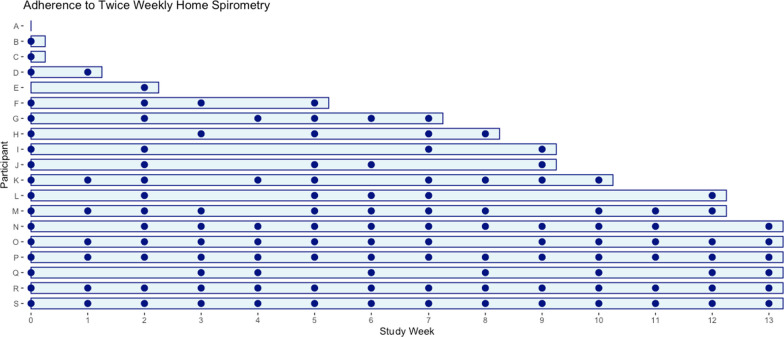
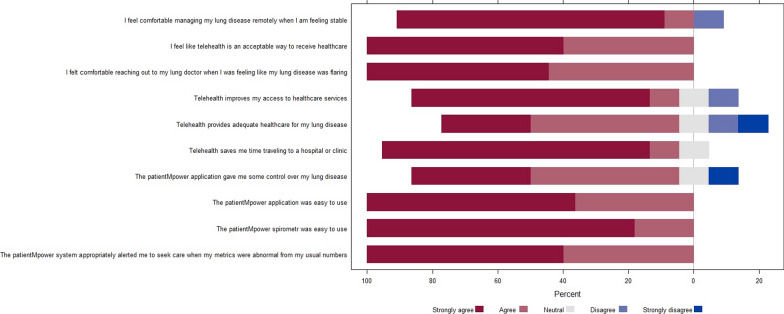
19 subjects completed the 3-month study period. Adherence to twice weekly spirometry was mean 53% ± 38%, with participants on average performing 2.26 ± 1.69 maneuvers per week. The median (Range) number of maneuvers per week was 2.0 (0.0, 7.0). The majority of participants responded favorably to the patient satisfaction survey questions. Themes regarding barriers to access included: lack of local specialty care, distance to center with expertise, and time, distance, and high cost associated with travel. Remote monitoring was well perceived amongst subjects as a way to improve access and overcome barriers.
Remote spirometry monitoring through web-based telehealth is acceptable and feasible for rural patients. Perceived benefits include overcoming access barriers like time, distance, and travel costs. However, cost, reimbursement, and internet access must be addressed before implementing it widely. Future studies are needed to ensure long-term feasibility and to compare outcomes with usual care.
间质性肺疾病包括一组罕见的肺部疾病,导致肺部组织炎症和瘢痕形成。监测疾病活动的典型方法是在医院环境中进行肺功能测试。然而,由于存在许多障碍,农村患者获得医疗服务可能会遇到困难。本研究评估了使用 MIR 测肺仪和 patientMpower 家庭监测平台对农村间质性肺疾病患者进行家庭肺量计远程监测的可行性和可接受性。
对 20 名农村间质性肺疾病患者进行了为期 3 个月的、非盲、非对照、前瞻性、多方法研究,以评估远程监测的可行性和实用性。研究评估包括在 3 个月内每周进行两次肺量计检查,同时进行 mMRC 呼吸困难和 EQ-5D-5L 健康相关生活质量问卷,每次肺量计检查都要进行问卷评估。完成后,鼓励受试者完成 11 个满意度调查问题,并参与半结构化定性访谈,以进一步探讨农村患者对远程医疗和远程患者监测的期望和看法。
19 名受试者完成了 3 个月的研究。每周进行两次肺量计检查的平均依从率为 53%±38%,参与者平均每周进行 2.26±1.69 次检查。每周的检查次数中位数(范围)为 2.0(0.0,7.0)。大多数参与者对患者满意度调查问题的回答是肯定的。关于获得医疗服务障碍的主题包括:缺乏当地专科医疗服务、距离有专业知识的中心较远、以及与旅行相关的时间、距离和高费用。远程监测在受试者中被很好地认为是改善获得医疗服务机会和克服障碍的一种方式。
通过基于网络的远程医疗进行远程肺量计监测对农村患者是可接受和可行的。感知到的益处包括克服时间、距离和旅行费用等获得医疗服务的障碍。然而,在广泛实施之前,必须解决成本、报销和互联网接入问题。需要进一步的研究来确保长期可行性,并比较远程监测与常规护理的结果。