
一种用于建模东非血吸虫病主要中间宿主发生情况的机器学习方法。
A machine learning approach for modeling the occurrence of the major intermediate hosts for schistosomiasis in East Africa.
机构信息
Department of Animal Ecology and Systematics, Justus Liebig University Giessen, Heinrich-Buff-Ring 26 (iFZ), 35392, Giessen, Germany.
Institute for Landscape Ecology and Resource Management, Justus Liebig University Giessen, Heinrich-Buff-Ring 26 (iFZ), 35392, Giessen, Germany.
出版信息
Sci Rep. 2024 Feb 21;14(1):4274. doi: 10.1038/s41598-024-54699-1.
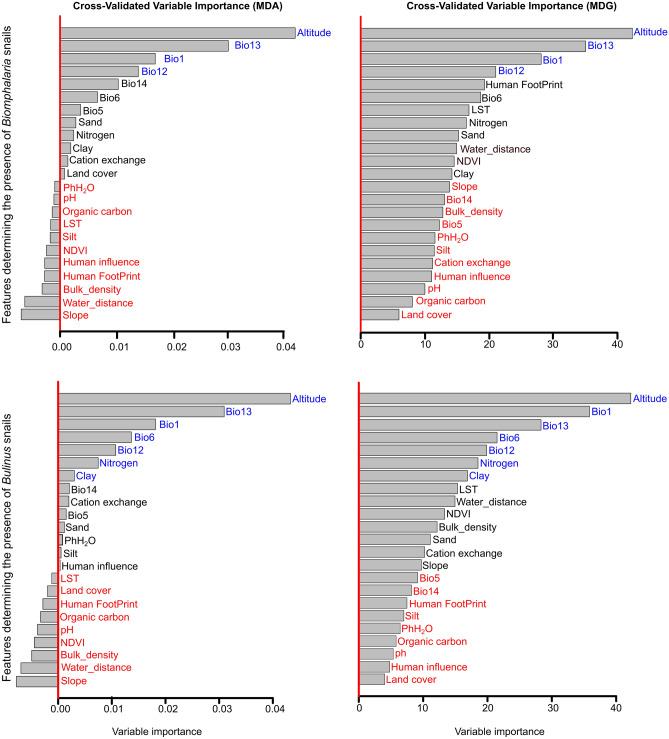
Schistosomiasis, a prevalent water-borne disease second only to malaria, significantly impacts impoverished rural communities, primarily in Sub-Saharan Africa where over 90% of the severely affected population resides. The disease, majorly caused by Schistosoma mansoni and S. haematobium parasites, relies on freshwater snails, specifically Biomphalaria and Bulinus species, as crucial intermediate host (IH) snails. Targeted snail control is advisable, however, there is still limited knowledge about the community structure of the two genera especially in East Africa. Utilizing a machine learning approach, we employed random forest to identify key features influencing the distribution of both IH snails in this region. Our results reveal geography and climate as primary factors for Biomphalaria, while Bulinus occurrence is additionally influenced by soil clay content and nitrogen concentration. Favorable climate conditions indicate a high prevalence of IHs in East Africa, while the intricate connection with geography might signify either dispersal limitations or environmental filtering. Predicted probabilities demonstrate non-linear patterns, with Bulinus being more likely to occur than Biomphalaria in the region. This study provides foundational framework insights for targeted schistosomiasis prevention and control strategies in the region, assisting health workers and policymakers in their efforts.
血吸虫病是一种流行的水传播疾病,仅次于疟疾,严重影响贫困的农村社区,主要在撒哈拉以南非洲,那里超过 90%的重病人口居住。这种疾病主要由曼氏血吸虫和埃及血吸虫寄生虫引起,依赖淡水蜗牛,特别是 B. glabrata 和 B. forskalii 物种,作为关键的中间宿主 (IH) 蜗牛。建议进行有针对性的蜗牛控制,但对于这两个属的群落结构,特别是在东非,仍然知之甚少。我们利用机器学习方法,采用随机森林来识别影响该地区两种 IH 蜗牛分布的关键特征。我们的结果表明,地理和气候是 B. glabrata 的主要因素,而 B. forskalii 的出现还受到土壤粘粒含量和氮浓度的影响。有利的气候条件表明东非 IH 的流行率很高,而与地理的复杂联系可能表明扩散限制或环境过滤。预测概率显示出非线性模式,B. forskalii 在该地区比 B. glabrata 更有可能出现。这项研究为该地区有针对性的血吸虫病预防和控制策略提供了基础框架见解,帮助卫生工作者和政策制定者努力。

 Zotero 插件