Manyangadze Tawanda, Chimbari Moses John, Gebreslasie Michael, Ceccato Pietro, Mukaratirwa Samson
Department of Public Health Medicine University of KwaZulu-Natal, School of Nursing and Public Health, Durban, South Africa.
School of Agriculture, Earth and Environmental Sciences, University of KwaZulu-Natal, Westville, Durban, South Africa.
Parasit Vectors. 2016 Nov 4;9(1):572. doi: 10.1186/s13071-016-1834-5.
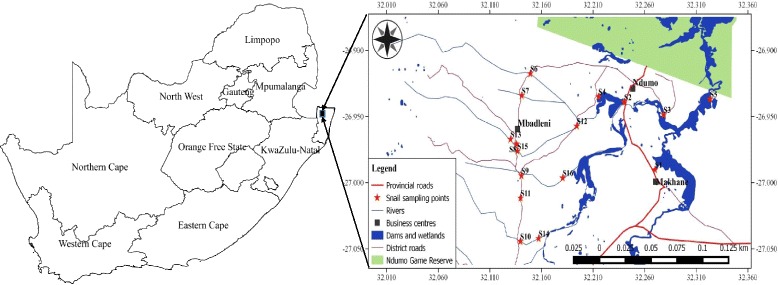
Schistosomiasis is a snail-borne disease endemic in sub-Saharan Africa transmitted by freshwater snails. The distribution of schistosomiasis coincides with that of the intermediate hosts as determined by climatic and environmental factors. The aim of this paper was to model the spatial and seasonal distribution of suitable habitats for Bulinus globosus and Biomphalaria pfeifferi snail species (intermediate hosts for Schistosoma haematobium and Schistosoma mansoni, respectively) in the Ndumo area of uMkhanyakude district, South Africa.
Maximum Entropy (Maxent) modelling technique was used to predict the distribution of suitable habitats for B. globosus and B. pfeifferi using presence-only datasets with ≥ 5 and ≤ 12 sampling points in different seasons. Precipitation, maximum and minimum temperatures, Normalised Difference Vegetation Index (NDVI), Normalised Difference Water Index (NDWI), pH, slope and Enhanced Vegetation Index (EVI) were the background variables in the Maxent models. The models were validated using the area under the curve (AUC) and omission rate.
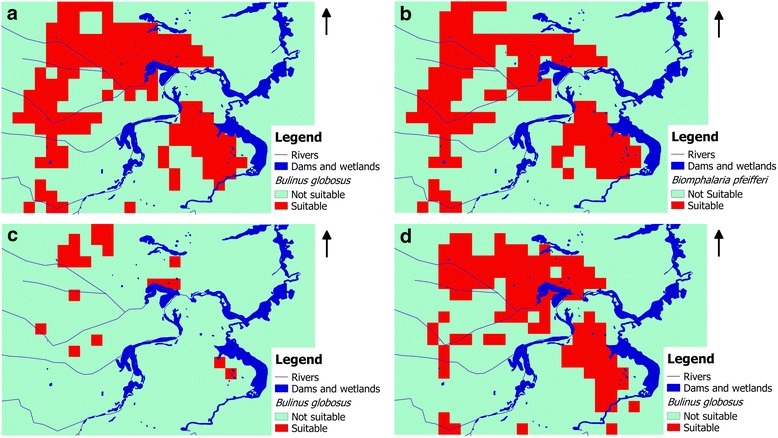
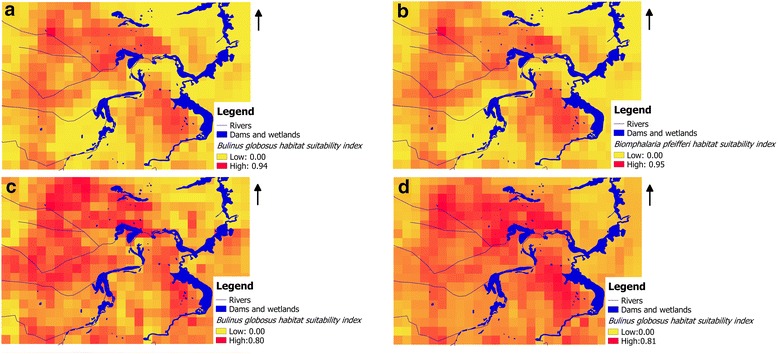
The predicted suitable habitats for intermediate snail hosts varied with seasons. The AUC for models in all seasons ranged from 0.71 to 1 and the prediction rates were between 0.8 and 0.9. Although B. globosus was found at more localities in the Ndumo area, there was also evidence of cohabiting with B. pfiefferi at some of the locations. NDWI had significant contribution to the models in all seasons.
The Maxent model is robust in snail habitat suitability modelling even with small dataset of presence-only sampling sites. Application of the methods and design used in this study may be useful in developing a control and management programme for schistosomiasis in the Ndumo area.
血吸虫病是一种由淡水蜗牛传播的、在撒哈拉以南非洲流行的蜗牛传播疾病。血吸虫病的分布与中间宿主的分布一致,这是由气候和环境因素决定的。本文的目的是模拟南非姆赫尼亚库德区恩杜莫地区适合球拟钉螺和费氏双脐螺(分别是埃及血吸虫和曼氏血吸虫的中间宿主)生存的栖息地的空间和季节分布。
利用最大熵(Maxent)建模技术,使用不同季节中采样点≥5个且≤12个的仅存在数据集,预测球拟钉螺和费氏双脐螺适合生存的栖息地分布。降水、最高和最低温度、归一化植被指数(NDVI)、归一化差异水指数(NDWI)、pH值、坡度和增强植被指数(EVI)是Maxent模型中的背景变量。使用曲线下面积(AUC)和遗漏率对模型进行验证。
中间蜗牛宿主的预测适宜栖息地随季节变化。所有季节模型的AUC范围为0.71至1,预测率在0.8至0.9之间。虽然在恩杜莫地区的更多地点发现了球拟钉螺,但也有证据表明在一些地点它与费氏双脐螺共存。NDWI在所有季节对模型都有显著贡献。
即使仅使用存在采样点的小数据集,Maxent模型在蜗牛栖息地适宜性建模中也很稳健。本研究中使用的方法和设计的应用可能有助于制定恩杜莫地区血吸虫病的控制和管理计划。