Vaidyanathan Sriram, Kerschner Jenny L, Paranjapye Alekh, Sinha Vrishti, Lin Brian, Bedrosian Tracy A, Thrasher Adrian J, Turchiano Giandomenico, Harris Ann, Porteus Matthew H
Center for Gene Therapy, Abigail Wexner Research Institute at Nationwide Children's Hospital, Columbus, OH 43205, USA.
Department of Pediatrics, The Ohio State University, Columbus, OH 43210, USA.
Mol Ther Nucleic Acids. 2024 Feb 2;35(1):102134. doi: 10.1016/j.omtn.2024.102134. eCollection 2024 Mar 12.
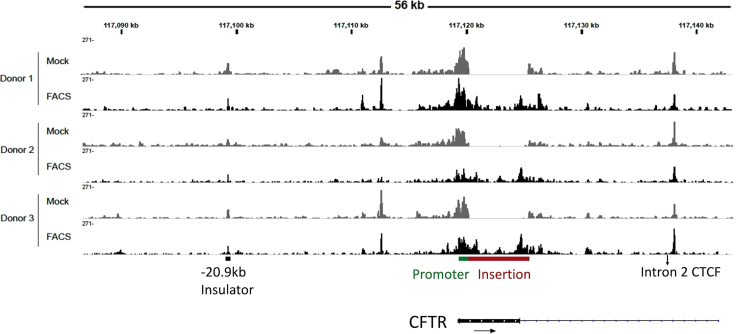
A "universal strategy" replacing the full-length cDNA may treat >99% of people with cystic fibrosis (pwCF), regardless of their specific mutations. Cas9-based gene editing was used to insert the cDNA and a truncated CD19 () enrichment tag at the locus in airway basal stem cells. This strategy restores CFTR function to non-CF levels. Here, we investigate the safety of this approach by assessing genomic and regulatory changes after cDNA insertion. Safety was first assessed by quantifying genetic rearrangements using CAST-seq. After validating restored CFTR function in edited and enriched airway cells, the locus open chromatin profile was characterized using ATAC-seq. The regenerative potential and differential gene expression in edited cells was assessed using scRNA-seq. CAST-seq revealed a translocation in ∼0.01% of alleles primarily occurring at a nononcogenic off-target site and large indels in 1% of alleles. The open chromatin profile of differentiated airway epithelial cells showed no appreciable changes, except in the region corresponding to the cDNA and cassette, indicating no detectable changes in gene regulation. Edited stem cells produced the same types of airway cells as controls with minimal alternations in gene expression. Overall, the universal strategy showed minor undesirable genomic changes.
一种替代全长cDNA的“通用策略”可能治疗超过99%的囊性纤维化患者(pwCF),无论其具体突变如何。基于Cas9的基因编辑被用于在气道基底干细胞的位点插入cDNA和截短的CD19()富集标签。该策略将CFTR功能恢复到非囊性纤维化水平。在此,我们通过评估cDNA插入后的基因组和调控变化来研究这种方法的安全性。安全性首先通过使用CAST-seq量化基因重排来评估。在编辑和富集的气道细胞中验证恢复的CFTR功能后,使用ATAC-seq对位点开放染色质图谱进行表征。使用scRNA-seq评估编辑细胞中的再生潜力和差异基因表达。CAST-seq显示约0.01%的等位基因发生易位,主要发生在一个非致癌性脱靶位点,1%的等位基因发生大的插入缺失。分化的气道上皮细胞的开放染色质图谱除了在对应于cDNA和盒的区域外没有明显变化,表明基因调控没有可检测到的变化。编辑后的干细胞产生与对照相同类型的气道细胞,基因表达变化最小。总体而言,通用策略显示出轻微的不良基因组变化。