Department of Neurology, University of Alabama at Birmingham, Birmingham, AL, United States.
IN8Bio, Inc., New York, NY, United States.
Front Immunol. 2024 Feb 7;15:1299044. doi: 10.3389/fimmu.2024.1299044. eCollection 2024.
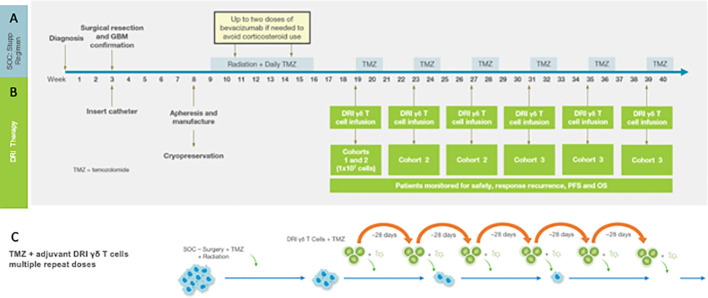
Cellular therapies, including chimeric antigen receptor T cell therapies (CAR-T), while generally successful in hematologic malignancies, face substantial challenges against solid tumors such as glioblastoma (GBM) due to rapid growth, antigen heterogeneity, and inadequate depth of response to cytoreductive and immune therapies, We have previously shown that GBM constitutively express stress associated NKG2D ligands (NKG2DL) recognized by gamma delta (γδ) T cells, a minor lymphocyte subset that innately recognize target molecules via the γδ T cell receptor (TCR), NKG2D, and multiple other mechanisms. Given that NKG2DL expression is often insufficient on GBM cells to elicit a meaningful response to γδ T cell immunotherapy, we then demonstrated that NKG2DL expression can be transiently upregulated by activation of the DNA damage response (DDR) pathway using alkylating agents such as Temozolomide (TMZ). TMZ, however, is also toxic to γδ T cells. Using a p140K/MGMT lentivector, which confers resistance to TMZ by expression of O(6)-methylguanine-DNA-methyltransferase (MGMT), we genetically engineered γδ T cells that maintain full effector function in the presence of therapeutic doses of TMZ. We then validated a therapeutic system that we termed Drug Resistance Immunotherapy (DRI) that combines a standard regimen of TMZ concomitantly with simultaneous intracranial infusion of TMZ-resistant γδ T cells in a first-in-human Phase I clinical trial (NCT04165941). This manuscript will discuss DRI as a rational therapeutic approach to newly diagnosed GBM and the importance of repeated administration of DRI in combination with the standard-of-care Stupp regimen in patients with stable minimal residual disease.
细胞疗法,包括嵌合抗原受体 T 细胞疗法 (CAR-T),虽然在血液恶性肿瘤中通常很成功,但在实体瘤如胶质母细胞瘤 (GBM) 方面面临着巨大的挑战,这是由于其快速生长、抗原异质性以及对细胞减灭和免疫治疗的反应不足。我们之前已经表明,GBM 持续表达应激相关的 NKG2D 配体 (NKG2DL),这些配体被γδ (γδ) T 细胞识别,γδ T 细胞是一种小淋巴细胞亚群,通过 γδ T 细胞受体 (TCR)、NKG2D 和多种其他机制固有地识别靶分子。鉴于 GBM 细胞上的 NKG2DL 表达通常不足以引起对 γδ T 细胞免疫治疗的有意义反应,我们随后证明 NKG2DL 表达可以通过激活 DNA 损伤反应 (DDR) 途径短暂上调,该途径使用烷基化剂,如替莫唑胺 (TMZ)。然而,TMZ 对 γδ T 细胞也有毒性。我们使用 p140K/MGMT 慢病毒载体,通过表达 O(6)-甲基鸟嘌呤-DNA-甲基转移酶 (MGMT) 赋予 TMZ 耐药性,对 γδ T 细胞进行基因工程改造,使其在 TMZ 的治疗剂量下保持完全的效应功能。然后,我们验证了一种治疗系统,我们称之为耐药免疫疗法 (DRI),该系统将 TMZ 的标准方案与同时颅内输注 TMZ 耐药 γδ T 细胞结合在首例人体 I 期临床试验中(NCT04165941)。本文将讨论 DRI 作为一种合理的治疗方法用于新诊断的 GBM,以及在有稳定微小残留疾病的患者中重复给予 DRI 与标准的 Stupp 方案联合的重要性。