Department of Genetics, Cell Biology, and Development, University of Minnesota, Minneapolis, United States.
Department of Biophysics, Molecular Biology, and Biochemistry, University of Minnesota, Minneapolis, United States.
Elife. 2024 Feb 22;13:e91719. doi: 10.7554/eLife.91719.
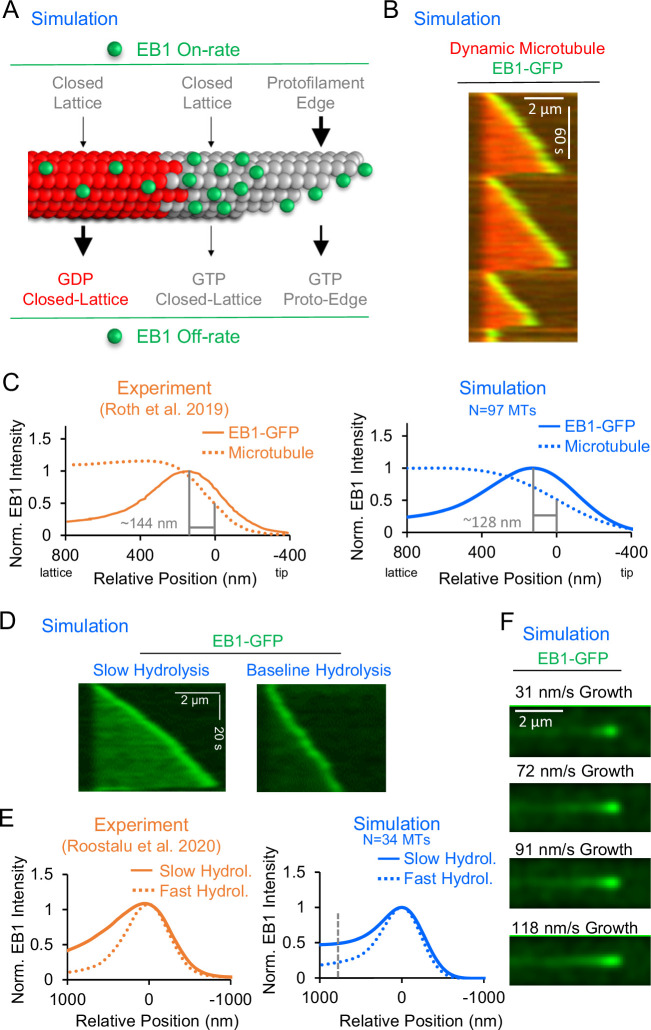
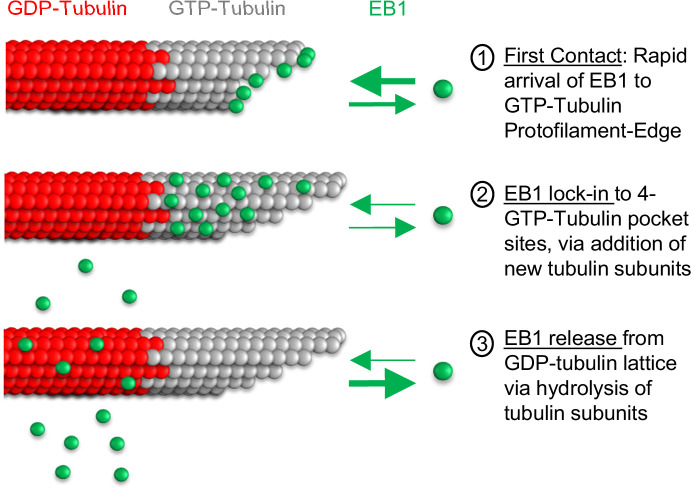
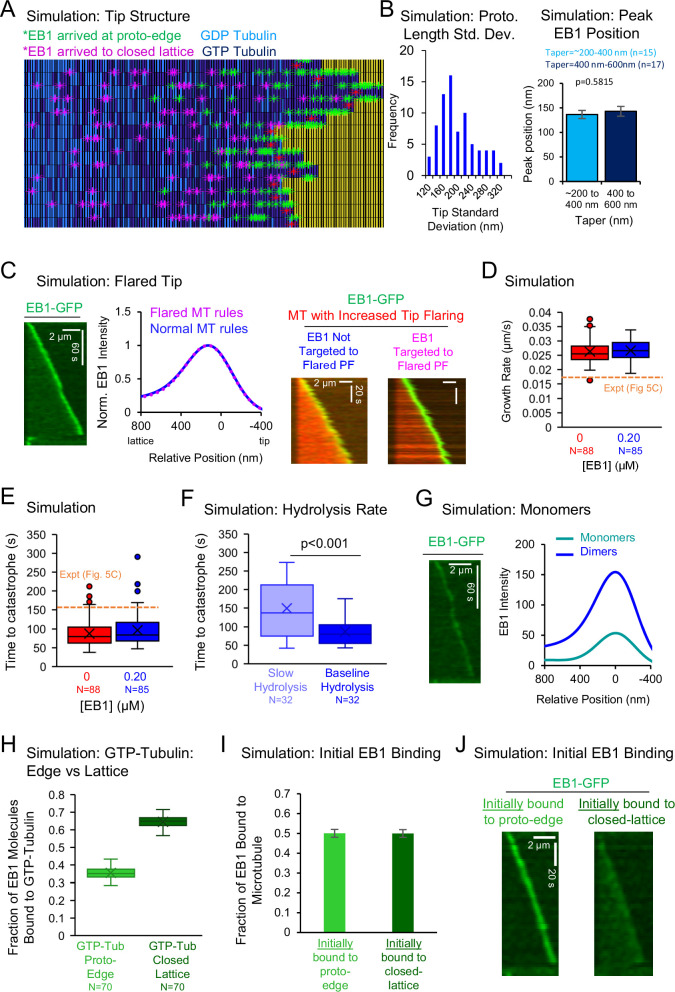
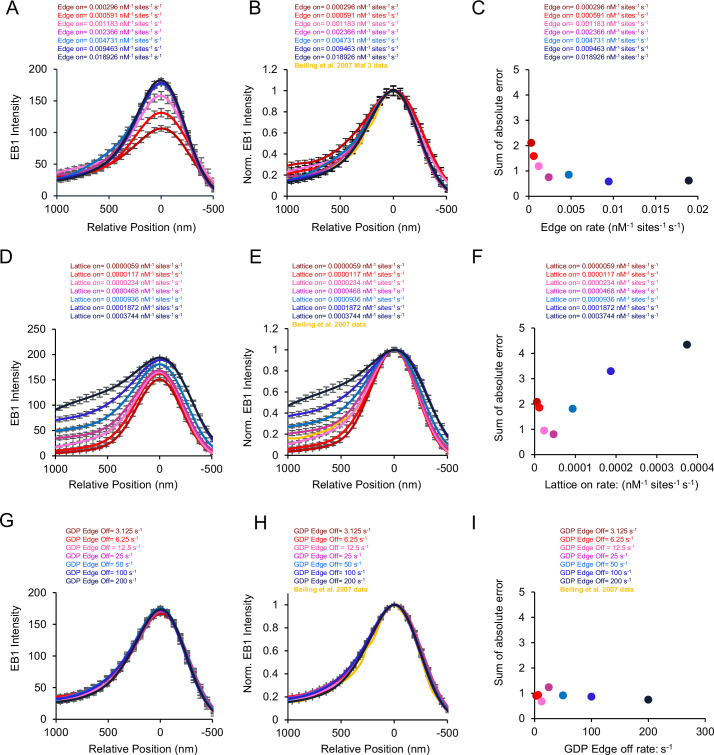
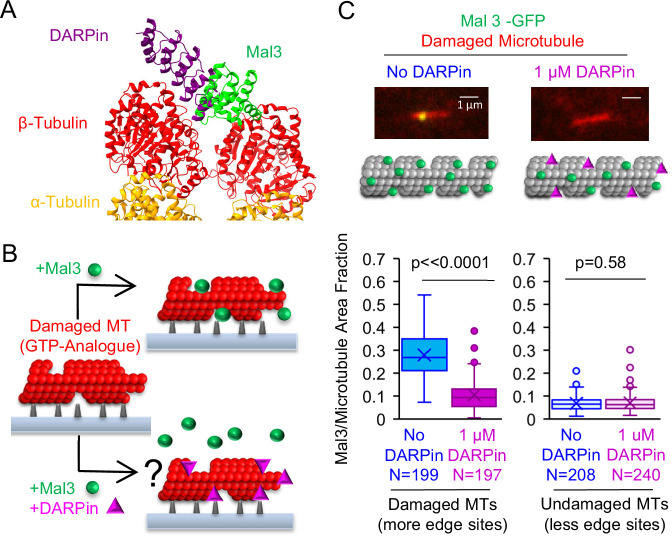
EB1 is a key cellular protein that delivers regulatory molecules throughout the cell via the tip-tracking of growing microtubule plus-ends. Thus, it is important to understand the mechanism for how EB1 efficiently tracks growing microtubule plus-ends. It is widely accepted that EB1 binds with higher affinity to GTP-tubulin subunits at the growing microtubule tip, relative to GDP-tubulin along the microtubule length. However, it is unclear whether this difference in affinity alone is sufficient to explain the tip-tracking of EB1 at growing microtubule tips. Previously, we found that EB1 binds to exposed microtubule protofilament-edge sites at a ~70 fold faster rate than to closed-lattice sites, due to diffusional steric hindrance to binding. Thus, we asked whether rapid protofilament-edge binding could contribute to efficient EB1 tip tracking. A computational simulation with differential EB1 on-rates based on closed-lattice or protofilament-edge binding, and with EB1 off-rates that were dependent on the tubulin hydrolysis state, robustly recapitulated experimental EB1 tip tracking. To test this model, we used cell-free biophysical assays, as well as live-cell imaging, in combination with a Designed Ankyrin Repeat Protein (DARPin) that binds exclusively to protofilament-edge sites, and whose binding site partially overlaps with the EB1 binding site. We found that DARPin blocked EB1 protofilament-edge binding, which led to a decrease in EB1 tip tracking on dynamic microtubules. We conclude that rapid EB1 binding to microtubule protofilament-edge sites contributes to robust EB1 tip tracking at the growing microtubule plus-end.
EB1 是一种关键的细胞蛋白,通过跟踪生长微管的尖端来在整个细胞内传递调节分子。因此,了解 EB1 如何有效地跟踪生长微管的尖端是很重要的。人们普遍认为,EB1 与生长微管尖端的 GTP-微管蛋白亚基的结合亲和力高于微管上的 GDP-微管蛋白。然而,目前尚不清楚这种亲和力的差异是否足以解释 EB1 在生长微管尖端的尖端跟踪。以前,我们发现 EB1 与暴露的微管原纤维边缘位点的结合速度比与封闭晶格位点的结合速度快约 70 倍,这是由于结合的扩散空间位阻。因此,我们想知道快速的原纤维边缘结合是否有助于 EB1 高效的尖端跟踪。基于封闭晶格或原纤维边缘结合的 EB1 上载率的差异,以及依赖于微管水解状态的 EB1 离解率的计算模拟,稳健地再现了实验 EB1 尖端跟踪。为了验证这个模型,我们使用了无细胞生物物理测定法,以及活细胞成像,结合了一种专门结合原纤维边缘位点的设计锚蛋白重复蛋白(DARPin),其结合位点与 EB1 结合位点部分重叠。我们发现 DARPin 阻断了 EB1 原纤维边缘结合,导致 EB1 在动态微管上的尖端跟踪减少。我们得出结论,EB1 与微管原纤维边缘位点的快速结合有助于 EB1 在生长微管的顶端进行稳健的尖端跟踪。