Bieling Peter, Kandels-Lewis Stefanie, Telley Ivo A, van Dijk Juliette, Janke Carsten, Surrey Thomas
European Molecular Biology Laboratory, Cell Biology and Biophysics Unit, 69117 Heidelberg, Germany.
J Cell Biol. 2008 Dec 29;183(7):1223-33. doi: 10.1083/jcb.200809190. Epub 2008 Dec 22.
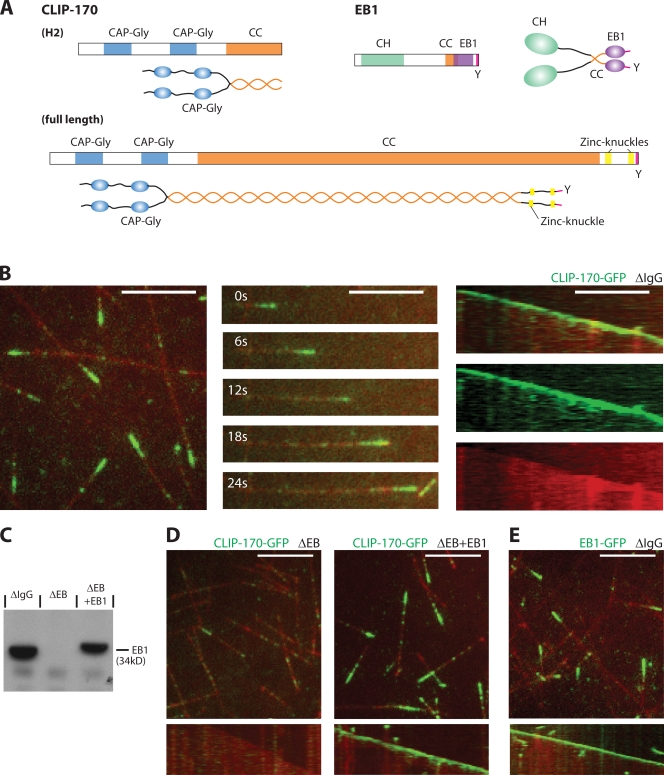
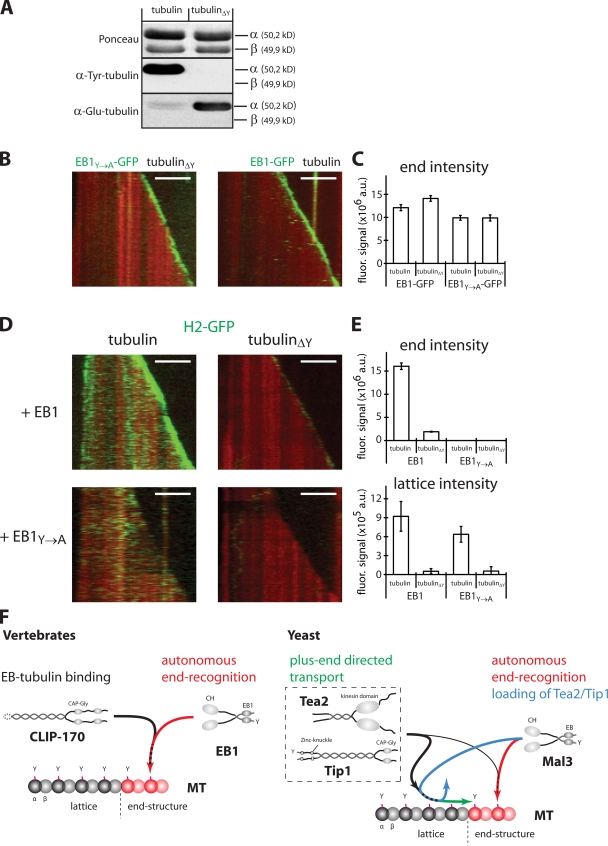
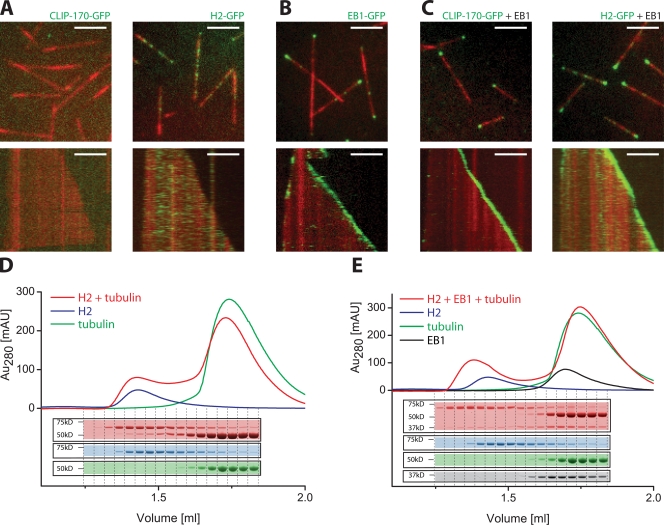
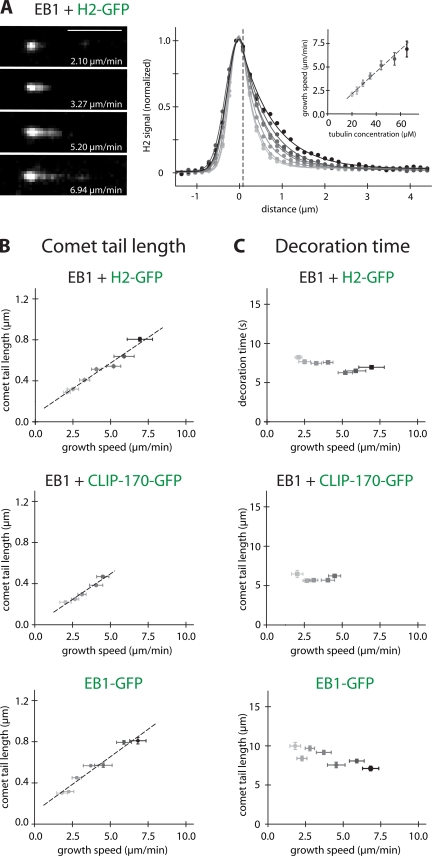
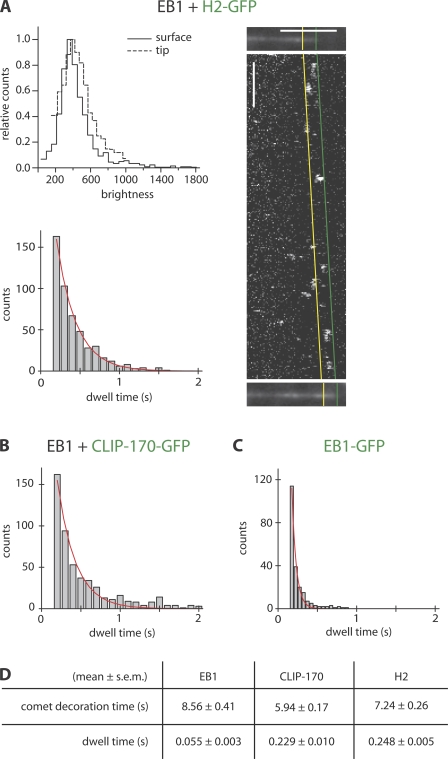
The microtubule cytoskeleton is crucial for the internal organization of eukaryotic cells. Several microtubule-associated proteins link microtubules to subcellular structures. A subclass of these proteins, the plus end-binding proteins (+TIPs), selectively binds to the growing plus ends of microtubules. Here, we reconstitute a vertebrate plus end tracking system composed of the most prominent +TIPs, end-binding protein 1 (EB1) and CLIP-170, in vitro and dissect their end-tracking mechanism. We find that EB1 autonomously recognizes specific binding sites present at growing microtubule ends. In contrast, CLIP-170 does not end-track by itself but requires EB1. CLIP-170 recognizes and turns over rapidly on composite binding sites constituted by end-accumulated EB1 and tyrosinated alpha-tubulin. In contrast to its fission yeast orthologue Tip1, dynamic end tracking of CLIP-170 does not require the activity of a molecular motor. Our results demonstrate evolutionary diversity of the plus end recognition mechanism of CLIP-170 family members, whereas the autonomous end-tracking mechanism of EB family members is conserved.
微管细胞骨架对于真核细胞的内部组织至关重要。几种微管相关蛋白将微管与亚细胞结构相连。这些蛋白的一个亚类,即正端结合蛋白(+TIPs),选择性地结合到微管不断生长的正端。在此,我们在体外重建了一个由最突出的 +TIPs、末端结合蛋白1(EB1)和CLIP-170组成的脊椎动物正端追踪系统,并剖析了它们的末端追踪机制。我们发现EB1能自主识别微管生长末端存在的特定结合位点。相比之下,CLIP-170自身并不进行末端追踪,而是需要EB1。CLIP-170识别由末端积累的EB1和酪氨酸化α-微管蛋白构成的复合结合位点,并在其上快速周转。与其裂殖酵母同源物Tip1不同,CLIP-170的动态末端追踪不需要分子马达的活性。我们的结果表明了CLIP-170家族成员正端识别机制的进化多样性,而EB家族成员的自主末端追踪机制是保守的。