
8 至 70 岁人群不同组织中端粒长度和 DNA 质量指标的跨组织比较。
Cross-tissue comparison of telomere length and quality metrics of DNA among individuals aged 8 to 70 years.
机构信息
Department of Biobehavioral Health, Penn State University, University Park, Pennsylvania, United States of America.
Department of Psychiatry and Behavioral Science, Tulane University School of Medicine, New Orleans, Louisiana, United States of America.
出版信息
PLoS One. 2024 Feb 22;19(2):e0290918. doi: 10.1371/journal.pone.0290918. eCollection 2024.
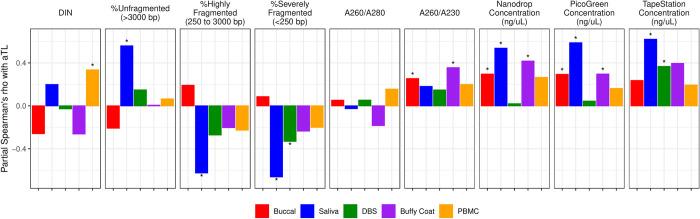
Telomere length (TL) is an important biomarker of cellular aging, yet its links with health outcomes may be complicated by use of different tissues. We evaluated within- and between-individual variability in TL and quality metrics of DNA across five tissues using a cross-sectional dataset ranging from 8 to 70 years (N = 197). DNA was extracted from all tissue cells using the Gentra Puregene DNA Extraction Kit. Absolute TL (aTL) in kilobase pairs was measured in buccal epithelial cells, saliva, dried blood spots (DBS), buffy coat, and peripheral blood mononuclear cells (PBMCs) using qPCR. aTL significantly shortened with age for all tissues except saliva and buffy coat, although buffy coat was available for a restricted age range (8 to 15 years). aTL did not significantly differ across blood-based tissues (DBS, buffy coat, PBMC), which had significantly longer aTL than buccal cells and saliva. Additionally, aTL was significantly correlated for the majority of tissue pairs, with partial Spearman's correlations controlling for age and sex ranging from ⍴ = 0.18 to 0.51. We also measured quality metrics of DNA including integrity, purity, and quantity of extracted DNA from all tissues and explored whether controlling for DNA metrics improved predictions of aTL. We found significant tissue variation: DNA from blood-based tissues had high DNA integrity, more acceptable A260/280 and A260/230 values, and greater extracted DNA concentrations compared to buccal cells and saliva. Longer aTL was associated with lower DNA integrity, higher extracted DNA concentrations, and higher A260/230, particularly for saliva. Model comparisons suggested that incorporation of quality DNA metrics improves models of TL, although relevant metrics vary by tissue. These findings highlight the merits of using blood-based tissues and suggest that incorporation of quality DNA metrics as control variables in population-based studies can improve TL predictions, especially for more variable tissues like buccal and saliva.
端粒长度(TL)是细胞衰老的一个重要生物标志物,但由于使用了不同的组织,其与健康结果的联系可能会变得复杂。我们使用一个从 8 岁到 70 岁的横断面数据集(N = 197),评估了 5 种组织中 TL 的个体内和个体间变异性以及 DNA 的质量指标。使用 Gentra Puregene DNA 提取试剂盒从所有组织细胞中提取 DNA。使用 qPCR 在颊上皮细胞、唾液、干血斑(DBS)、白细胞层和外周血单核细胞(PBMC)中测量以千碱基对为单位的绝对 TL(aTL)。除了唾液和白细胞层外,所有组织的 aTL 都随着年龄的增长而显著缩短,尽管白细胞层的年龄范围有限(8 至 15 岁)。基于血液的组织(DBS、白细胞层、PBMC)之间的 aTL 没有显著差异,它们的 aTL 明显长于颊细胞和唾液。此外,大多数组织对的 aTL 显著相关,控制年龄和性别的部分 Spearman 相关性从 ⍴=0.18 到 0.51。我们还测量了所有组织的 DNA 质量指标,包括完整性、纯度和提取的 DNA 量,并探讨了控制 DNA 指标是否能改善 aTL 的预测。我们发现了显著的组织差异:与颊细胞和唾液相比,基于血液的组织的 DNA 具有更高的 DNA 完整性、更可接受的 A260/280 和 A260/230 值以及更高的提取 DNA 浓度。较长的 aTL 与较低的 DNA 完整性、较高的提取 DNA 浓度和较高的 A260/230 相关,尤其是唾液。模型比较表明,纳入 DNA 质量指标可以改善 TL 模型,尽管相关指标因组织而异。这些发现突出了使用基于血液的组织的优点,并表明在基于人群的研究中纳入作为控制变量的 DNA 质量指标可以改善 TL 预测,特别是对于像颊部和唾液这样更具变异性的组织。


 Zotero 插件