Hastings Waylon J, Eisenberg Dan T A, Shalev Idan
Department of Biobehavioral Health, The Pennsylvania State University, University Park PA, USA.
Department of Anthropology, University of Washington, Seattle, WA, USA.
Exp Results. 2020;1. doi: 10.1017/exp.2020.58. Epub 2020 Nov 16.
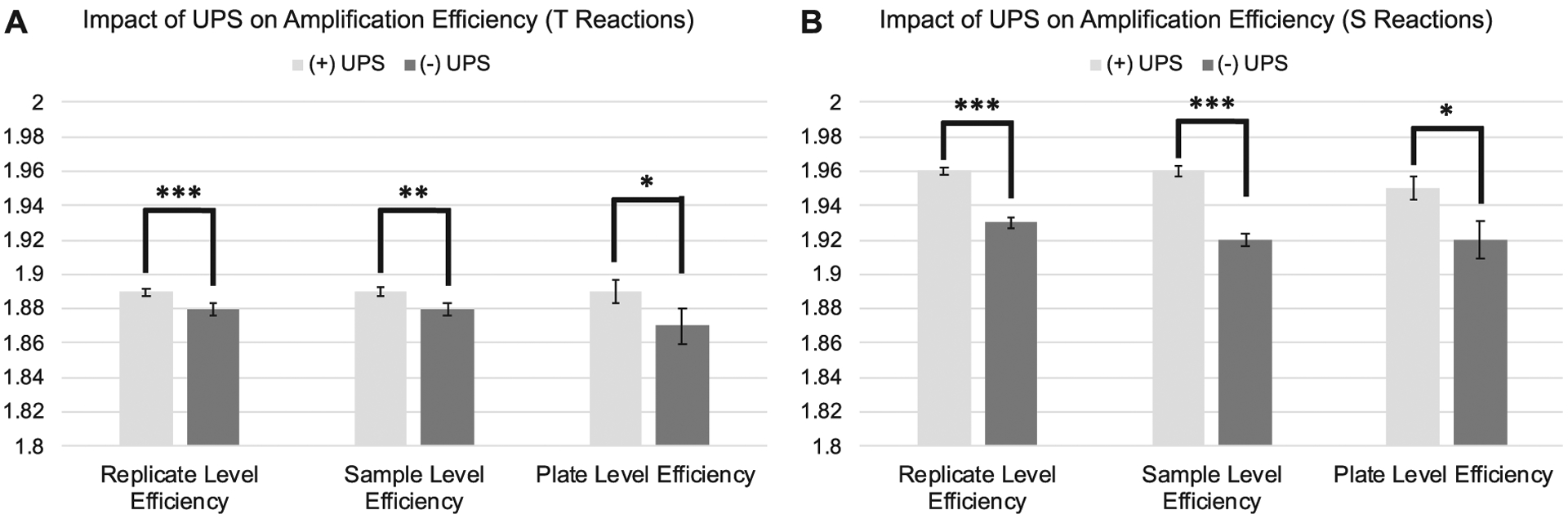
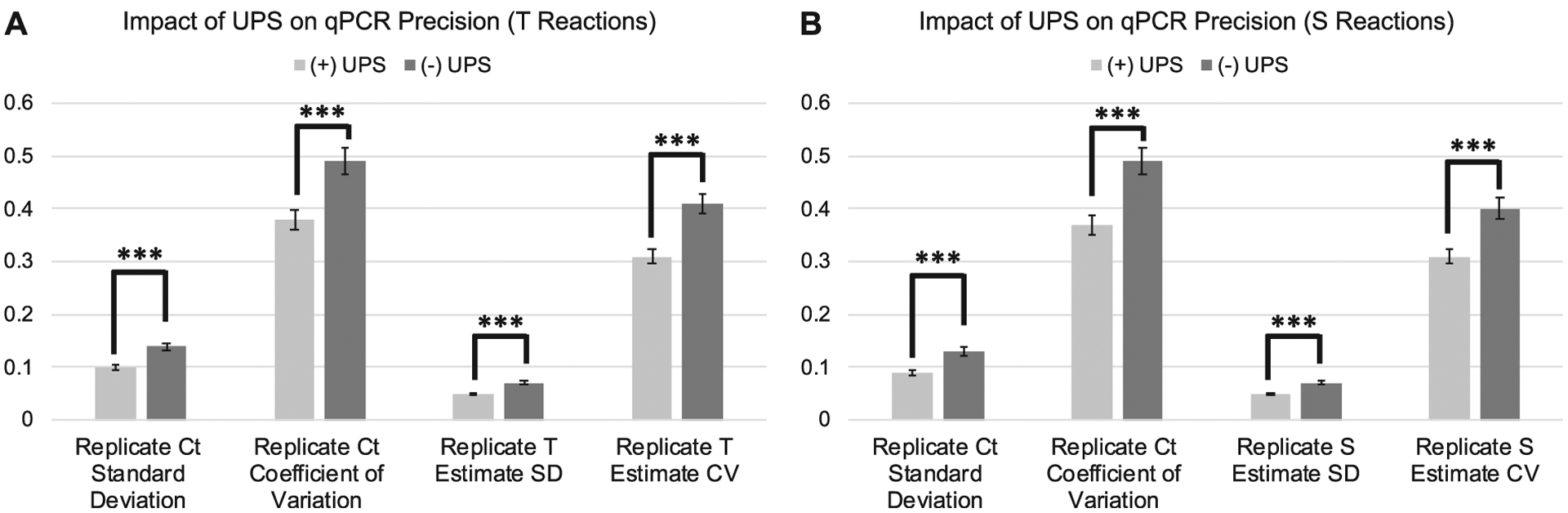
Technical challenges associated with telomere length (TL) measurements have prompted concerns regarding their utility as a biomarker of aging. Several factors influence TL assessment qPCR, the most common measurement method in epidemiological studies, including storage conditions and DNA extraction method. Here, we tested the impact of power supply during the qPCR assay. Momentary fluctuations in power can affect the functioning of high-performance electronics, including real-time thermocyclers. We investigated if mitigating these fluctuations by using an uninterruptible power supply (UPS) influenced TL assessment qPCR. Samples run with a UPS had significantly lower standard deviation ( < 0.001) and coefficient of variation ( < 0.001) across technical replicates than those run without a UPS. UPS usage also improved exponential amplification efficiency at the replicate, sample, and plate levels. Together these improvements translated to increased performance across metrics of external validity including correlation with age, within-person correlation across tissues, and correlation between parents and offspring.
与端粒长度(TL)测量相关的技术挑战引发了人们对其作为衰老生物标志物效用的担忧。有几个因素会影响TL评估——qPCR是流行病学研究中最常用的测量方法,包括储存条件和DNA提取方法。在此,我们测试了qPCR检测过程中电源的影响。电源的瞬间波动会影响包括实时热循环仪在内的高性能电子设备的运行。我们研究了使用不间断电源(UPS)减轻这些波动是否会影响TL评估——qPCR。与未使用UPS运行的样本相比,使用UPS运行的样本在技术重复中的标准差(<0.001)和变异系数(<0.001)显著更低。使用UPS还提高了重复、样本和平板水平的指数扩增效率。这些改进共同转化为外部有效性指标的性能提升,包括与年龄的相关性、不同组织间的个体内相关性以及亲子相关性。