Dementia Research Institute, Institute of Neurology, University College London, at the Francis Crick Institute, London, NW1 AT, UK.
Laboratory for the Research of Neurodegenerative Diseases, VIB Center for Brain & Disease Research, and Leuven Brain Institute, KU Leuven, Leuven, 3000, Belgium.
EMBO J. 2024 Mar;43(6):887-903. doi: 10.1038/s44318-024-00057-w. Epub 2024 Feb 23.
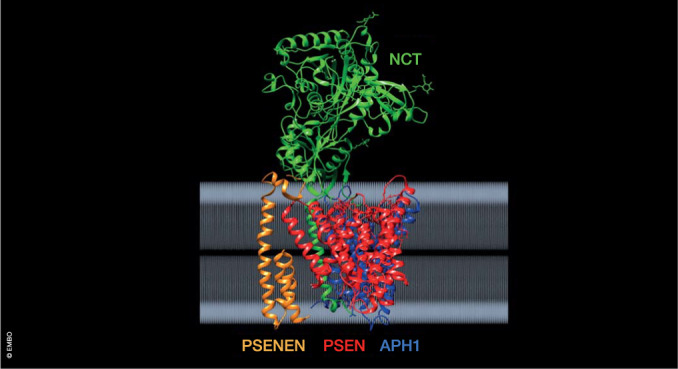
Two phase-III clinical trials with anti-amyloid peptide antibodies have met their primary goal, i.e. slowing of Alzheimer's disease (AD) progression. However, antibody therapy may not be the optimal therapeutic modality for AD prevention, as we will discuss in the context of the earlier small molecules described as "γ-secretase modulators" (GSM). We review here the structure, function, and pathobiology of γ-secretases, with a focus on how mutations in presenilin genes result in early-onset AD. Significant progress has been made in generating compounds that act in a manner opposite to pathogenic presenilin mutations: they stabilize the proteinase-substrate complex, thereby increasing the processivity of substrate cleavage and altering the size spectrum of Aβ peptides produced. We propose the term "γ-secretase allosteric stabilizers" (GSAS) to distinguish these compounds from the rather heterogenous class of GSM. The GSAS represent, in theory, a precision medicine approach to the prevention of amyloid deposition, as they specifically target a discrete aspect in a complex cell biological signalling mechanism that initiates the pathological processes leading to Alzheimer's disease.
两项针对抗淀粉样肽抗体的 III 期临床试验达到了主要目标,即减缓阿尔茨海默病(AD)的进展。然而,抗体疗法可能不是 AD 预防的最佳治疗方式,正如我们将在前面讨论的被描述为“γ-分泌酶调节剂”(GSM)的小分子的背景下讨论的那样。我们在这里回顾了 γ-分泌酶的结构、功能和病理生物学,重点介绍了早发性 AD 中载脂蛋白 E 基因的突变如何导致其发生。在生成作用方式与致病性早老素突变相反的化合物方面已经取得了重大进展:它们稳定蛋白酶-底物复合物,从而增加底物切割的连续性,并改变产生的 Aβ肽的大小谱。我们提出“γ-分泌酶别构稳定剂”(GSAS)一词来区分这些化合物和相当异质的 GSM 类。从理论上讲,GSAS 代表了一种预防淀粉样蛋白沉积的精准医疗方法,因为它们专门针对引发导致阿尔茨海默病的病理过程的复杂细胞生物学信号机制中的一个离散方面。