Center for Psychopharmacology, Diakonhjemmet Hospital, Oslo, Norway.
Department of Life Sciences and Health, Oslo Metropolitan University, Oslo, Norway.
Eur J Clin Pharmacol. 2024 Jun;80(6):839-845. doi: 10.1007/s00228-024-03655-z. Epub 2024 Feb 23.
Lamotrigine was previously reported to reduce serum concentration of quetiapine. The aim of this study was to investigate whether lamotrigine dose or quetiapine formulation was of importance for the drug interaction.
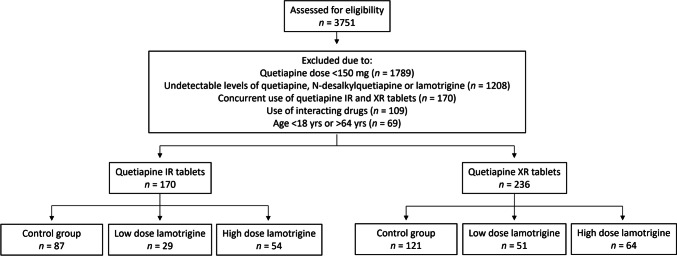
Patients combining lamotrigine with quetiapine (cases) were included retrospectively from a routine therapeutic drug monitoring (TDM) service, as were a control group of patients using quetiapine without any interacting drugs. The case and control groups were divided into groups using immediate release (IR) and extended release (XR) quetiapine. The case group was further split into high-dose (> 200 mg/day) and low-dose (≤ 200 mg/day) lamotrigine users. Quetiapine concentration-to-dose (C/D) ratio and metabolite-to-parent ratio (MPR) were compared between the control group and dose-separated case groups using ANOVA test and t-tests.
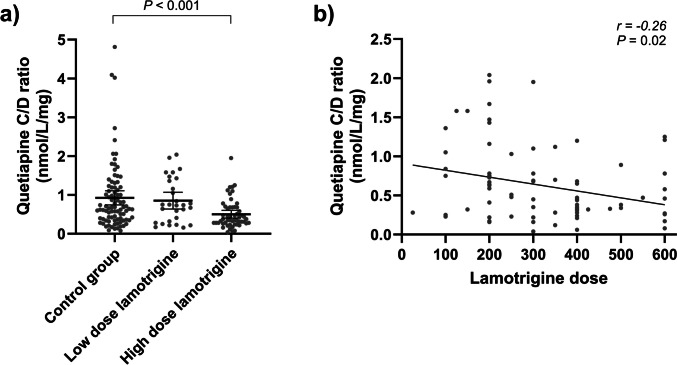
In total, 406 patients were included. The mean C/D ratio of IR quetiapine was 46% lower in the high-dose lamotrigine group compared with the control group (P < 0.001), while no interaction effect was present in the low dose lamotrigine group (P = 0.7). Regardless of lamotrigine dose, there was no difference in quetiapine C/D ratio for patients using the XR formulation (P = 0.4). The quetiapine MPR was unaffected regardless of formulation and lamotrigine dose (P ≥ 0.06).
The effect of lamotrigine in reducing quetiapine concentration is only significant for patients using quetiapine IR tablets who are treated with lamotrigine doses > 200 mg/day. Because of high variability in the interaction effect, TDM of quetiapine should be recommended during co-prescription of high-dose lamotrigine.
先前有报道称拉莫三嗪可降低喹硫平的血清浓度。本研究旨在探讨拉莫三嗪剂量或喹硫平剂型对药物相互作用的重要性。
从常规治疗药物监测(TDM)服务中回顾性纳入同时使用拉莫三嗪和喹硫平的患者(病例组),以及未使用任何相互作用药物的仅使用喹硫平的患者作为对照组。病例组和对照组进一步分为速释(IR)和缓释(XR)喹硫平组。病例组还分为高剂量(>200mg/天)和低剂量(≤200mg/天)拉莫三嗪使用者。采用方差分析和 t 检验比较对照组和剂量分组病例组之间的喹硫平浓度-剂量(C/D)比值和代谢物-母体比值(MPR)。
共纳入 406 例患者。与对照组相比,高剂量拉莫三嗪组 IR 喹硫平的平均 C/D 比值低 46%(P<0.001),而低剂量拉莫三嗪组无相互作用效应(P=0.7)。无论拉莫三嗪剂量如何,使用 XR 剂型的患者的喹硫平 C/D 比值无差异(P=0.4)。无论剂型和拉莫三嗪剂量如何,喹硫平 MPR 均不受影响(P≥0.06)。
拉莫三嗪降低喹硫平浓度的作用仅对使用 IR 喹硫平片剂且接受拉莫三嗪剂量>200mg/天治疗的患者有意义。由于相互作用效应的高度变异性,在高剂量拉莫三嗪联合处方时应推荐进行喹硫平 TDM。