Ariga Katsuhiko
Research Center for Materials Nanoarchitectonics (MANA), National Institute for Materials Science (NIMS), 1-1 Namiki, Tsukuba 305-0044, Ibaraki, Japan.
Graduate School of Frontier Sciences, The University of Tokyo, 5-1-5 Kashiwanoha, Kashiwa 277-8561, Chiba, Japan.
Materials (Basel). 2024 Feb 17;17(4):936. doi: 10.3390/ma17040936.
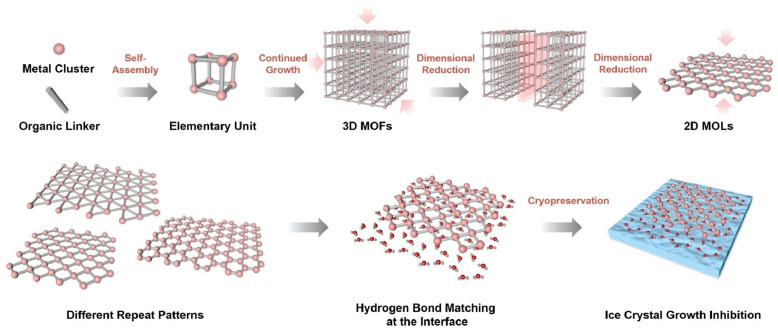
It has become clear that superior material functions are derived from precisely controlled nanostructures. This has been greatly accelerated by the development of nanotechnology. The next step is to assemble materials with knowledge of their nano-level structures. This task is assigned to the post-nanotechnology concept of nanoarchitectonics. However, nanoarchitectonics, which creates intricate three-dimensional functional structures, is not always easy. Two-dimensional nanoarchitectonics based on reactions and arrangements at the surface may be an easier target to tackle. A better methodology would be to define a two-dimensional structure and then develop it into a three-dimensional structure and function. According to these backgrounds, this review paper is organized as follows. The introduction is followed by a summary of the three issues; (i) 2D to 3D dynamic structure control: liquid crystal commanded by the surface, (ii) 2D to 3D rational construction: a metal-organic framework (MOF) and a covalent organic framework (COF); (iii) 2D to 3D functional amplification: cells regulated by the surface. In addition, this review summarizes the important aspects of the ultimate three-dimensional nanoarchitectonics as a perspective. The goal of this paper is to establish an integrated concept of functional material creation by reconsidering various reported cases from the viewpoint of nanoarchitectonics, where nanoarchitectonics can be regarded as a method for everything in materials science.
很明显,优异的材料功能源自精确控制的纳米结构。纳米技术的发展极大地加速了这一进程。下一步是利用对材料纳米级结构的了解来组装材料。这项任务被赋予了纳米结构学这一纳米技术后的概念。然而,创建复杂三维功能结构的纳米结构学并非总是易事。基于表面反应和排列的二维纳米结构学可能是一个更容易攻克的目标。一种更好的方法是定义二维结构,然后将其发展为三维结构和功能。基于这些背景,本综述论文的组织如下。引言之后是三个问题的总结:(i)二维到三维动态结构控制:表面引导的液晶;(ii)二维到三维合理构建:金属有机框架(MOF)和共价有机框架(COF);(iii)二维到三维功能放大:表面调控的细胞。此外,本综述作为一个视角总结了终极三维纳米结构学的重要方面。本文的目标是通过从纳米结构学的角度重新审视各种已报道的案例,建立一个功能材料创制的综合概念,其中纳米结构学可被视为材料科学中一切事物的一种方法。