Institute of Virology, Ulm University Medical Center, 89081 Ulm, Germany.
Viruses. 2024 Feb 13;16(2):290. doi: 10.3390/v16020290.
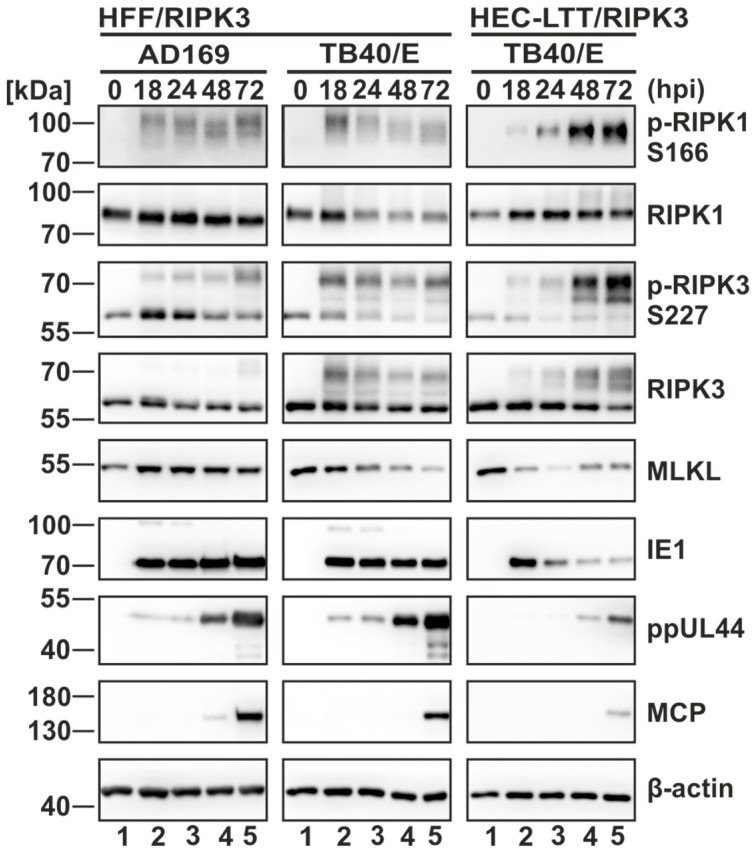
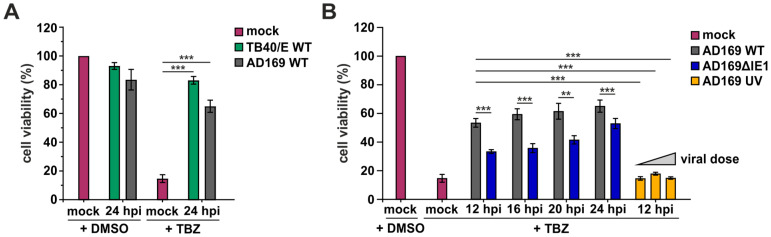
Programmed necrosis is an integral part of intrinsic immunity, serving to combat invading pathogens and restricting viral dissemination. The orchestration of necroptosis relies on a precise interplay within the necrosome complex, which consists of RIPK1, RIPK3 and MLKL. Human cytomegalovirus (HCMV) has been found to counteract the execution of necroptosis during infection. In this study, we identify the immediate-early 1 (IE1) protein as a key antagonist of necroptosis during HCMV infection. Infection data obtained in a necroptosis-sensitive cell culture system revealed a robust regulation of post-translational modifications (PTMs) of the necrosome complex as well as the importance of IE1 expression for an effective counteraction of necroptosis. Interaction analyses unveiled an association of IE1 and RIPK3, which occurs in an RHIM-domain independent manner. We propose that this interaction manipulates the PTMs of RIPK3 by promoting its ubiquitination. Furthermore, IE1 was found to exert an indirect activity by modulating the levels of MLKL via antagonizing its interferon-mediated upregulation. Overall, we claim that IE1 performs a broad modulation of innate immune signaling to impede the execution of necroptotic cell death, thereby generating a favorable environment for efficient viral replication.
程序性细胞坏死是固有免疫的一个组成部分,有助于对抗入侵病原体并限制病毒传播。细胞坏死的调控依赖于坏死小体复合物内的精确相互作用,该复合物由 RIPK1、RIPK3 和 MLKL 组成。已发现人类巨细胞病毒 (HCMV) 在感染期间会对抗细胞坏死的执行。在本研究中,我们确定早期即刻蛋白 1 (IE1) 蛋白是 HCMV 感染期间细胞坏死的关键拮抗剂。在细胞坏死敏感的细胞培养系统中获得的感染数据揭示了对坏死小体复合物的翻译后修饰 (PTMs) 的强烈调控,以及 IE1 表达对于有效对抗细胞坏死的重要性。相互作用分析揭示了 IE1 和 RIPK3 的关联,这种关联以 RHIM 结构域非依赖性的方式发生。我们提出,这种相互作用通过促进 RIPK3 的泛素化来操纵其 PTMs。此外,发现 IE1 通过拮抗其干扰素介导的上调来调节 MLKL 的水平,从而发挥间接活性。总体而言,我们声称 IE1 对先天免疫信号进行广泛的调节,以阻止细胞坏死性细胞死亡的执行,从而为有效的病毒复制创造有利的环境。