Division of Infection and Immunity, the Roslin Institute, Easter Bush Campus, University of Edinburgh, Edinburgh EH259RG, UK.
Division of Functional Genetics and Development, the Roslin Institute, Easter Bush Campus, University of Edinburgh, Edinburgh EH259RG, UK.
Viruses. 2024 Feb 15;16(2):297. doi: 10.3390/v16020297.
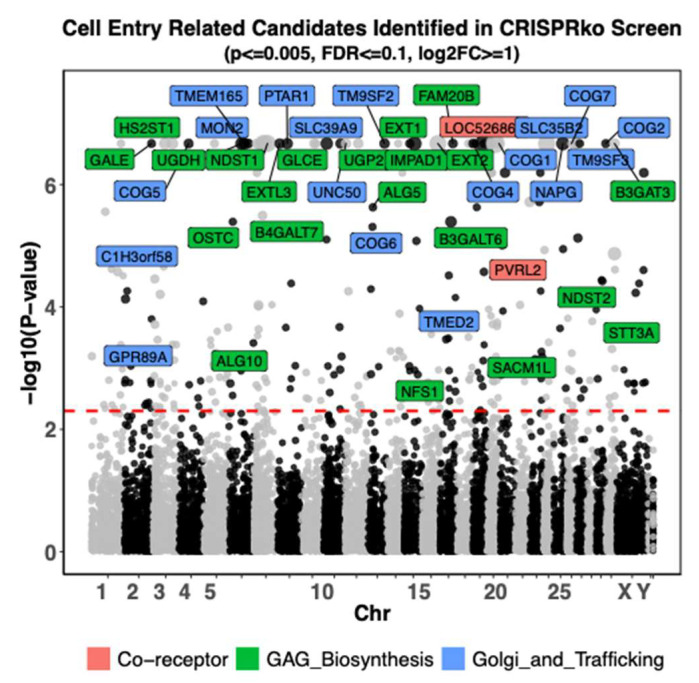
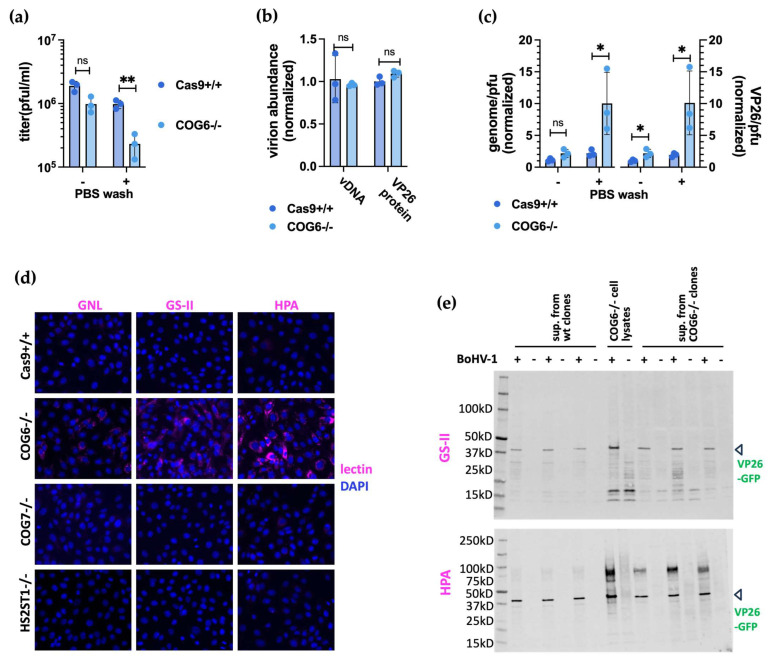
To identify host factors that affect Bovine Herpes Virus Type 1 (BoHV-1) infection we previously applied a genome wide CRISPR knockout screen targeting all bovine protein coding genes. By doing so we compiled a list of both pro-viral and anti-viral proteins involved in BoHV-1 replication. Here we provide further analysis of those that are potentially involved in viral entry into the host cell. We first generated single cell knockout clones deficient in some of the candidate genes for validation. We provide evidence that Polio Virus Receptor-related protein (PVRL2) serves as a receptor for BoHV-1, mediating more efficient entry than the previously identified Polio Virus Receptor (PVR). By knocking out two enzymes that catalyze HSPG chain elongation, HST2ST1 and GLCE, we further demonstrate the significance of HSPG in BoHV-1 entry. Another intriguing cluster of candidate genes, COG1, COG2 and COG4-7 encode six subunits of the Conserved Oligomeric Golgi (COG) complex. MDBK cells lacking COG6 produced fewer but bigger plaques compared to control cells, suggesting more efficient release of newly produced virions from these COG6 knockout cells, due to impaired HSPG biosynthesis. We further observed that viruses produced by the COG6 knockout cells consist of protein(s) with reduced N-glycosylation, potentially explaining their lower infectivity. To facilitate candidate validation, we also detailed a one-step multiplex CRISPR interference (CRISPRi) system, an orthogonal method to KO that enables quick and simultaneous deployment of three CRISPRs for efficient gene inactivation. Using CRISPR3i, we verified eight candidates that have been implicated in the synthesis of surface heparan sulfate proteoglycans (HSPGs). In summary, our experiments confirmed the two receptors PVR and PVRL2 for BoHV-1 entry into the host cell and other factors that affect this process, likely through the direct or indirect roles they play during HSPG synthesis and glycosylation of viral proteins.
为了鉴定影响牛疱疹病毒 1 型(BoHV-1)感染的宿主因素,我们之前应用了一个针对所有牛蛋白编码基因的全基因组 CRISPR 敲除筛选。通过这样做,我们编制了一个参与 BoHV-1 复制的促病毒和抗病毒蛋白的清单。在这里,我们对那些可能参与病毒进入宿主细胞的蛋白进行了进一步的分析。我们首先生成了一些候选基因的单细胞敲除克隆进行验证。我们提供的证据表明,脊髓灰质炎病毒受体相关蛋白(PVRL2)是 BoHV-1 的受体,介导比先前鉴定的脊髓灰质炎病毒受体(PVR)更有效的进入。通过敲除两种催化 HSPG 链延伸的酶,HST2ST1 和 GLCE,我们进一步证明了 HSPG 在 BoHV-1 进入中的重要性。另一组有趣的候选基因,COG1、COG2 和 COG4-7 编码保守寡糖高尔基体(COG)复合物的六个亚基。与对照细胞相比,缺乏 COG6 的 MDBK 细胞产生的斑块更少但更大,这表明由于 HSPG 生物合成受损,从这些 COG6 敲除细胞中释放新产生的病毒粒子更有效。我们还观察到,COG6 敲除细胞产生的病毒由具有减少的 N-糖基化的蛋白质组成,这可能解释了它们较低的感染力。为了便于候选基因验证,我们还详细介绍了一种一步多重 CRISPR 干扰(CRISPRi)系统,这是一种正交方法,可以快速有效地同时部署三个 CRISPR 以实现基因失活。使用 CRISPR3i,我们验证了 8 个参与合成表面肝素硫酸蛋白聚糖(HSPGs)的候选基因。总之,我们的实验证实了 PVR 和 PVRL2 是 BoHV-1 进入宿主细胞的两种受体,以及其他影响该过程的因素,这些因素可能通过它们在 HSPG 合成和病毒蛋白糖基化过程中发挥的直接或间接作用来影响该过程。