Dept. of Urology, Helsinki University Hospital and University of Helsinki, Helsinki, Finland.
Department of Oncology and Radiotherapy, FICAN West Cancer Centre, University of Turku, Turku University Hospital, Turku, Finland.
Cancer Med. 2024 Feb;13(3):e6998. doi: 10.1002/cam4.6998.
Hypoxia inducible factors, HIF-1α and HIF-2α, and their main regulators, the prolyl hydroxylase domain proteins (PHDs), mediate cellular response to hypoxia and contribute to tumor progression in clear cell renal cell carcinoma (ccRCC). These biomarkers may improve the value of traditional histopathological features in predicting disease progression after nephrectomy for localized ccRCC and guide patient selection for adjuvant treatments.
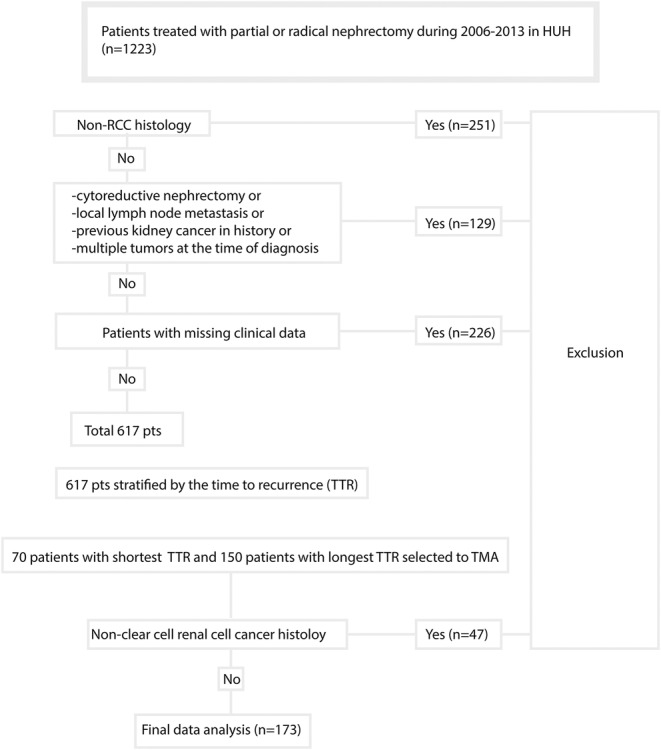
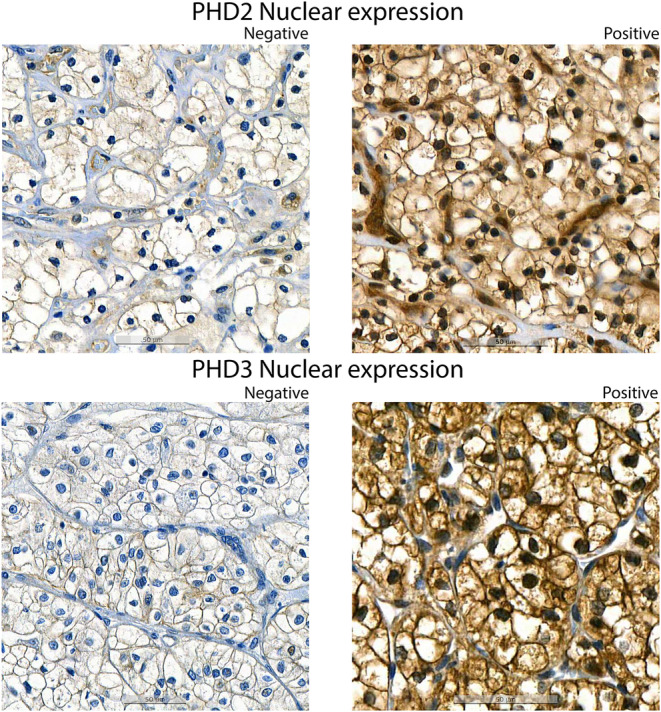
In this study, we analyzed the associations of PHD2 and PHD3 with histopathological tumor features and recurrence-free survival (RFS) in a retrospective cohort of 173 patients who had undergone surgery for localized ccRCC at Helsinki University Hospital (HUH), Finland. An external validation cohort of 191 patients was obtained from Turku University Hospital (TUH), Finland. Tissue-microarrays (TMA) were constructed using the primary tumor samples. Clinical parameters and follow-up information from 2006 to 2019 were obtained from electronic medical records. The cytoplasmic and nuclear expression of PHD2, and PHD3 were scored based on immunohistochemical staining and their associations with histopathological features and RFS were evaluated.
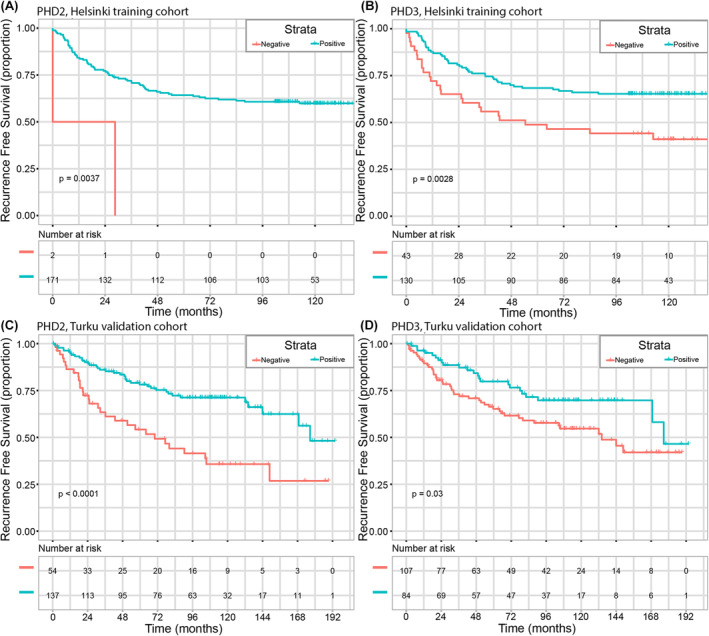
Nuclear PHD2 and PHD3 expression in cancer cells were associated with lower pT-stage and Fuhrman grade compared with negative nuclei. Patients with positive nuclear expression of PHD2 and PHD3 in cancer cells had favorable RFS compared with patients having negative tumors. The nuclear expression of PHD2 was independently associated with a decreased risk of disease recurrence or death from RCC in multivariable analysis. These results were observed in both cohorts.
The absence of nuclear PHD2 and PHD3 expression in ccRCC was associated with poor RFS and the nuclear expression of PHD2 predicted RFS regardless of other known histopathological prognostic factors. Nuclear PHD2 and PHD3 are potential prognostic biomarkers in patients with localized ccRCC and should be further investigated and validated in prospective studies.
缺氧诱导因子 HIF-1α 和 HIF-2α 及其主要调节因子脯氨酰羟化酶结构域蛋白(PHD)介导细胞对缺氧的反应,并促进透明细胞肾细胞癌(ccRCC)的肿瘤进展。这些生物标志物可能会提高传统组织病理学特征在预测局限性 ccRCC 患者肾切除术后疾病进展方面的价值,并指导辅助治疗患者的选择。
本研究分析了芬兰赫尔辛基大学医院(HUH) 173 例局限性 ccRCC 手术患者的 PHD2 和 PHD3 与组织病理学肿瘤特征和无复发生存(RFS)的相关性。从芬兰图尔库大学医院(TUH)获得了 191 例外部验证队列患者。使用原发性肿瘤样本构建组织微阵列(TMA)。从电子病历中获取 2006 年至 2019 年的临床参数和随访信息。基于免疫组织化学染色,对 PHD2 和 PHD3 的细胞质和核表达进行评分,并评估其与组织病理学特征和 RFS 的相关性。
与阴性核相比,癌细胞中核 PHD2 和 PHD3 的表达与较低的 pT 分期和 Fuhrman 分级相关。与阴性肿瘤患者相比,癌细胞中 PHD2 和 PHD3 核表达阳性的患者 RFS 较好。多变量分析显示,PHD2 的核表达与降低的 RCC 疾病复发或死亡风险独立相关。这些结果在两个队列中均观察到。
ccRCC 中缺乏核 PHD2 和 PHD3 的表达与 RFS 不良相关,而核 PHD2 的表达预测了 RFS,无论其他已知的组织病理学预后因素如何。核 PHD2 和 PHD3 可能是局限性 ccRCC 患者的潜在预后生物标志物,应在前瞻性研究中进一步研究和验证。