
缺氧诱导因子脯氨酰羟化酶结构域蛋白(PHDs):抗肿瘤治疗的潜在靶点?
HIF-Prolyl Hydroxylase Domain Proteins (PHDs) in Cancer-Potential Targets for Anti-Tumor Therapy?
作者信息
Gaete Diana, Rodriguez Diego, Watts Deepika, Sormendi Sundary, Chavakis Triantafyllos, Wielockx Ben
机构信息
Institute of Clinical Chemistry and Laboratory Medicine, Technische Universität Dresden, 01307 Dresden, Germany.
出版信息
Cancers (Basel). 2021 Feb 27;13(5):988. doi: 10.3390/cancers13050988.
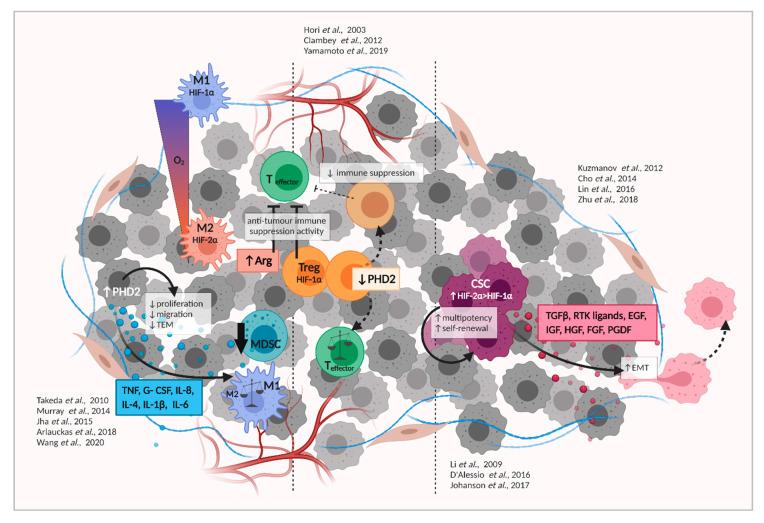
Solid tumors are typically associated with unbridled proliferation of malignant cells, accompanied by an immature and dysfunctional tumor-associated vascular network. Consequent impairment in transport of nutrients and oxygen eventually leads to a hypoxic environment wherein cells must adapt to survive and overcome these stresses. Hypoxia inducible factors (HIFs) are central transcription factors in the hypoxia response and drive the expression of a vast number of survival genes in cancer cells and in cells in the tumor microenvironment. HIFs are tightly controlled by a class of oxygen sensors, the HIF-prolyl hydroxylase domain proteins (PHDs), which hydroxylate HIFs, thereby marking them for proteasomal degradation. Remarkable and intense research during the past decade has revealed that, contrary to expectations, PHDs are often overexpressed in many tumor types, and that inhibition of PHDs can lead to decreased tumor growth, impaired metastasis, and diminished tumor-associated immune-tolerance. Therefore, PHDs represent an attractive therapeutic target in cancer research. Multiple PHD inhibitors have been developed that were either recently accepted in China as erythropoiesis stimulating agents (ESA) or are currently in phase III trials. We review here the function of HIFs and PHDs in cancer and related therapeutic opportunities.
实体瘤通常与恶性细胞的无节制增殖相关,同时伴有不成熟且功能失调的肿瘤相关血管网络。营养物质和氧气运输的相应受损最终导致缺氧环境,在这种环境中细胞必须适应以存活并克服这些压力。缺氧诱导因子(HIFs)是缺氧反应中的核心转录因子,驱动癌细胞和肿瘤微环境中的细胞中大量存活基因的表达。HIFs受到一类氧传感器——HIF脯氨酰羟化酶结构域蛋白(PHDs)的严格调控,PHDs使HIFs羟化,从而标记它们以便蛋白酶体降解。在过去十年中,显著且深入的研究表明,与预期相反,PHDs在许多肿瘤类型中常常过度表达,并且抑制PHDs可导致肿瘤生长减缓、转移受损以及肿瘤相关免疫耐受减弱。因此,PHDs是癌症研究中一个有吸引力的治疗靶点。已经开发出多种PHD抑制剂,其中一些最近在中国被批准作为促红细胞生成素(ESA),还有一些目前正处于III期试验阶段。我们在此综述HIFs和PHDs在癌症中的功能以及相关的治疗机会。

 Zotero 插件