Department of Emergency, Shenzhen Second People's Hospital,The First Affiliated Hospital of Shenzhen University, No. 3002 Sungang Road, Futian District, Shenzhen, 518035, Guangdong, China.
Department of Nephrology, Shenzhen Second People's Hospital, Shenzhen, 518035, Guangdong, China.
Cardiovasc Diabetol. 2024 Feb 24;23(1):81. doi: 10.1186/s12933-024-02165-7.
Current literature is deficient in robust evidence delineating the correlation between the triglyceride glucose-body mass index (TyG-BMI) and the incidence of stroke. Consequently, this investigation seeks to elucidate the potential link between TyG-BMI and stroke risk in a cohort of middle-aged and senior Chinese individuals.
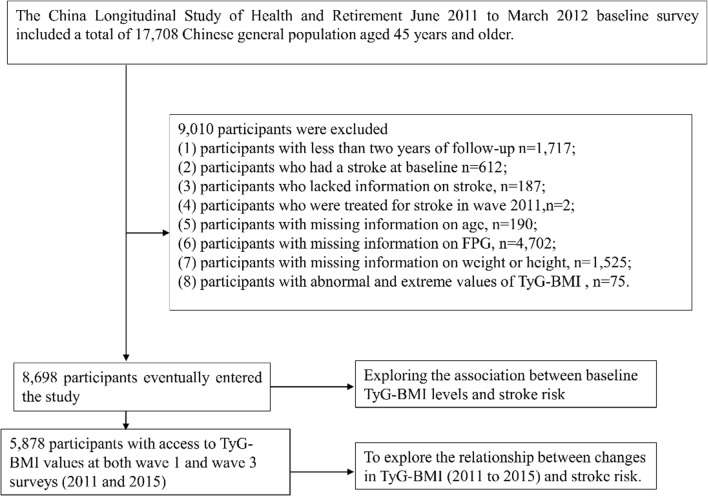
This study employs longitudinal data from four waves of the China Health and Retirement Longitudinal Study (CHARLS) conducted in 2011, 2013, 2015, and 2018, encompassing 8,698 participants. The CHARLS cohort was assembled using a multistage probability sampling technique. Participants underwent comprehensive evaluations through standardized questionnaires administered via face-to-face interviews. Our analytic strategy involved the application of Cox proportional hazards regression models to investigate the association between TyG-BMI and the risk of stroke. To discern potential non-linear relationships, we incorporated Cox proportional hazards regression with smooth curve fitting. Additionally, we executed a battery of sensitivity and subgroup analyses to validate the robustness of our findings.
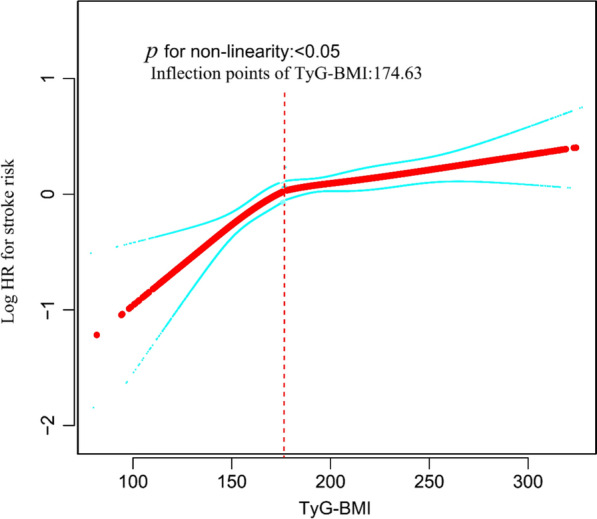
Our study utilized a multivariate Cox proportional hazards regression model and found a significant correlation between the TyG-BMI and the risk of stroke. Specifically, a 10-unit increase in TyG-BMI corresponded to a 4.9% heightened risk of stroke (HR = 1.049, 95% CI 1.029-1.069). The analysis also uncovered a non-linear pattern in this relationship, pinpointed by an inflection point at a TyG-BMI value of 174.63. To the left of this inflection point-meaning at lower TyG-BMI values-a 10-unit hike in TyG-BMI was linked to a more substantial 14.4% rise in stroke risk (HR 1.144; 95% CI 1.044-1.253). Conversely, to the right of the inflection point-at higher TyG-BMI values-each 10-unit increment was associated with a smaller, 3.8% increase in the risk of stroke (HR 1.038; 95% CI 1.016-1.061).
In the middle-aged and elderly Chinese population, elevated TyG-BMI was significantly and positively associated with stroke risk. In addition, there was also a specific non-linear association between TyG-BMI and stroke (inflection point 174.63). Further reduction of TyG-BMI below 174.63 through lifestyle changes and dietary control can significantly reduce the risk of stroke.
目前的文献缺乏有力证据来描述甘油三酯-葡萄糖-体重指数(TyG-BMI)与中风发病率之间的相关性。因此,本研究旨在探讨中年和老年中国人中 TyG-BMI 与中风风险之间的潜在联系。
本研究使用了 2011 年、2013 年、2015 年和 2018 年四次中国健康与退休纵向研究(CHARLS)的纵向数据,共纳入 8698 名参与者。CHARLS 队列采用多阶段概率抽样技术组建。通过面对面访谈的方式,对参与者进行标准化问卷的全面评估。我们采用 Cox 比例风险回归模型来探讨 TyG-BMI 与中风风险之间的关系。为了识别潜在的非线性关系,我们采用 Cox 比例风险回归与平滑曲线拟合相结合的方法。此外,我们还进行了一系列敏感性和亚组分析,以验证研究结果的稳健性。
我们的研究采用多变量 Cox 比例风险回归模型,发现 TyG-BMI 与中风风险之间存在显著相关性。具体来说,TyG-BMI 增加 10 个单位,中风风险增加 4.9%(HR=1.049,95%CI 1.029-1.069)。分析还发现,这种关系存在非线性模式,拐点位于 TyG-BMI 值 174.63。在拐点左侧,即 TyG-BMI 值较低的情况下,TyG-BMI 增加 10 个单位,中风风险增加 14.4%(HR 1.144;95%CI 1.044-1.253)。相反,在拐点右侧,即 TyG-BMI 值较高的情况下,TyG-BMI 每增加 10 个单位,中风风险增加 3.8%(HR 1.038;95%CI 1.016-1.061)。
在中年和老年中国人群中,升高的 TyG-BMI 与中风风险显著正相关。此外,TyG-BMI 与中风之间还存在特定的非线性关联(拐点 174.63)。通过生活方式改变和饮食控制,将 TyG-BMI 降低到 174.63 以下,可以显著降低中风风险。