
我们呼吸的空气:减轻中东呼吸综合征冠状病毒(MERS-CoV)在住院病房空气传播的通风策略数值研究。
The air we breathe: Numerical investigation of ventilation strategies to mitigate airborne dispersion of MERS-CoV in inpatient wards.
作者信息
Satheesan Manoj Kumar, Tsang Tsz Wun, Wong Ling Tim, Mui Kwok Wai
机构信息
Department of Building Environment and Energy Engineering, The Hong Kong Polytechnic University, Hung Hom, Hong Kong SAR, China.
出版信息
Heliyon. 2024 Feb 14;10(4):e26159. doi: 10.1016/j.heliyon.2024.e26159. eCollection 2024 Feb 29.
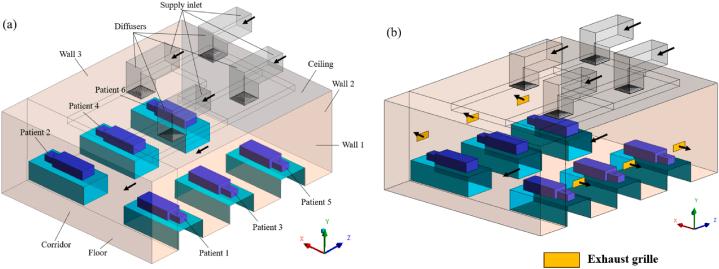
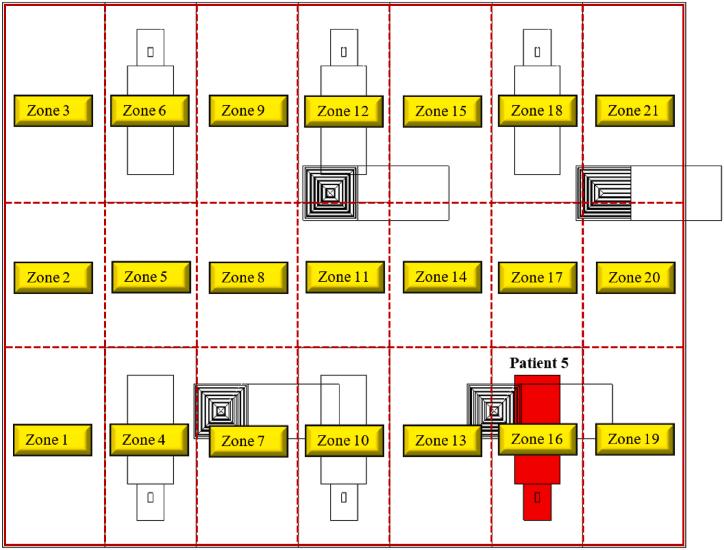
Ventilation strategies for infection control in hospitals has been predominantly directed towards isolation rooms and operating theatres, with relatively less emphasis on perceived low risk spaces, such as general wards. Typically, the ventilation systems in general wards are intended to optimize patient thermal comfort and energy conservation. The emission of pathogens from exhalation activity, such as sneezing, by an undiagnosed infectious patient admitted to general wards, is a significant concern for infection outbreaks. However, the ventilation guidelines for general wards with respect to infection control are vague. This research article presents a numerical study on the effect of varying air change rates (3 h, 6 h, 9 h, 13 h) and exhaust flow rates (10%, 50% of supply air quantity) on the concentration of airborne pathogens in a mechanically ventilated general inpatient ward. The findings imply that the breathing zone directly above the source patient has the highest level of pathogen exposure, followed by the breathing zones at the bedside and adjacent patients close to the source patient. The dispersion of pathogens throughout the ward over time is also apparent. However, a key difference while adopting a lower ACH (3 h) and a higher ACH (13 h) in this study was that the latter had a significantly lower number of suspended pathogens in the breathing zone than the former. Thus, this research suggests high ventilation rates for general wards, contrary to current ventilation standards. In addition, combining a higher air change rate (13 h) with a high exhaust flow rate (50% of supply air) through a local exhaust grille dramatically reduced suspended pathogens within the breathing zone, further mitigating the risk of pathogen exposure for ward users. Therefore, this study presents an effective ventilation technique to dilute and eliminate airborne infectious pathogens, minimizing their concentration and the risk of infection.
医院感染控制的通风策略主要针对隔离病房和手术室,而对普通病房等被认为风险较低的空间相对关注较少。通常,普通病房的通风系统旨在优化患者的热舒适度并节约能源。对于收治到普通病房的未确诊感染患者,打喷嚏等呼气活动中病原体的排放是感染爆发的一个重大问题。然而,普通病房在感染控制方面的通风指南并不明确。本文通过数值研究,探讨了换气次数(3次/小时、6次/小时、9次/小时、13次/小时)和排风量(送风量的10%、50%)变化对机械通风普通住院病房空气中病原体浓度的影响。研究结果表明,源患者正上方的呼吸区病原体暴露水平最高,其次是床边和靠近源患者的相邻患者的呼吸区。病原体在病房内随时间的扩散也很明显。然而,本研究中采用较低换气次数(3次/小时)和较高换气次数(13次/小时)的一个关键区别在于,后者呼吸区内悬浮病原体的数量明显低于前者。因此,与当前通风标准相反,本研究建议普通病房采用高通风率。此外,通过局部排风口格栅将较高的换气次数(13次/小时)与高排风量(送风量的50%)相结合,可显著减少呼吸区内的悬浮病原体,进一步降低病房使用者接触病原体的风险。因此,本研究提出了一种有效的通风技术,可稀释和消除空气中的传染性病原体,将其浓度和感染风险降至最低。






 Zotero 插件