Gebremariam Hintsa G, Taye Shifferaw, Tarekegn Abrham Gebre
Civil and Environmental Engineering, Addis Ababa Institute of Technology, Addis Ababa University, Addis Ababa, Ethiopia.
Department of Civil Engineering, College of Engineering and Technology, Adigrat University, Adigrat, Tigray, Ethiopia.
Heliyon. 2024 Feb 14;10(4):e26212. doi: 10.1016/j.heliyon.2024.e26212. eCollection 2024 Feb 29.
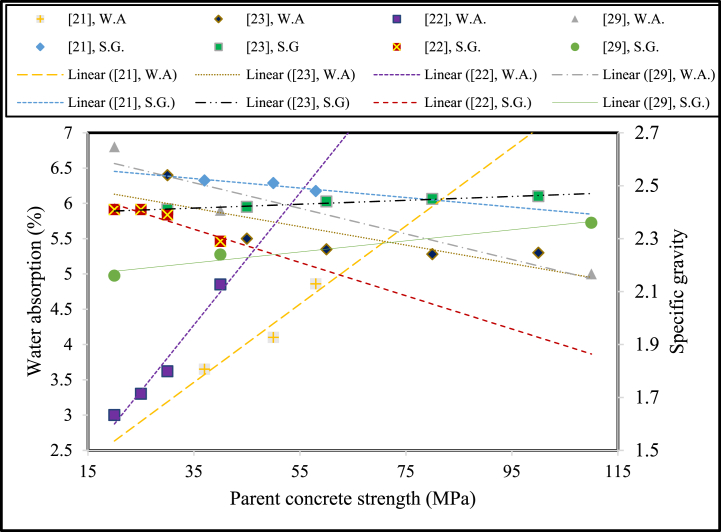
Previous studies in the literature have illustrated that the strength properties of the parent concrete (PC), that might come from an assortment of origins, may considerably affect the characteristics of Recycled Concrete Aggregates (RCAs) and Recycled Aggregate Concrete (RAC). The effects of PC strength on physical, mechanical, long-term, and microstructural properties of RCAs and RACs have been extensively studied. These properties include water absorption, specific gravity, compressive strength, elastic modulus, splitting tensile strength, flexural strength, durability, and microstructure. These studies examining the influence of source concrete grade on the characteristics of RCA as well as RAC have been comprehensively reviewed in this paper. Upon reviewing the literature, it was found that the porosity of the source concrete and the crushing procedure of the source concrete aggregates were the two main causes of variability in the results of the RCA characteristics. Contrary to the widespread perception that, quote, "RACs in general have lower quality than virgin aggregate concrete", studies on the effects of parent concrete on RAC characteristics have shown that RACs produced with aggregates obtained from recycling high-strength concrete (not less than 80 MPa) can have equivalent or better characteristics than conventional natural aggregate concrete. Therefore, by carefully considering the quality of the RCAs, it is possible to produce high-performance RAC without the need for additional natural aggregates. The limitations of previous studies have been identified in this work, and recommendations for further research have been provided
文献中先前的研究表明,母体混凝土(PC)的强度特性可能源自多种来源,会对再生混凝土骨料(RCA)和再生骨料混凝土(RAC)的特性产生重大影响。PC强度对RCA和RAC的物理、力学、长期和微观结构特性的影响已得到广泛研究。这些特性包括吸水率、比重、抗压强度、弹性模量、劈裂抗拉强度、抗弯强度、耐久性和微观结构。本文对这些研究进行了全面综述,这些研究考察了源混凝土等级对RCA以及RAC特性的影响。在查阅文献时发现,源混凝土的孔隙率和源混凝土骨料的破碎过程是RCA特性结果变异性的两个主要原因。与普遍认为的“一般来说,RAC的质量低于原生骨料混凝土”相反,关于母体混凝土对RAC特性影响的研究表明,用回收高强度混凝土(不低于80MPa)获得的骨料生产的RAC可以具有与传统天然骨料混凝土相当或更好的特性。因此,通过仔细考虑RCA的质量,有可能生产出高性能的RAC,而无需额外的天然骨料。这项工作确定了先前研究的局限性,并提供了进一步研究的建议