Myint Leslie
Department of Mathematics, Statistics, and Computer Science, Macalester College, Saint Paul, MN USA.
Health Serv Outcomes Res Methodol. 2024;24(1):95-111. doi: 10.1007/s10742-023-00305-2. Epub 2023 Mar 16.
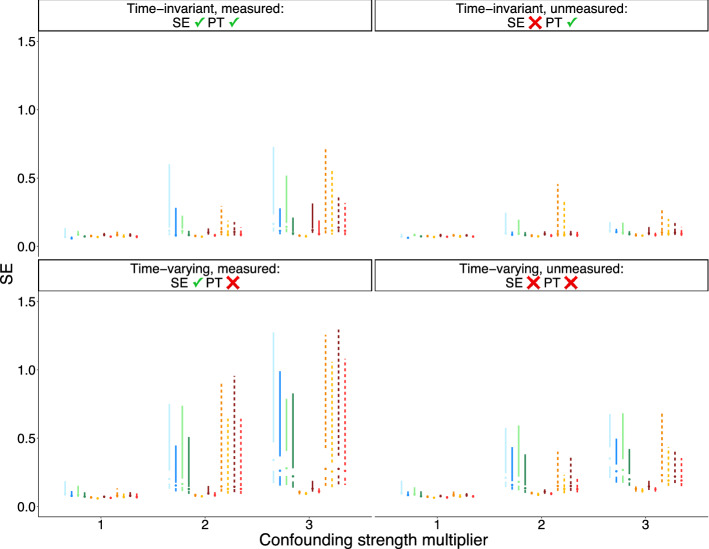
This article clarifies how the biostatistical literature on time-varying treatments (TVT) can provide tools for dealing with time-varying confounding in difference-in-differences (DiD) studies. I use a simulation study to compare the bias and standard error of inverse probability weighting estimators from the TVT framework, a DiD framework, and hybrid approaches that combine ideas from both frameworks. I simulated longitudinal data with treatment effect heterogeneity over multiple time points using linear and logistic models. Simulation settings looked at both time-invariant confounders and time-varying confounders affected by prior treatment. Estimators that combined ideas from both frameworks had lower bias than standard TVT and DiD estimators when assumptions were unmet. The TVT framework provides estimation tools that can complement DiD tools in a wide range of applied settings. It also provides alternate estimands for consideration in policy settings.
本文阐明了关于时变治疗(TVT)的生物统计学文献如何为处理差分法(DiD)研究中的时变混杂因素提供工具。我进行了一项模拟研究,以比较来自TVT框架、DiD框架以及结合了两个框架思想的混合方法的逆概率加权估计量的偏差和标准误差。我使用线性模型和逻辑模型模拟了在多个时间点上具有治疗效果异质性的纵向数据。模拟设置考察了时不变混杂因素以及受先前治疗影响的时变混杂因素。当假设不成立时,结合了两个框架思想的估计量比标准的TVT和DiD估计量具有更低的偏差。TVT框架提供了可以在广泛的应用场景中补充DiD工具的估计工具。它还提供了在政策制定场景中可供考虑的替代估计量。