Amambo Glory N, Fombad Fanny F, Chounna Ndongmo Patrick W, Abong Raphael Awah, Njouendou Abdel Jelil, Beng Amuam Andrew, Nji Theobald Mue, Esum Mathias Eyong, Fru-Cho Jerome, Manuel Ritter, Kebede Deribe, Enyong Peter Ivo, Hoerauf Achim, Koudou Benjamin, Bockarie Moses, Wanji Samuel
Parasites and Vector Research Unit (PAVRU), Department of Microbiology and Parasitology, University of Buea, P.O. Box 63, Buea, Cameroon.
Res1earch Foundation for Tropical Diseases and Environment (REFOTDE), P.O. Box 474, Buea, Cameroon.
Parasite Epidemiol Control. 2024 Feb 17;25:e00343. doi: 10.1016/j.parepi.2024.e00343. eCollection 2024 May.
Loiasis is an endemic filarial infection in the rainforest zone of West and Central Africa. Repeated annual community-directed treatment with ivermectin (CDTI) delivered for several years to control onchocerciasis has been shown to reduce the prevalence and intensity of Loiasis in some co-endemic areas. However, the impact of these multiple rounds of CDTI on entomological indicators of loiasis transmission is not known, and was therefore assessed in this study in areas with contrasting histories of CDTI.
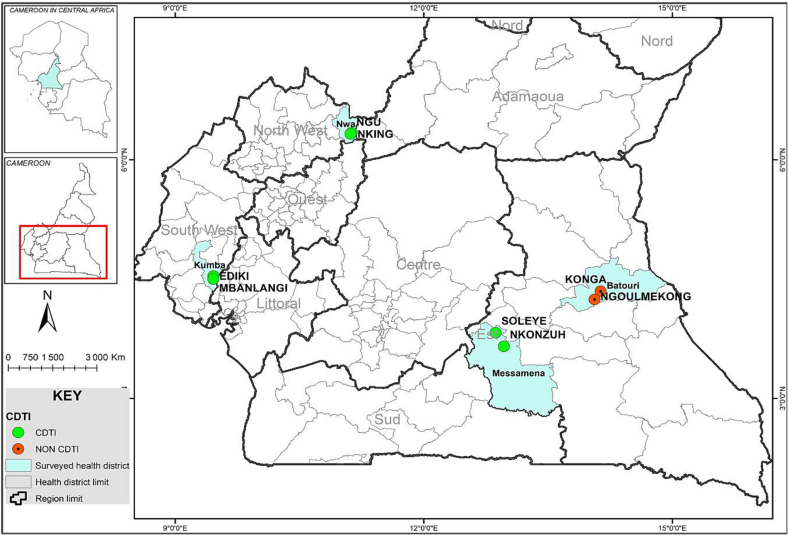
The study was conducted in the East, North-west and South-west 1 CDTI project sites of Cameroon. Two communities per CDTI project were selected for fly collection and dissection. Ivermectin treatment coverage was documented in these areas, and this was correlated to infection and infective rates. A total of 7029 female were collected from 6 communities of the 3 CDTI projects (East, North-west, and South-west 1) and from 2 communities in a non-CDTI district (East).
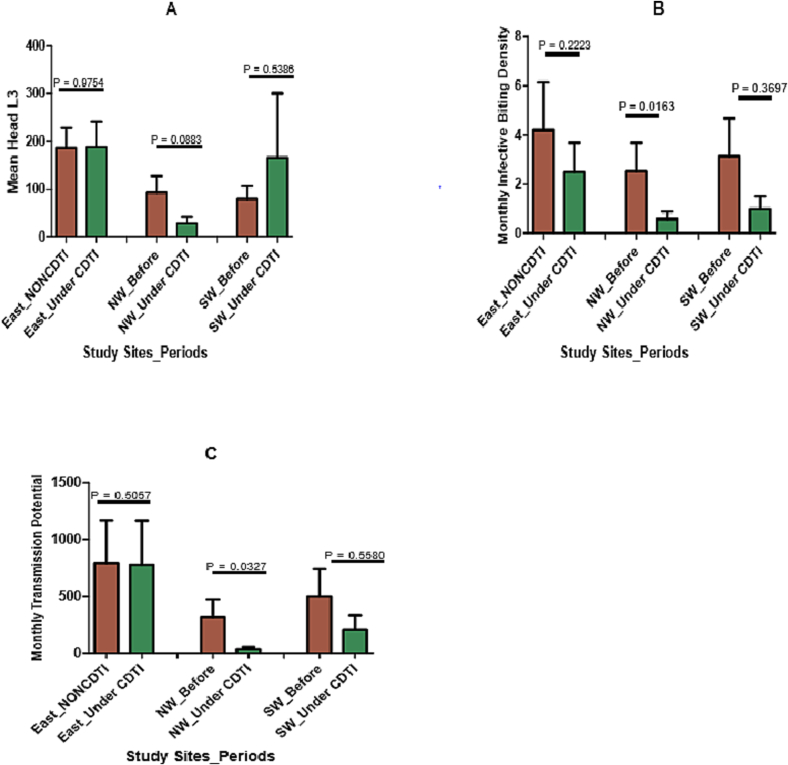
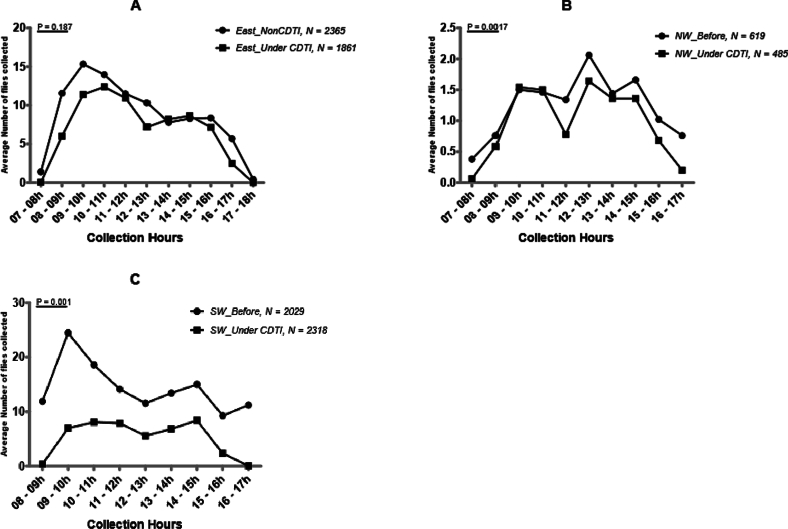
biting densities and parous rates were significantly reduced in the North-west and South-west sites post-CDTI, while in the East, biting densities were similar in non-CDTI and CDTI sites, with higher parous rates observed in the non-CDTI site. Infection and infective rates in the East non-CDTI site were 4.4% and 1.8% respectively, as compared to 3.3% and 1.3% in the CDTI site after 10 ivermectin rounds (there were no baseline data for the latter). In the North-west site, significant reductions in infection and infective rates from 10.2% and 4.2% respectively, to 3.5% and 1.2 (after 9 rounds of ivermectin treatment), were recorded following CDTI. In the South-west, infection rate significantly increased from 1.74% to 2.8% and infective rate remained statistically unchanged after 14 rounds of CDTI (0.45% - 0.40%). Similar trends in Mean Head L3 were observed except in the East site where this indicator was similar in both CDTI and control sites. Only in the North-west site did monthly transmission potentials decrease significantly.
This study demonstrated that the impact of repeated annual treatment with ivermectin for the control of onchocerciasis using community directed delivery approach on the entomological indicators of loiasis varies with bioecological zones. Community directed treatment with ivermectin induced a significant reduction in the entomological indicators of loiasis in the North-West project site which lies in forest savanna area. A non-significant decrease was observed in the East project site and in contrast, a significant increase was observed in the South-West 1 project site which both lies in the rainforest zones.
罗阿丝虫病是西非和中非雨林地区的一种地方性丝虫感染病。多年来,为控制盘尾丝虫病而进行的每年重复的社区定向伊维菌素治疗(CDTI)已被证明可降低一些共流行地区罗阿丝虫病的患病率和感染强度。然而,这些多轮CDTI对罗阿丝虫病传播的昆虫学指标的影响尚不清楚,因此本研究在具有不同CDTI历史的地区对其进行了评估。
该研究在喀麦隆的东部、西北部和西南部1个CDTI项目地点进行。每个CDTI项目选取两个社区进行采蝇和解剖。记录这些地区伊维菌素治疗的覆盖率,并将其与感染率和感染性率相关联。总共从3个CDTI项目(东部、西北部和西南部1)的6个社区以及1个非CDTI地区(东部)的2个社区收集了7029只雌蝇。
在西北部和西南部地区,CDTI后叮咬密度和经产率显著降低,而在东部,非CDTI地区和CDTI地区的叮咬密度相似,非CDTI地区的经产率更高。东部非CDTI地区的感染率和感染性率分别为4.4%和1.8%,而在进行10轮伊维菌素治疗后,CDTI地区的感染率和感染性率分别为3.3%和1.3%(后者无基线数据)。在西北部地区,CDTI后感染率和感染性率从分别的10.2%和4.2%显著降低至3.5%和1.2%(在进行9轮伊维菌素治疗后)。在西南部地区,经过14轮CDTI后,感染率从1.74%显著增加至2.8%,感染性率在统计学上保持不变(0.45% - 0.40%)。除了在东部地区,CDTI地区和对照地区的平均头节L3指标相似外,在其他地区均观察到类似趋势。只有在西北部地区,每月传播潜能显著降低。
本研究表明,采用社区定向给药方法每年重复使用伊维菌素控制盘尾丝虫病对罗阿丝虫病昆虫学指标的影响因生物生态区域而异。在位于森林稀树草原地区的西北部项目地点,社区定向伊维菌素治疗使罗阿丝虫病的昆虫学指标显著降低。在东部项目地点观察到不显著的下降,相反,在均位于雨林地区的西南部1项目地点观察到显著增加。