Garcia Maria João, Leadley Regina, Ross Janine, Bozeat Sasha, Redhead Gabrielle, Hansson Oskar, Iwatsubo Takeshi, Villain Nicolas, Cummings Jeffrey
F. Hoffmann-La Roche, Ltd., Basel, Switzerland.
Mtech Access Ltd, IT Centre, Innovation Way, Heslington, York, UK.
J Alzheimers Dis Rep. 2024 Feb 16;8(1):203-240. doi: 10.3233/ADR-230045. eCollection 2024.
Alzheimer's disease (AD) causes progressive decline of cognition and function. There is a lack of systematic literature reviews on prognostic and predictive factors in its early clinical stages (eAD), i.e., mild cognitive impairment due to AD and mild AD dementia.
To identify prognostic factors affecting eAD progression and predictive factors for treatment efficacy and safety of approved and/or under late-stage development disease-modifying treatments.
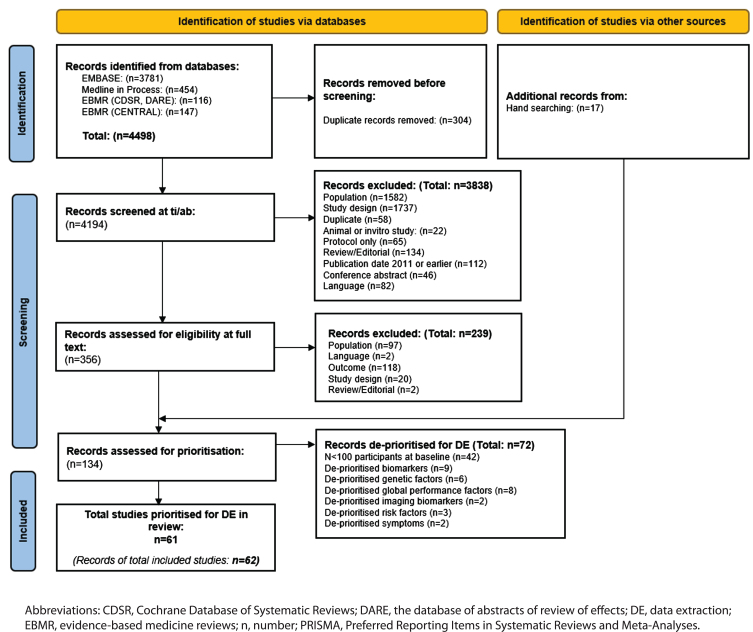
Databases were searched (August 2022) for studies reporting prognostic factors associated with eAD progression and predictive factors for treatment response. The Quality in Prognostic Factor Studies tool or the Cochrane risk of bias tool were used to assess risk of bias. Two reviewers independently screened the records. A single reviewer performed data extraction and quality assessment. A second performed a 20% check. Content experts reviewed and interpreted the data collected.
Sixty-one studies were included. Self-reporting, diagnosis definition, and missing data led to high risk of bias. Population size ranged from 110 to 11,451. Analyses found data indicating that older age was and depression may be associated with progression. Greater baseline cognitive impairment was associated with progression. may be a prognostic factor, a predictive factor for treatment efficacy and predicts an adverse response (ARIA). Elevated biomarkers (CSF/plasma p-tau, CSF t-tau, and plasma neurofilament light) were associated with disease progression.
Age was the strongest risk factor for progression. Biomarkers were associated with progression, supporting their use in trial selection and aiding diagnosis. Baseline cognitive impairment was a prognostic factor. predicted ARIA, aligning with emerging evidence and relevant to treatment initiation/monitoring.
阿尔茨海默病(AD)会导致认知和功能的进行性衰退。目前缺乏关于其临床早期阶段(eAD),即由AD引起的轻度认知障碍和轻度AD痴呆的预后和预测因素的系统性文献综述。
确定影响eAD进展的预后因素以及已获批和/或处于后期研发阶段的疾病修饰治疗的疗效和安全性的预测因素。
检索数据库(2022年8月),查找报告与eAD进展相关的预后因素和治疗反应预测因素的研究。使用预后因素研究质量工具或Cochrane偏倚风险工具评估偏倚风险。两名评审员独立筛选记录。一名评审员进行数据提取和质量评估。另一名进行20%的检查。内容专家对收集到的数据进行审查和解读。
纳入61项研究。自我报告、诊断定义和数据缺失导致高偏倚风险。样本量从110到11451不等。分析发现数据表明年龄较大和抑郁可能与疾病进展相关。更大的基线认知障碍与疾病进展相关。[此处原文缺失部分内容]可能是一个预后因素、治疗疗效的预测因素,并可预测不良事件(淀粉样蛋白相关影像异常,ARIA)。生物标志物升高(脑脊液/血浆磷酸化tau蛋白、脑脊液总tau蛋白和血浆神经丝轻链)与疾病进展相关。
年龄是疾病进展的最强风险因素。生物标志物与疾病进展相关,支持其在试验选择和辅助诊断中的应用。基线认知障碍是一个预后因素。[此处原文缺失部分内容]可预测ARIA,与新出现的证据一致,且与治疗开始/监测相关。