
2022年阿尔茨海默病药物研发进展
Alzheimer's disease drug development pipeline: 2022.
作者信息
Cummings Jeffrey, Lee Garam, Nahed Pouyan, Kambar Mina Esmail Zadeh Nojoo, Zhong Kate, Fonseca Jorge, Taghva Kazem
机构信息
Chambers-Grundy Center for Transformative Neuroscience, Department of Brain Health, School of Integrated Health Sciences University of Nevada, Las Vegas (UNLV) Henderson Nevada USA.
Department of Brain Health, School of Integrated Health Sciences University of Nevada, Las Vegas (UNLV) Henderson Nevada USA.
出版信息
Alzheimers Dement (N Y). 2022 May 4;8(1):e12295. doi: 10.1002/trc2.12295. eCollection 2022.
INTRODUCTION
Alzheimer's disease (AD) represents a global health crisis. Treatments are needed to prevent, delay the onset, slow the progression, improve cognition, and reduce behavioral disturbances of AD. We review the current clinical trials and drugs in development for the treatment of AD.
METHODS
We searched the governmental website clinicaltrials.gov where are all clinical trials conducted in the United States must be registered. We used artificial intelligence (AI) and machine learning (ML) approaches to ensure comprehensive detection and characterization of trials and drugs in development. We use the Common Alzheimer's Disease Research Ontology (CADRO) to classify drug targets and mechanisms of action of drugs in the pipeline.
RESULTS
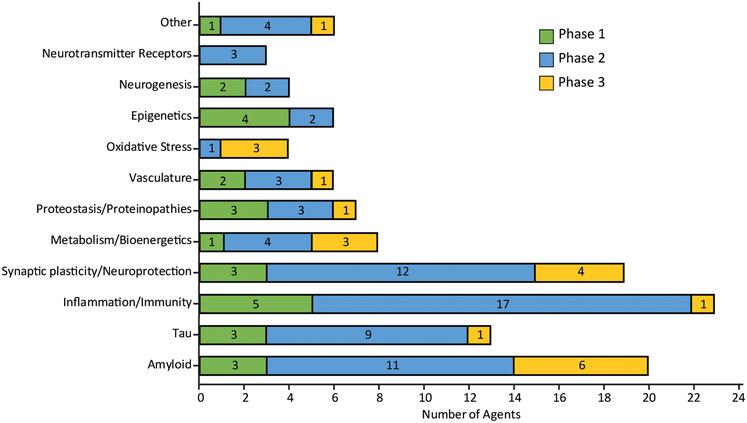
As of January 25, 2022 (index date for this study) there were 143 agents in 172 clinical trials for AD. The pipeline included 31 agents in 47 trials in Phase 3, 82 agents in 94 trials in Phase 2, and 30 agents in 31 trials in Phase 1. Disease-modifying therapies represent 83.2% of the total number of agents in trials; symptomatic cognitive enhancing treatments represent 9.8% of agents in trials; and drugs for the treatment of neuropsychiatric symptoms comprise 6.9%. There is a diverse array of drug targets represented by agents in trials including nearly all CADRO categories. Thirty-seven percent of the candidate agents in the pipeline are repurposed drugs approved for other indications. A total of 50,575 participants are needed to fulfill recruitment requirements for all currently active clinical trials.
DISCUSSION
The AD drug development pipeline has agents representing a substantial array of treatment mechanisms and targets. Advances in drug design, outcome measures, use of biomarkers, and trial conduct promise to accelerate the delivery of new and better treatments for patients with AD.
HIGHLIGHTS
There are 143 drugs in the current Alzheimer's disease (AD) drug development pipeline.Disease-modifying therapies represent 83.2% of the candidate treatments.Current trials require 50,575 participants who will donate 3,878,843 participant-weeks to clinical trials.The biopharmaceutical industry sponsors 50% of all clinical trials including 68% of Phase 3 trials.Sixty-three percent of Phase 3 trials and 46% of Phase 2 trials include non-North American clinical trial site locations indicating the global ecosystem required for AD drug development.
引言
阿尔茨海默病(AD)是一场全球健康危机。需要有治疗方法来预防、延缓发病、减缓疾病进展、改善认知并减少AD的行为障碍。我们综述了目前用于治疗AD的临床试验和正在研发的药物。
方法
我们搜索了政府网站clinicaltrials.gov,在美国进行的所有临床试验都必须在该网站注册。我们使用人工智能(AI)和机器学习(ML)方法来确保全面检测和描述正在研发的试验和药物。我们使用常见阿尔茨海默病研究本体(CADRO)对正在研发的药物的靶点和作用机制进行分类。
结果
截至2022年1月25日(本研究的索引日期),有143种药物用于172项AD临床试验。研发管线包括31种药物用于47项3期试验、82种药物用于94项2期试验以及30种药物用于31项1期试验。疾病修饰疗法占试验药物总数的83.2%;有症状的认知增强治疗占试验药物的9.8%;用于治疗神经精神症状的药物占6.9%。试验中的药物代表了各种各样的药物靶点,几乎涵盖了所有CADRO类别。研发管线中37%的候选药物是已获批用于其他适应症的重新利用药物。所有当前正在进行的临床试验共需要招募50575名参与者。
讨论
AD药物研发管线中的药物代表了大量的治疗机制和靶点。药物设计、结局指标、生物标志物的使用以及试验开展方面的进展有望加速为AD患者提供新的、更好的治疗方法。
要点
目前阿尔茨海默病(AD)药物研发管线中有143种药物。疾病修饰疗法占候选治疗方法的83.2%。当前试验需要50575名参与者,他们将为临床试验贡献3878843个参与者周。生物制药行业赞助了所有临床试验的50%,包括68%的3期试验。63%的3期试验和46%的2期试验包括非北美临床试验地点,这表明AD药物研发需要全球生态系统。


 Zotero 插件