Li Min, Zhang Fang-Jie, Bai Rui-Jun
Department of Orthopaedics, Wuxi Ninth People's Hospital, Soochow University, Wuxi, Jiangsu, 214000, People's Republic of China.
National Clinical Research Center for Geriatric Disorders (Xiangya Hospital), Changsha, Hunan, 410008, People's Republic of China.
J Inflamm Res. 2024 Feb 19;17:1105-1120. doi: 10.2147/JIR.S444758. eCollection 2024.
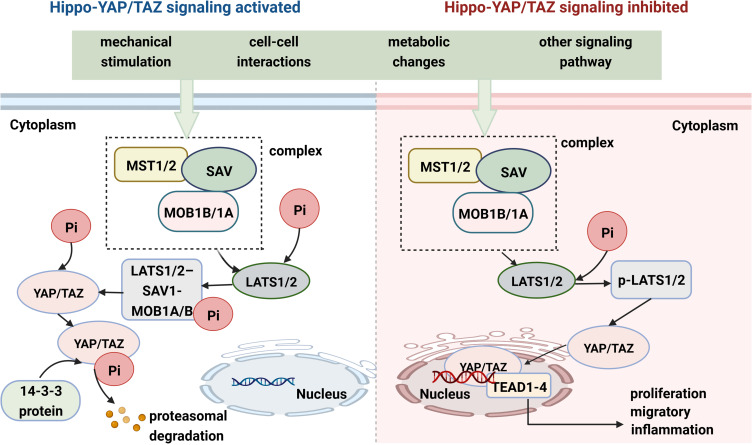
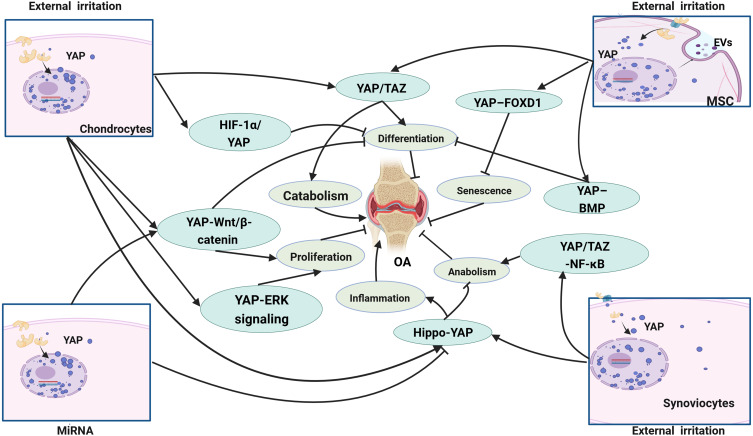
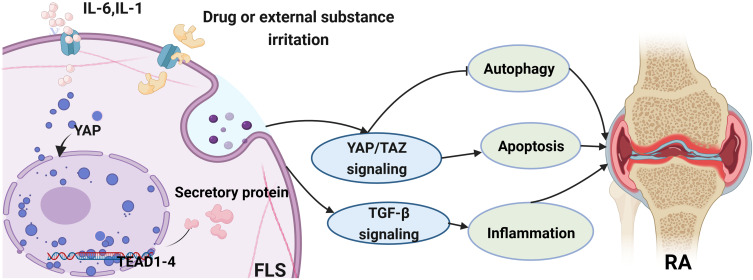
Arthritis is the most prevalent joint disease and is characterized by articular cartilage degradation, synovial inflammation, and changes in periarticular and subchondral bone. Recent studies have reported that Yes-associated protein (YAP) and the transcriptional coactivator with PDZ-binding motif (TAZ) have significant effects on the proliferation, migration, and survival of chondrocytes and fibroblast-like synovial cells (FLSs). YAP/TAZ signaling pathway, as well as the related Hippo-YAP signaling pathway, are responsible for the condition of cells and articular cartilage in joints. They are tightly regulated to maintain metabolism in chondrocytes and FLSs because abnormal expression may result in cartilage damage. However, the roles and mechanisms of the Hippo-YAP pathway in arthritis remain largely unknown. This review summarizes the roles and key functions of YAP/TAZ and the Hippo-YAP signaling pathway in FLSs and chondrocytes for the induction of proliferation, migration, survival, and differentiation in rheumatoid arthritis (RA) and osteoarthritis (OA) research. We also discuss the therapeutic strategies involving YAP/TAZ and the related Hippo-YAP signaling pathway involved in OA.
关节炎是最常见的关节疾病,其特征为关节软骨退化、滑膜炎症以及关节周围和软骨下骨的变化。最近的研究报道,Yes相关蛋白(YAP)和具有PDZ结合基序的转录共激活因子(TAZ)对软骨细胞和成纤维样滑膜细胞(FLS)的增殖、迁移和存活具有显著影响。YAP/TAZ信号通路以及相关的Hippo-YAP信号通路负责关节中细胞和关节软骨的状态。它们受到严格调控以维持软骨细胞和FLS中的代谢,因为异常表达可能导致软骨损伤。然而,Hippo-YAP通路在关节炎中的作用和机制仍 largely未知。本综述总结了YAP/TAZ和Hippo-YAP信号通路在FLS和软骨细胞中在类风湿关节炎(RA)和骨关节炎(OA)研究中诱导增殖、迁移、存活和分化的作用及关键功能。我们还讨论了涉及YAP/TAZ和与OA相关的Hippo-YAP信号通路的治疗策略。