Ali Afgar, Mahla Sattarzadeh Bardsiri, Reza Vahidi, Hossein Arezoomand, Bahareh Kashani, Mohammad Hosseininaveh, Fatemeh Sharifi, Mostafa Amopour Bahnamiry, Leili Rouhi
Research Center for Hydatid Disease in Iran Kerman University of Medical Sciences Kerman Iran.
Stem Cells and Regenerative Medicine Innovation Center Kerman University of Medical Sciences Kerman Iran.
EJHaem. 2024 Feb 11;5(1):191-205. doi: 10.1002/jha2.849. eCollection 2024 Feb.
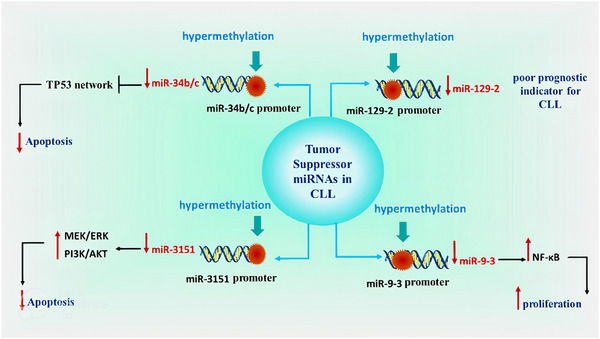
Small noncoding ribonucleic acids called microRNAs coordinate numerous critical physiological and biological processes such as cell division, proliferation, and death. These regulatory molecules interfere with the function of many genes by binding the 3'-UTR region of target mRNAs to inhibit their translation or even degrade them. Given that a large proportion of miRNAs behave as either tumor suppressors or oncogenes, any genetic or epigenetic aberration changeing their structure and/or function could initiate tumor formation and development. An example of such cancers is chronic lymphocytic leukemia (CLL), the most prevalent adult leukemia in Western nations, which is caused by unregulated growth and buildup of defective cells in the peripheral blood and lymphoid organs. Genetic alterations at cellular and molecular levels play an important role in the occurrence and development of CLL. In this vein, it was noted that the development of this disease is noticeably affected by changes in the expression and function of miRNAs. Many studies on miRNAs have shown that these molecules are pivotal in the prognosis of different cancers, including CLL, and their epigenetic alterations (e.g., methylation) can predict disease progression and response to treatment. Furthermore, miRNAs are involved in the development of drug resistance in CLL, and targeting these molecules can be considered a new therapeutic approach for the treatment of this disease. MiRNA screening can offer important information on the etiology and development of CLL. Considering the importance of miRNAs in gene expression regulation, their application in the diagnosis, prognosis, and treatment of CLL is reviewed in this paper.
被称为微小RNA(miRNA)的小型非编码核糖核酸协调着众多关键的生理和生物学过程,如细胞分裂、增殖和死亡。这些调节分子通过与靶标mRNA的3'-UTR区域结合来干扰许多基因的功能,从而抑制其翻译甚至使其降解。鉴于很大一部分miRNA起着抑癌基因或癌基因的作用,任何改变其结构和/或功能的遗传或表观遗传畸变都可能引发肿瘤的形成和发展。慢性淋巴细胞白血病(CLL)就是这样一种癌症的例子,它是西方国家最常见的成人白血病,由外周血和淋巴器官中缺陷细胞的不受控制的生长和积累引起。细胞和分子水平的基因改变在CLL的发生和发展中起着重要作用。在这方面,人们注意到这种疾病的发展受到miRNA表达和功能变化的显著影响。许多关于miRNA的研究表明,这些分子在包括CLL在内的不同癌症的预后中起着关键作用,并且它们的表观遗传改变(例如甲基化)可以预测疾病进展和对治疗的反应。此外,miRNA参与了CLL的耐药性发展,靶向这些分子可被视为治疗这种疾病的一种新的治疗方法。miRNA筛选可以提供有关CLL病因和发展的重要信息。鉴于miRNA在基因表达调控中的重要性,本文对其在CLL诊断、预后和治疗中的应用进行了综述。