Alyamany Ruah, Alnughmush Ahmed, Almutlaq Malak, Alyamany Mohammed, Alfayez Mansour
Department of Hematology, Stem Cell Transplant and Cellular Therapy, Oncology Centre, King Faisal Specialist Hospital and Research Centre, Riyadh, Saudi Arabia.
Department of Medicine, King Faisal Specialist Hospital and Research Centre, Riyadh, Saudi Arabia.
Front Oncol. 2024 Feb 9;14:1345492. doi: 10.3389/fonc.2024.1345492. eCollection 2024.
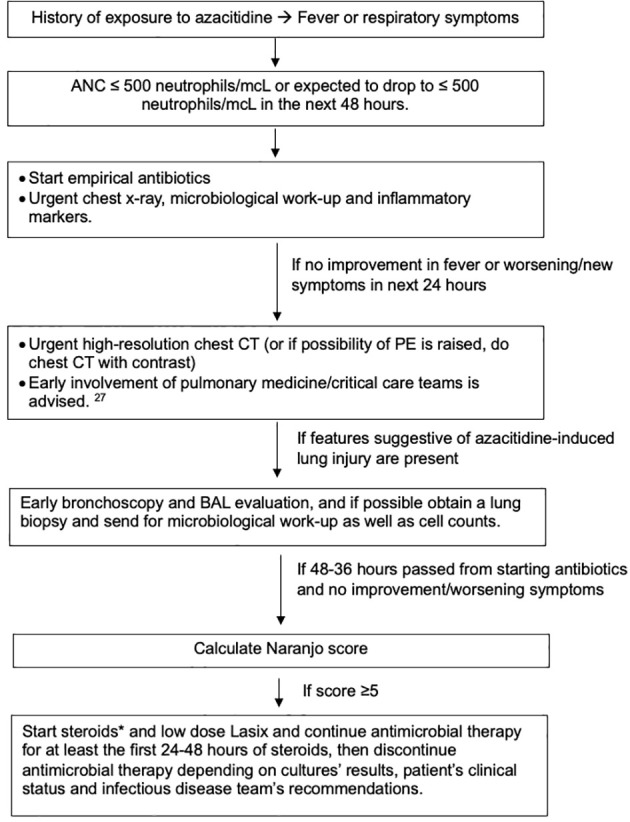
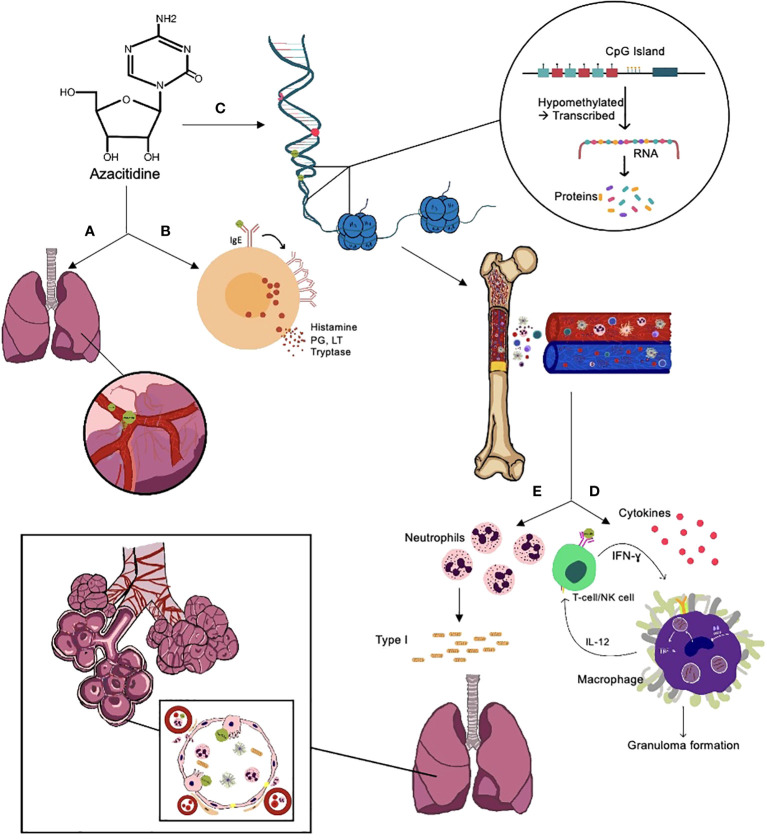
Azacitidine, a hypomethylating agent, has caused a paradigm shift in the outcomes of patients with myelodysplastic syndrome (MDS) and acute myeloid leukemia (AML) who are not eligible for stem cell transplantation, particularly in combination with BCL2 and IDH inhibitors. Azacitidine and Azacitidine-based combinations have been widely considered a safe low-intensity therapy when compared to traditional conventional treatments. The development of lung toxicity from azacitidine is not a well-characterized adverse event. However, if it happens, it can be fatal, especially if not recognized and treated promptly. In this review, we aim to familiarize the reader with the presentation of azacitidine-induced lung injury, provide our suggested approach to management based on our experience and the current understanding of its mechanism, and review the literature of 20 case reports available on this topic.
阿扎胞苷是一种去甲基化药物,它使不符合干细胞移植条件的骨髓增生异常综合征(MDS)和急性髓系白血病(AML)患者的治疗结果发生了范式转变,特别是与BCL2和异柠檬酸脱氢酶(IDH)抑制剂联合使用时。与传统的常规治疗相比,阿扎胞苷及其联合疗法被广泛认为是一种安全的低强度治疗。阿扎胞苷引起的肺部毒性是一种特征尚不明确的不良事件。然而,如果发生这种情况,可能会致命,尤其是在未得到及时识别和治疗的情况下。在本综述中,我们旨在让读者熟悉阿扎胞苷所致肺损伤的表现,根据我们的经验和对其机制的当前认识提供建议的处理方法,并回顾关于该主题的20例病例报告的文献。