Salas-Ramirez Maikol, Leube Julian, Lassmann Michael, Tran-Gia Johannes
Department of Nuclear Medicine, University Hospital Würzburg, Oberdürrbacher Str. 6, 97080, Würzburg, Germany.
EJNMMI Phys. 2024 Feb 26;11(1):21. doi: 10.1186/s40658-024-00622-6.
CT-based attenuation correction (CT-AC) plays a major role in accurate activity quantification by SPECT/CT imaging. However, the effect of kilovoltage peak (kVp) and quality-reference mAs (QRM) on the attenuation coefficient image (μ-map) and volume CT dose index (CTDI) have not yet been systematically evaluated. Therefore, the aim of this study was to fill this gap and investigate the influence of kVp and QRM on CT-AC in Lu SPECT/CT imaging.
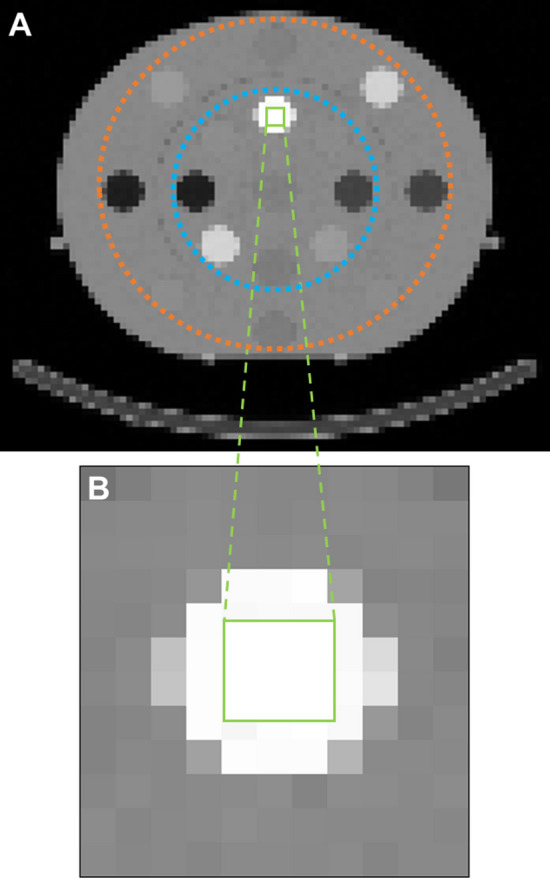
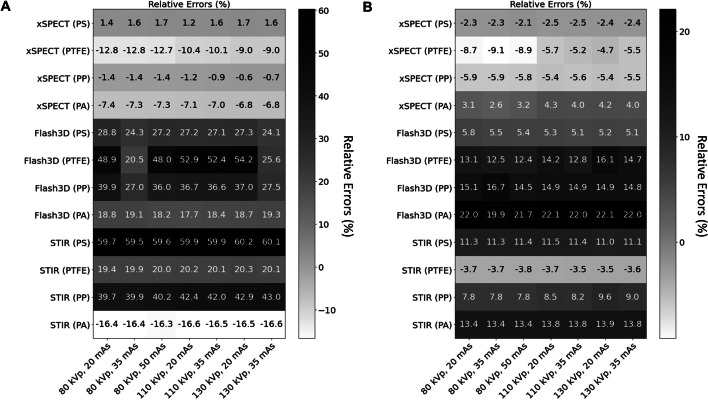
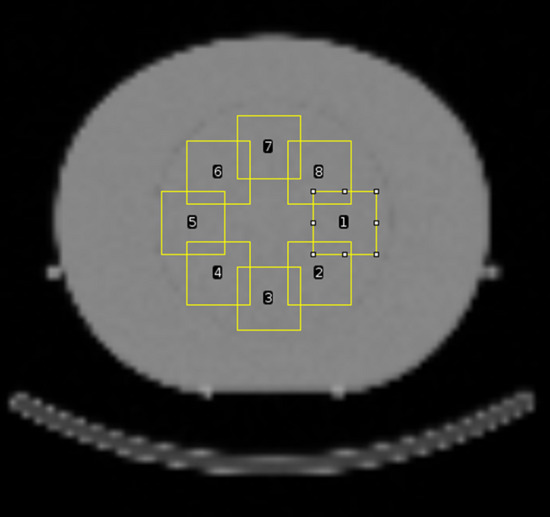
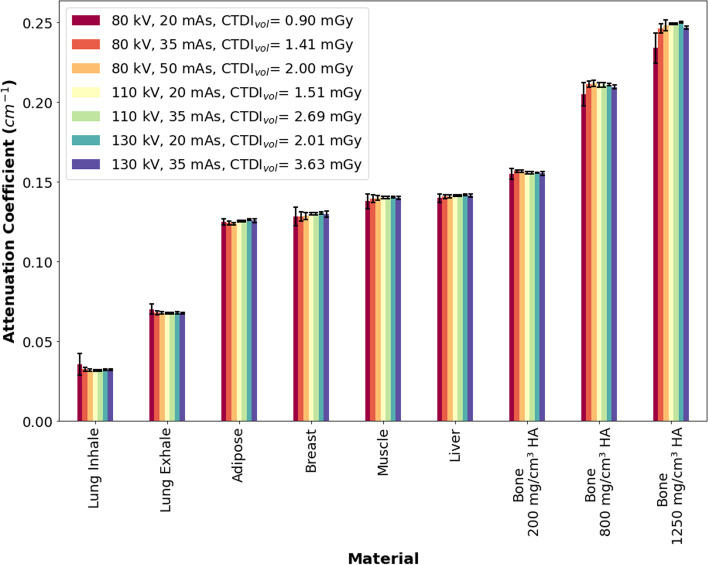
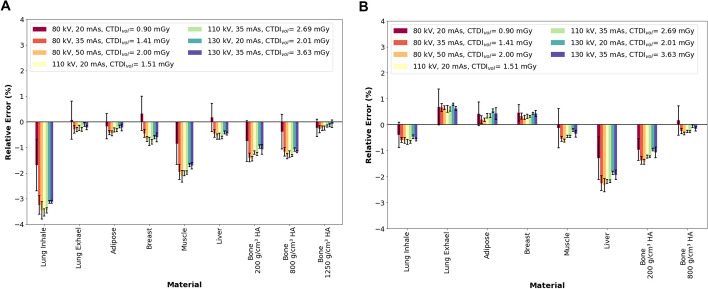
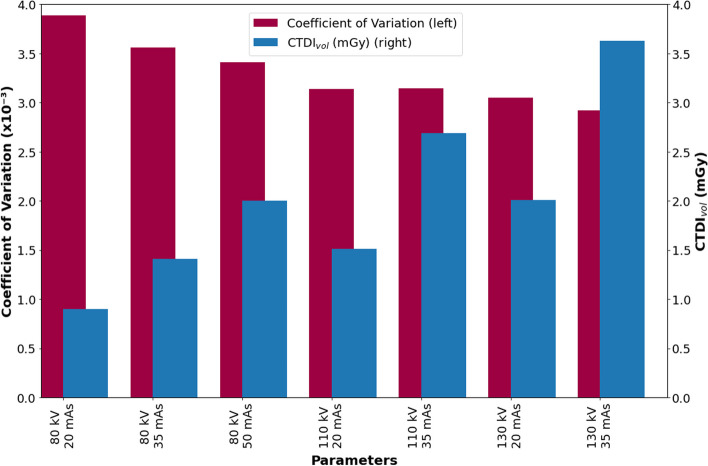
Seventy low-dose CT acquisitions of an Electron Density Phantom (seventeen inserts of nine tissue-equivalent materials) were acquired using various kVp and QRM combinations on a Siemens Symbia Intevo Bold SPECT/CT system. Using manufacturer reconstruction software, Lu μ-maps were generated for each CT image, and three low-dose CT related aspects were examined. First, the μ-map-based attenuation values (μ) were compared with theoretical values (μ). Second, changes in Lu activity expected due to changes in the μ-map were calculated using a modified Chang method. Third, the noise in the μ-map was assessed by measuring the coefficient of variation in a volume of interest in the homogeneous section of the Electron Density Phantom. Lastly, two phantoms were designed to simulate attenuation in four tissue-equivalent materials for two different source geometries (1-mL and 10-mL syringes). Lu SPECT/CT imaging was performed using three different reconstruction algorithms (xSPECT Quant, Flash3D, STIR), and the SPECT-based activities were compared against the nominal activities in the sources.
The largest relative errors between μ and μ were observed in the lung inhale insert (range: 18%-36%), while it remained below 6% for all other inserts. The resulting changes in Lu activity quantification were -3.5% in the lung inhale insert and less than -2.3% in all other inserts. Coefficient of variation and CTDI ranged from 0.3% and 3.6 mGy (130 kVp, 35 mAs) to 0.4% and 0.9 mGy (80 kVp, 20 mAs), respectively. The SPECT-based activity quantification using xSPECT Quant reconstructions outperformed all other reconstruction algorithms.
This study shows that kVp and QRM values in low-dose CT imaging have a minimum effect on quantitative Lu SPECT/CT imaging, while the selection of low values of kVp and QRM reduce the CTDI.
基于CT的衰减校正(CT-AC)在SPECT/CT成像的准确活度定量中起着重要作用。然而,千伏峰值(kVp)和质量参考毫安秒(QRM)对衰减系数图像(μ图)和容积CT剂量指数(CTDI)的影响尚未得到系统评估。因此,本研究的目的是填补这一空白,并研究kVp和QRM对Lu SPECT/CT成像中CT-AC的影响。
在西门子Symbia Intevo Bold SPECT/CT系统上,使用各种kVp和QRM组合对电子密度体模(九种组织等效材料的十七个插入物)进行了70次低剂量CT采集。使用制造商的重建软件,为每个CT图像生成Lu μ图,并检查了三个与低剂量CT相关的方面。首先,将基于μ图的衰减值(μ)与理论值(μ)进行比较。其次,使用改进的Chang方法计算由于μ图变化而预期的Lu活度变化。第三,通过测量电子密度体模均匀部分感兴趣体积内的变异系数来评估μ图中的噪声。最后,设计了两个体模来模拟两种不同源几何形状(1 mL和10 mL注射器)在四种组织等效材料中的衰减。使用三种不同的重建算法(xSPECT Quant、Flash3D、STIR)进行Lu SPECT/CT成像,并将基于SPECT的活度与源中的标称活度进行比较。
在肺吸气插入物中观察到μ与μ之间的最大相对误差(范围:18%-36%),而所有其他插入物的相对误差均保持在6%以下。在肺吸气插入物中,Lu活度定量的最终变化为-3.5%,在所有其他插入物中小于-2.3%。变异系数和CTDI分别从0.3%和3.6 mGy(130 kVp,35 mAs)到0.4%和0.9 mGy(80 kVp,20 mAs)不等。使用xSPECT Quant重建的基于SPECT的活度定量优于所有其他重建算法。
本研究表明,低剂量CT成像中的kVp和QRM值对定量Lu SPECT/CT成像的影响最小,而选择较低的kVp和QRM值可降低CTDI。