Institute of Science and Technology Austria, Klosterneuburg 3400, Austria.
School of Economics, The University of Queensland, Brisbane, QLD 4067, Australia.
Proc Natl Acad Sci U S A. 2024 Mar 5;121(10):e2315558121. doi: 10.1073/pnas.2315558121. Epub 2024 Feb 26.
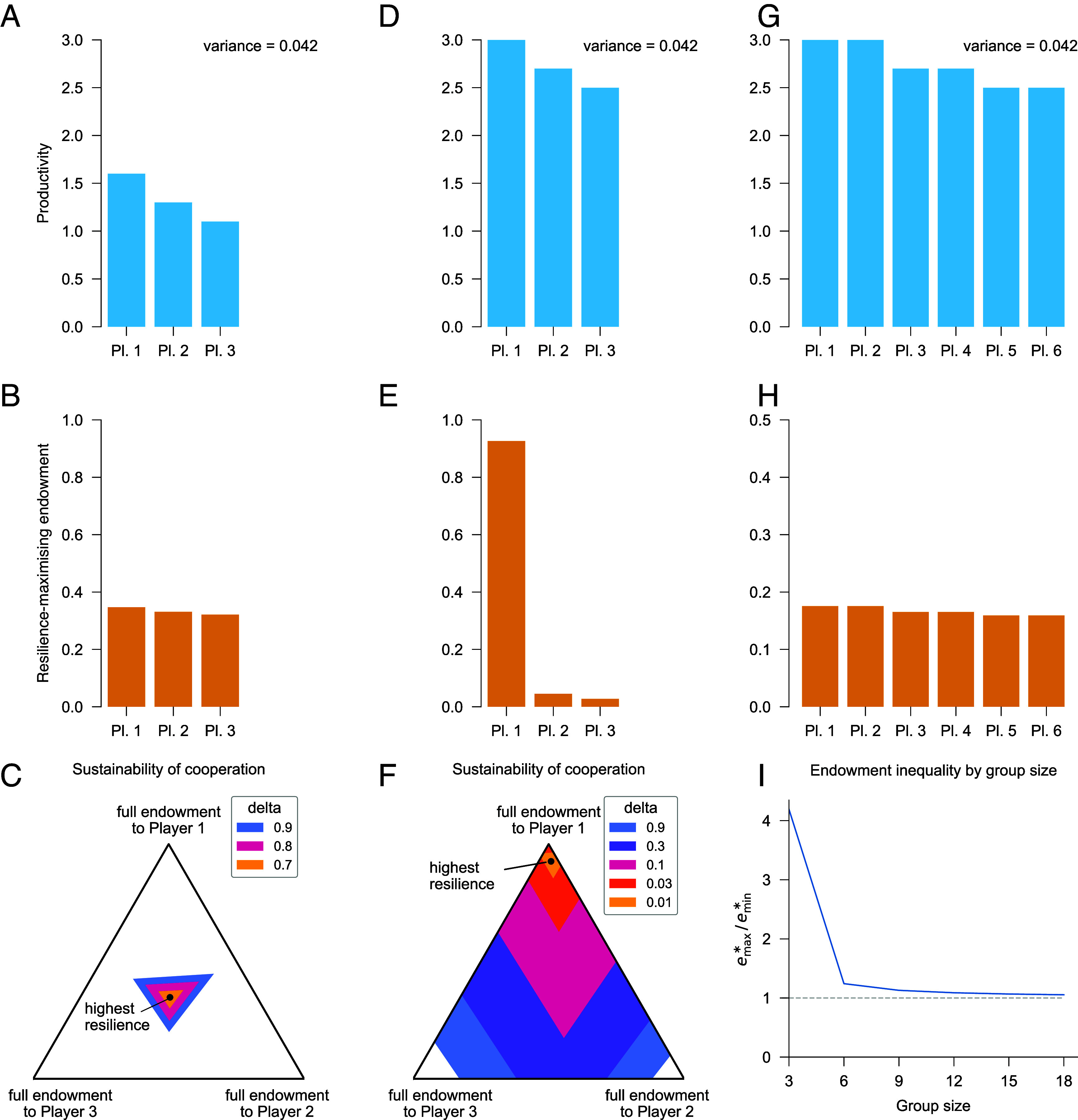
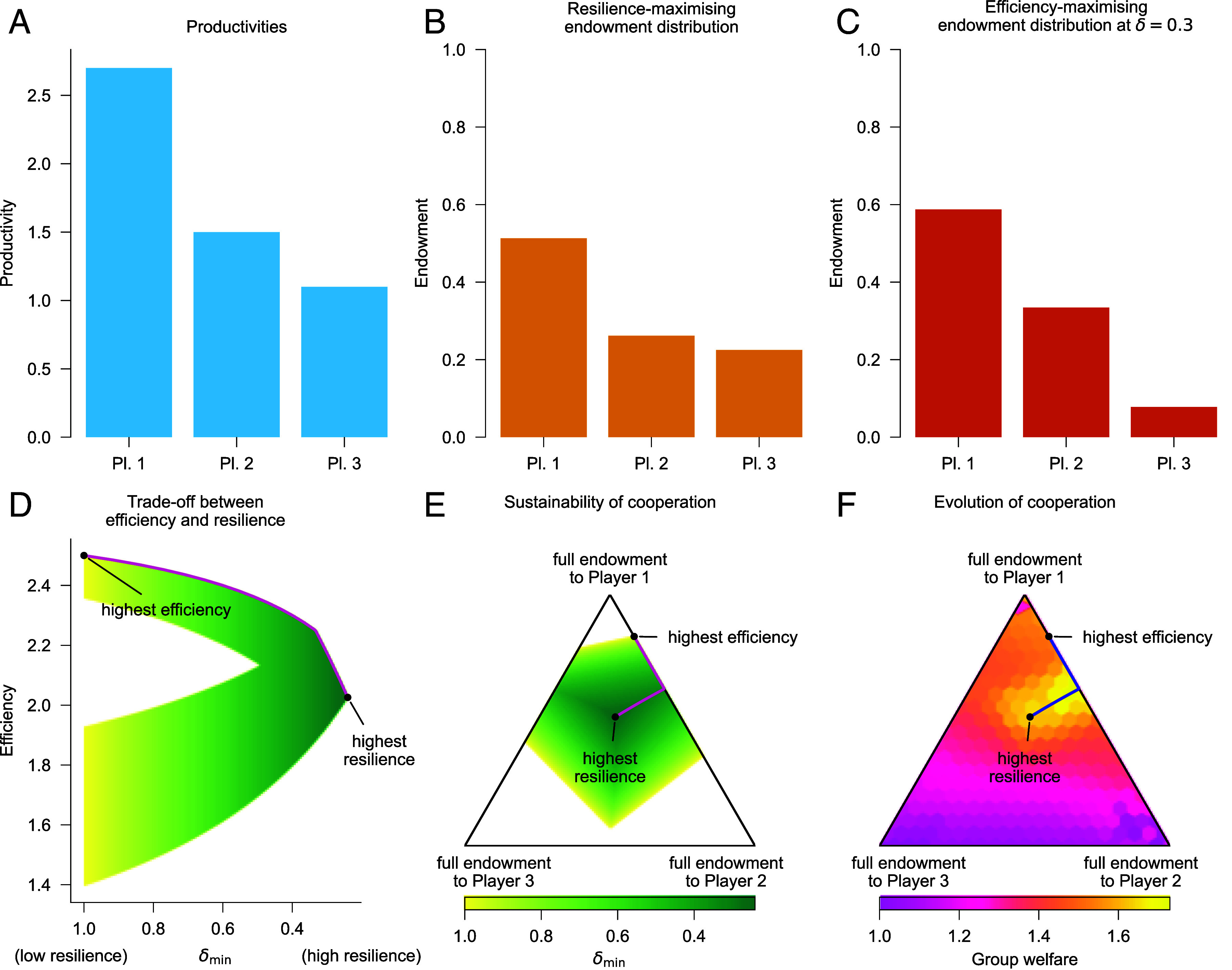
Direct reciprocity is a powerful mechanism for cooperation in social dilemmas. The very logic of reciprocity, however, seems to require that individuals are symmetric, and that everyone has the same means to influence each others' payoffs. Yet in many applications, individuals are asymmetric. Herein, we study the effect of asymmetry in linear public good games. Individuals may differ in their endowments (their ability to contribute to a public good) and in their productivities (how effective their contributions are). Given the individuals' productivities, we ask which allocation of endowments is optimal for cooperation. To this end, we consider two notions of optimality. The first notion focuses on the resilience of cooperation. The respective endowment distribution ensures that full cooperation is feasible even under the most adverse conditions. The second notion focuses on efficiency. The corresponding endowment distribution maximizes group welfare. Using analytical methods, we fully characterize these two endowment distributions. This analysis reveals that both optimality notions favor some endowment inequality: More productive players ought to get higher endowments. Yet the two notions disagree on how unequal endowments are supposed to be. A focus on resilience results in less inequality. With additional simulations, we show that the optimal endowment allocation needs to account for both the resilience and the efficiency of cooperation.
直接互惠是解决社会困境中合作问题的有力机制。然而,互惠的逻辑似乎要求个体是对称的,并且每个人都有相同的手段来影响彼此的收益。然而,在许多应用中,个体是不对称的。在本文中,我们研究了线性公共物品博弈中不对称性的影响。个体在禀赋(贡献公共物品的能力)和生产力(贡献的有效性)方面可能存在差异。考虑到个体的生产力,我们要问哪种禀赋分配对合作最有利。为此,我们考虑了两种最优性概念。第一个概念侧重于合作的弹性。相应的禀赋分配确保了即使在最不利的条件下,也能实现完全合作。第二个概念侧重于效率。对应的禀赋分配最大化了群体福利。我们使用分析方法,充分描述了这两种禀赋分配。该分析表明,这两种最优性概念都有利于某种程度的禀赋不平等:生产力较高的参与者应该获得更高的禀赋。然而,这两种概念在不平等的禀赋应该达到何种程度上存在分歧。对弹性的关注会导致不平等程度降低。通过额外的模拟,我们表明最优的禀赋分配需要考虑合作的弹性和效率。