Padureanu Vlad, Marinaș Cristian Marius, Bobirca Anca, Padureanu Rodica, Patrascu Stefan, Dascalu Ana Maria, Bobirca Florin, Tribus Laura, Alexandru Cristina, Serboiu Crenguta, Dumitrascu Catalin, Musetescu Anca
Department of Internal Medicine, Emergency County Hospital of Craiova, University of Medicine and Pharmacy of Craiova, Craiova, ROU.
Department of Anatomy, University of Medicine and Pharmacy of Craiova, Craiova, ROU.
Cureus. 2024 Jan 27;16(1):e53041. doi: 10.7759/cureus.53041. eCollection 2024 Jan.
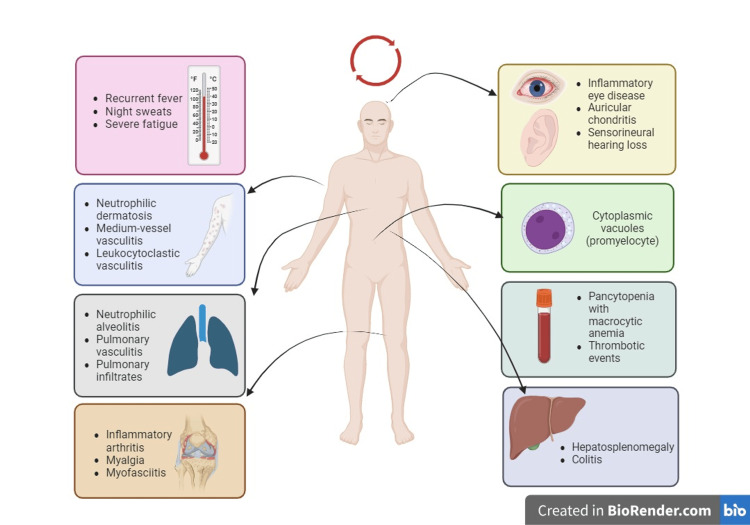
The newly identified refractory adult-onset autoinflammatory syndrome known as VEXAS (vacuoles, E1 enzyme, X-linked, autoinflammatory, somatic) syndrome is brought on by somatic mutations in the ubiquitin-like modifier-activating enzyme 1 (UBA1) gene in hematopoietic stem and progenitor cells that change the expression of the UBA1 isoform. As a result, patients have a variety of hematologic and systemic inflammatory symptoms. All types of medical professionals should treat VEXAS syndrome seriously due to the high fatality rate. To better comprehend the condition and enhance the prognosis for VEXAS syndrome, this review article describes the essential traits and clinical signs of the condition. The discussion of future directions in the study of systemic inflammatory disorders brought on by somatic mutations concludes.
新发现的难治性成人起病的自身炎症综合征,即VEXAS(空泡、E1酶、X连锁、自身炎症、体细胞)综合征,是由造血干细胞和祖细胞中泛素样修饰激活酶1(UBA1)基因的体细胞突变引起的,这些突变改变了UBA1亚型的表达。因此,患者会出现各种血液学和全身性炎症症状。由于VEXAS综合征的死亡率很高,各类医学专业人员都应认真对待。为了更好地理解该病症并改善VEXAS综合征的预后,这篇综述文章描述了该病症的基本特征和临床症状。文章最后讨论了由体细胞突变引起的全身性炎症疾病研究的未来方向。