Janicot Remi, Maziarz Marcin, Park Jong-Chan, Zhao Jingyi, Luebbers Alex, Green Elena, Philibert Clementine Eva, Zhang Hao, Layne Mathew D, Wu Joseph C, Garcia-Marcos Mikel
Department of Biochemistry & Cell Biology, Chobanian & Avedisian School of Medicine, Boston University, Boston, MA 02118, USA.
Stanford Cardiovascular Institute, Stanford University School of Medicine, Stanford, CA 94305, USA.
Cell. 2024 Mar 14;187(6):1527-1546.e25. doi: 10.1016/j.cell.2024.01.028. Epub 2024 Feb 26.
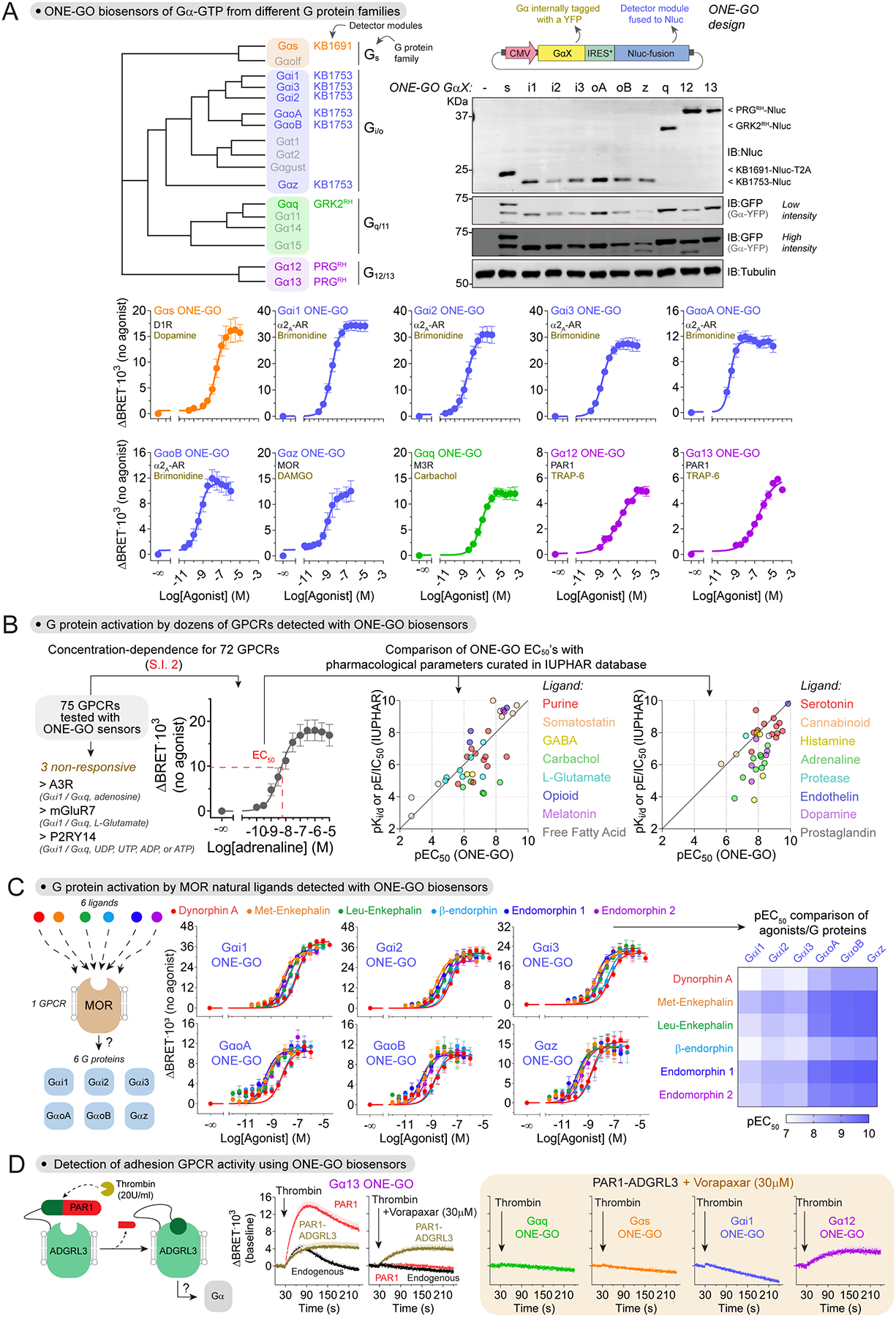
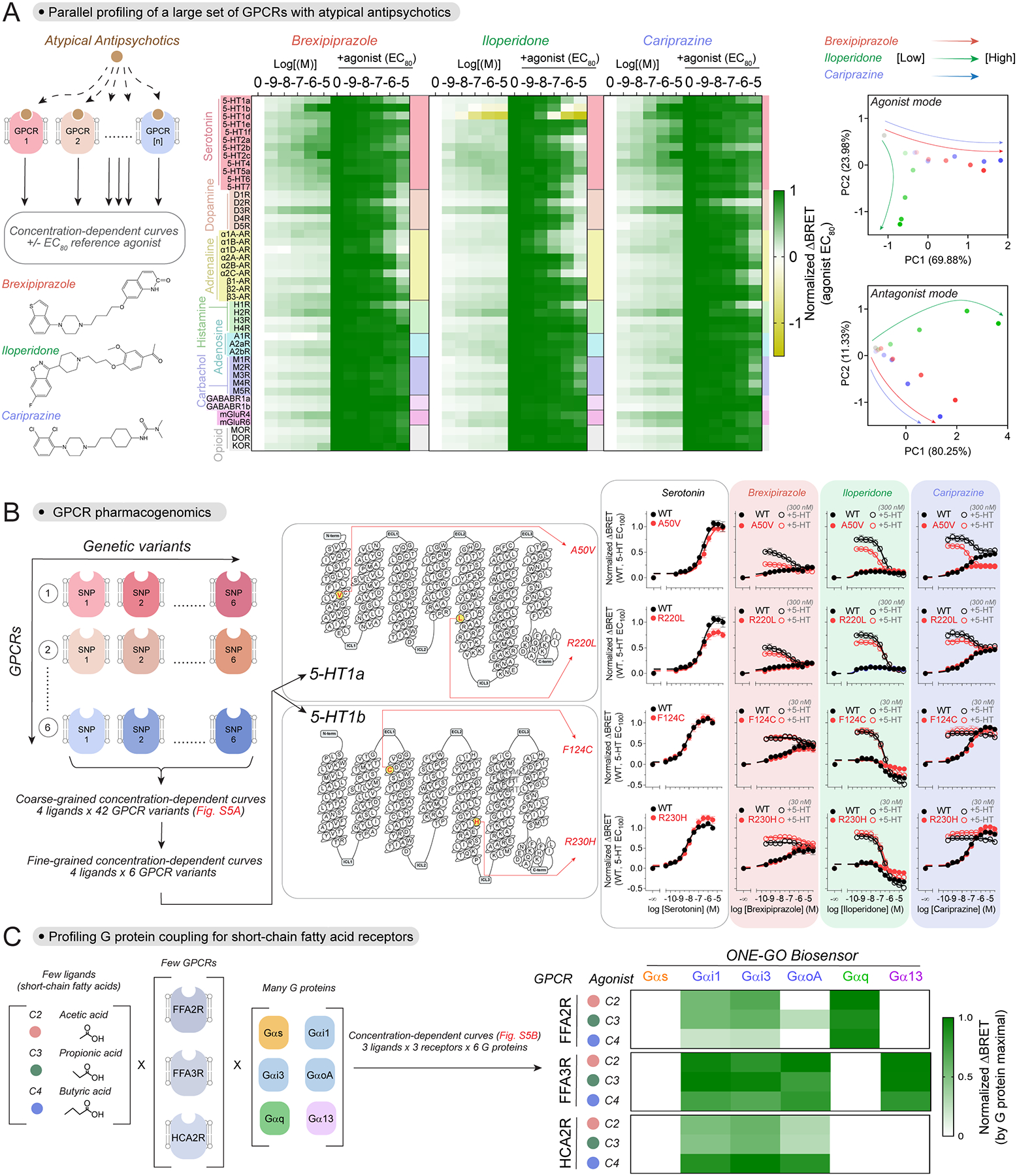
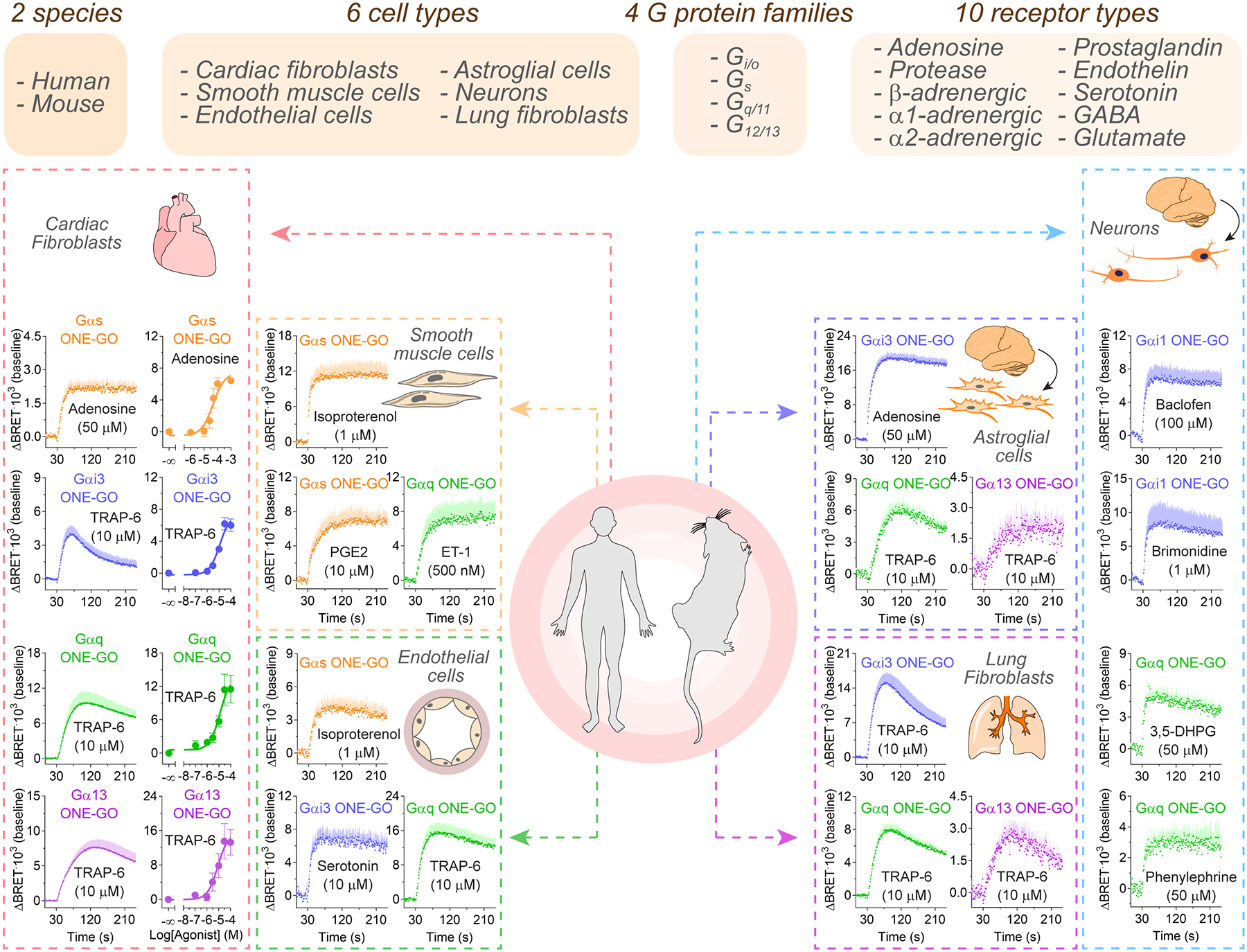
G protein-coupled receptors (GPCRs) are the largest family of druggable proteins encoded in the human genome, but progress in understanding and targeting them is hindered by the lack of tools to reliably measure their nuanced behavior in physiologically relevant contexts. Here, we developed a collection of compact ONE vector G-protein Optical (ONE-GO) biosensor constructs as a scalable platform that can be conveniently deployed to measure G-protein activation by virtually any GPCR with high fidelity even when expressed endogenously in primary cells. By characterizing dozens of GPCRs across many cell types like primary cardiovascular cells or neurons, we revealed insights into the molecular basis for G-protein coupling selectivity of GPCRs, pharmacogenomic profiles of anti-psychotics on naturally occurring GPCR variants, and G-protein subtype signaling bias by endogenous GPCRs depending on cell type or upon inducing disease-like states. In summary, this open-source platform makes the direct interrogation of context-dependent GPCR activity broadly accessible.
G蛋白偶联受体(GPCRs)是人类基因组中编码的最大的可成药蛋白家族,但由于缺乏在生理相关环境中可靠测量其细微行为的工具,对它们的理解和靶向研究进展受阻。在此,我们开发了一系列紧凑型单载体G蛋白光学(ONE-GO)生物传感器构建体,作为一个可扩展平台,即使在原代细胞中内源性表达时,也能方便地用于以高保真度测量几乎任何GPCR的G蛋白激活。通过对多种细胞类型(如原代心血管细胞或神经元)中的数十种GPCR进行表征,我们揭示了GPCR的G蛋白偶联选择性的分子基础、抗精神病药物对天然存在的GPCR变体的药物基因组学概况,以及内源性GPCR根据细胞类型或诱导疾病样状态时的G蛋白亚型信号偏向。总之,这个开源平台使广泛获取对依赖于环境的GPCR活性的直接研究成为可能。