Kingsmore Stephen F, Nofsinger Russell, Ellsworth Kasia
Rady Children's Institute for Genomic Medicine, Rady Children's Hospital, San Diego, CA, USA.
NPJ Genom Med. 2024 Feb 27;9(1):17. doi: 10.1038/s41525-024-00404-0.
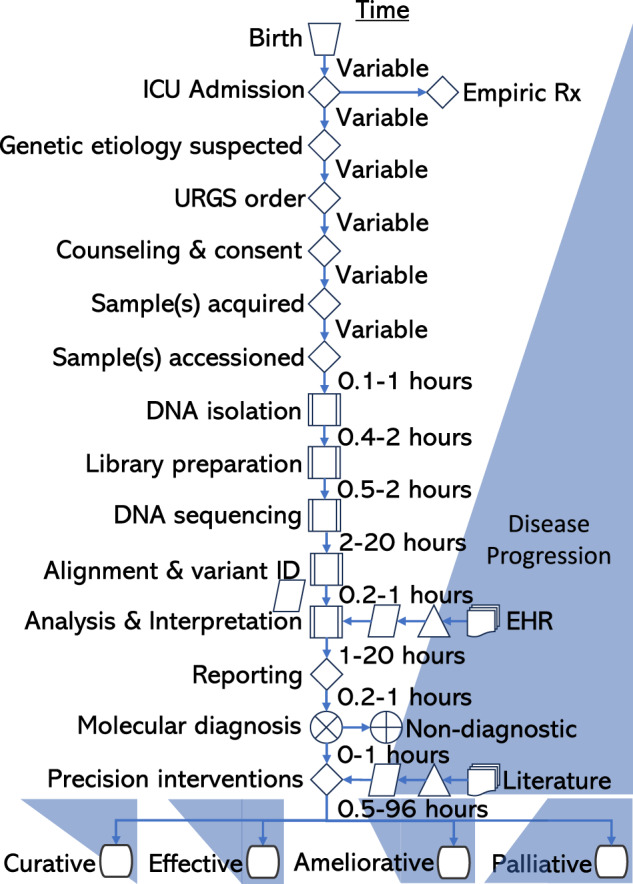
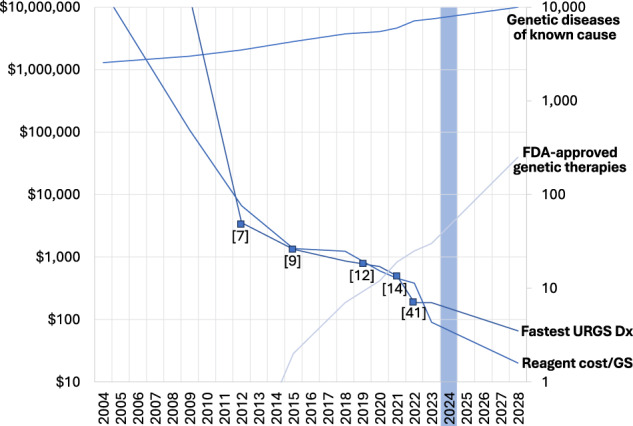
Single locus (Mendelian) diseases are a leading cause of childhood hospitalization, intensive care unit (ICU) admission, mortality, and healthcare cost. Rapid genome sequencing (RGS), ultra-rapid genome sequencing (URGS), and rapid exome sequencing (RES) are diagnostic tests for genetic diseases for ICU patients. In 44 studies of children in ICUs with diseases of unknown etiology, 37% received a genetic diagnosis, 26% had consequent changes in management, and net healthcare costs were reduced by $14,265 per child tested by URGS, RGS, or RES. URGS outperformed RGS and RES with faster time to diagnosis, and higher rate of diagnosis and clinical utility. Diagnostic and clinical outcomes will improve as methods evolve, costs decrease, and testing is implemented within precision medicine delivery systems attuned to ICU needs. URGS, RGS, and RES are currently performed in <5% of the ~200,000 children likely to benefit annually due to lack of payor coverage, inadequate reimbursement, hospital policies, hospitalist unfamiliarity, under-recognition of possible genetic diseases, and current formatting as tests rather than as a rapid precision medicine delivery system. The gap between actual and optimal outcomes in children in ICUs is currently increasing since expanded use of URGS, RGS, and RES lags growth in those likely to benefit through new therapies. There is sufficient evidence to conclude that URGS, RGS, or RES should be considered in all children with diseases of uncertain etiology at ICU admission. Minimally, diagnostic URGS, RGS, or RES should be ordered early during admissions of critically ill infants and children with suspected genetic diseases.
单基因座(孟德尔式)疾病是儿童住院、重症监护病房(ICU)收治、死亡以及医疗费用的主要原因。快速基因组测序(RGS)、超快速基因组测序(URGS)和快速外显子组测序(RES)是针对ICU患者遗传性疾病的诊断测试。在44项对病因不明疾病的ICU儿童研究中,37%获得了基因诊断,26%的治疗方案因此改变,通过URGS、RGS或RES检测的每个儿童的医疗费用净减少了14,265美元。URGS在诊断时间、诊断率和临床实用性方面优于RGS和RES。随着方法的改进、成本的降低以及在适应ICU需求的精准医疗服务系统中实施检测,诊断和临床结果将会改善。由于缺乏支付方覆盖、报销不足、医院政策、住院医师不熟悉、对可能的遗传疾病认识不足以及目前作为检测而非快速精准医疗服务系统的形式,目前在每年可能受益的约200,000名儿童中,进行URGS、RGS和RES检测的比例不到5%。由于URGS、RGS和RES的广泛应用滞后于那些可能通过新疗法受益的儿童数量的增长,目前ICU儿童实际与最佳结果之间的差距正在扩大。有充分的证据表明,对于所有因病因不明疾病入住ICU的儿童,都应考虑进行URGS、RGS或RES检测。至少,对于疑似患有遗传疾病的危重症婴幼儿和儿童,应在入院早期就进行诊断性URGS、RGS或RES检测。