Department of Clinical Laboratory, National Center for Respiratory Medicine, National Clinical Research Center for Respiratory Disease, State Key Laboratory of Respiratory Disease, Guangzhou Institute of Respiratory Health, The First Affiliated Hospital of Guangzhou Medical University, Guangzhou, China.
Department of Child Allergy, Chenzhou First People's Hospital, Chenzhou, China.
Sci Rep. 2024 Feb 27;14(1):4754. doi: 10.1038/s41598-024-54574-z.
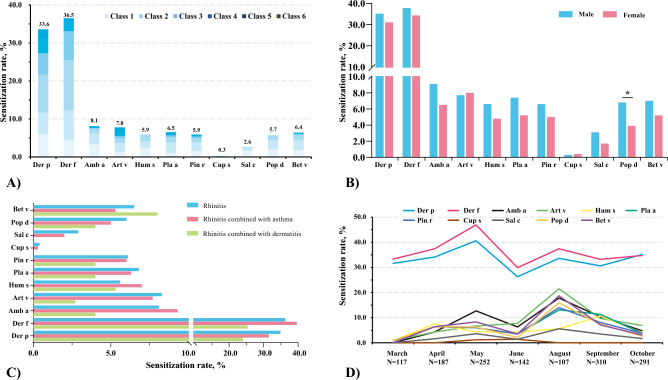
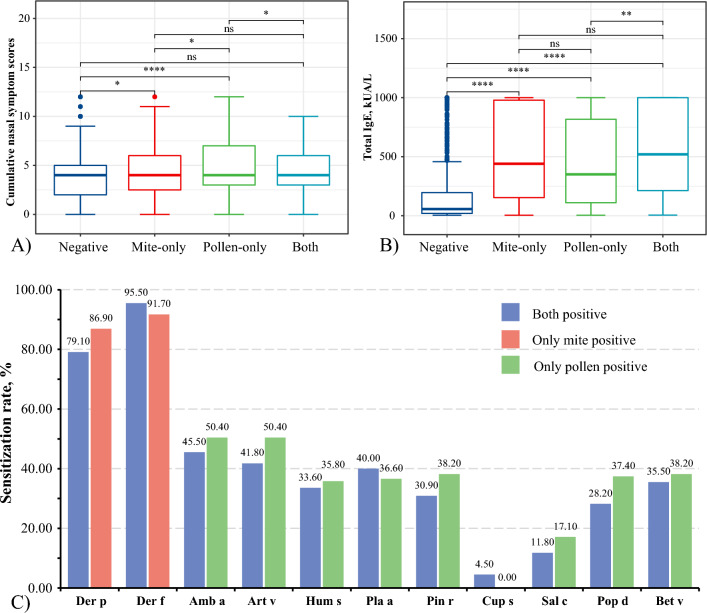
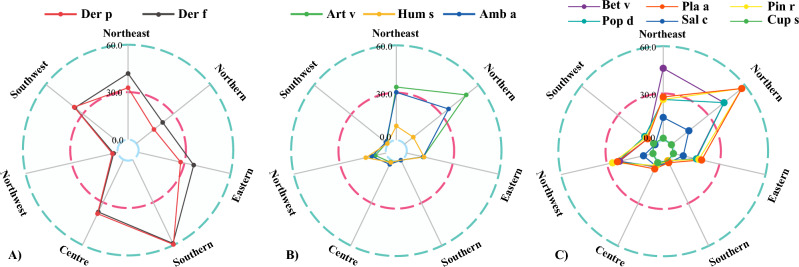
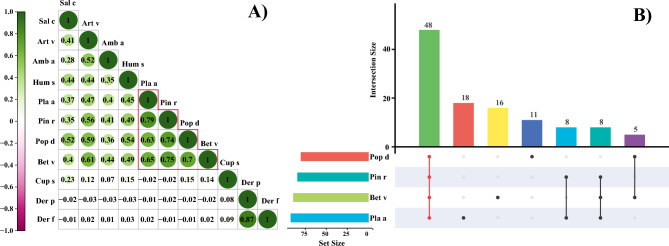
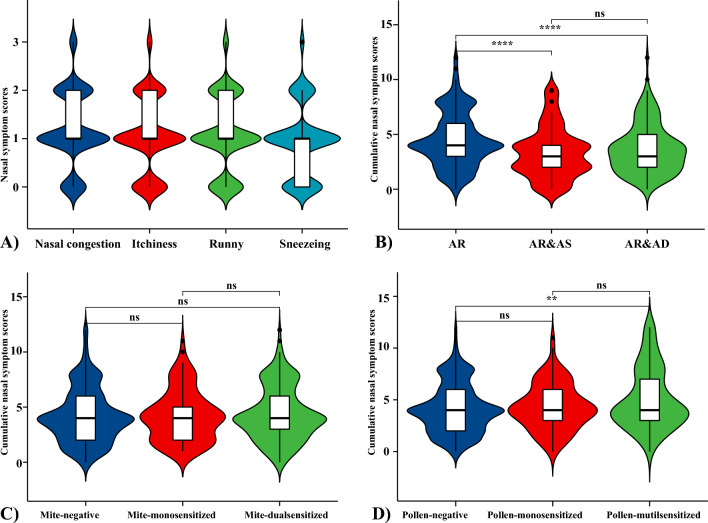
This study is nationwide multicenter epidemiological research, aimed at investigating the distribution changes and seasonal patterns of various airborne allergens among preschool children with allergic rhinitis (AR) in different regions of China, and analyzing the clinical correlation between sensitization to various airborne allergens and AR symptoms in children. Information on children was collected through standard questionnaires, and total IgE (tIgE) and specific IgE (sIgE) for 11 inhalant allergens were tested. The results showed that dust mites are the primary allergens for preschool AR children (39%). Among pollen allergens, Amb a had the highest positivity rate (8.1%), followed by Art v (7.8%). The sensitization rates for two mites peaked in May (46.9% and 40.6%). Art v peaked in August (21.5%), while Amb a had peaks in May (12.7%) and August (17.8%). The sensitization peaks for various tree pollens mainly occurred in August. In the Eastern monsoon region, the sensitization rate to mites was significantly higher than in the Northwest arid and semi-arid regions; whereas, for pollen allergens, the sensitization rates to Amb a, Pla a, Pin a, Pop d, and Bet v were significantly higher in the Northwest arid and semi-arid regions than in the Eastern monsoon region. The correlation among various tree pollens, specifically between Pla a, Pin r, Pop d, and Bet v was strong (0.63 ~ 0.79), with a cross-overlapping percentage of 53.9%. Children with multiple pollen sensitizations had higher cumulative nasal symptom scores than those negative for pollen (P < 0.01). Children with only pollen sensitization had higher cumulative rhinitis symptom scores than the all-negative group (P < 0.0001) and the mite-only sensitization group [P < 0.05], while the mite-only sensitization group also had higher scores than the all-negative group [P < 0.05], and the group sensitized to both pollen and mites had lower scores than the pollen-only group [P < 0.05]. This study indicates that sensitization to mites and grass pollens exhibits significant regional differences, with grass pollen allergies primarily occurring in autumn, sensitization to pollens in general exhibits a pronounced seasonal pattern. Moreover, pollen sensitization aggravates nasal and ocular symptoms in AR children.
本研究为全国多中心流行病学研究,旨在调查中国不同地区学龄前过敏性鼻炎(AR)儿童各种气传过敏原的分布变化和季节性模式,并分析儿童对各种气传过敏原的致敏与 AR 症状之间的临床相关性。通过标准问卷收集儿童信息,并检测 11 种吸入性过敏原的总 IgE(tIgE)和特异性 IgE(sIgE)。结果显示,尘螨是学龄前 AR 儿童的主要过敏原(39%)。在花粉过敏原中,Amb a 的阳性率最高(8.1%),其次是 Art v(7.8%)。两种螨的致敏率在 5 月达到高峰(46.9%和 40.6%)。Art v 在 8 月达到高峰(21.5%),而 Amb a 在 5 月达到高峰(12.7%)和 8 月达到高峰(17.8%)。各种树花粉的致敏高峰主要发生在 8 月。在东亚季风区,螨的致敏率明显高于西北干旱半干旱区;而对于花粉过敏原,Amb a、Pla a、Pin a、Pop d 和 Bet v 的致敏率在西北干旱半干旱区明显高于东亚季风区。各种树花粉之间存在较强的相关性,特别是 Pla a、Pin r、Pop d 和 Bet v 之间的相关性较强(0.63~0.79),交叉重叠率为 53.9%。有多种花粉致敏的儿童累积鼻部症状评分高于无花粉致敏的儿童(P<0.01)。仅有花粉致敏的儿童累积鼻炎症状评分高于全阴性组(P<0.0001)和螨仅致敏组[P<0.05],而螨仅致敏组也高于全阴性组[P<0.05],且同时致敏于花粉和螨的组的评分低于仅致敏于花粉组[P<0.05]。本研究表明,螨和草花粉致敏具有明显的地域差异,草花粉过敏主要发生在秋季,花粉过敏普遍具有明显的季节性模式。此外,花粉致敏会加重 AR 儿童的鼻部和眼部症状。